Pages

Showing posts with label roasted coffee. Show all posts

Friday, 21 September 2018

Extending Freshly Roasted Coffee Lifespan

The main enemies of Freshly Roasted Coffee are Time, Oxygen, and Moisture.

A solution has been presented to the public that is more beneficial to the manufacturers than to the end user.

Background info:

Immediately after roasting the coffee beans begin to emit carbon dioxide in sufficient volume and pressure to burst a hermetically sealed bag.  Some roasters opted to degas the beans for one to three days to alleviate this problem while manufacturers came up with a new product, the valve.
http://nxt-roasters.blogspot.com/2011/12/do-coffee-bag-valves-leak-1.html
http://nxt-roasters.blogspot.com/2012/05/revisited.html

Valve Limitation - as currently used:
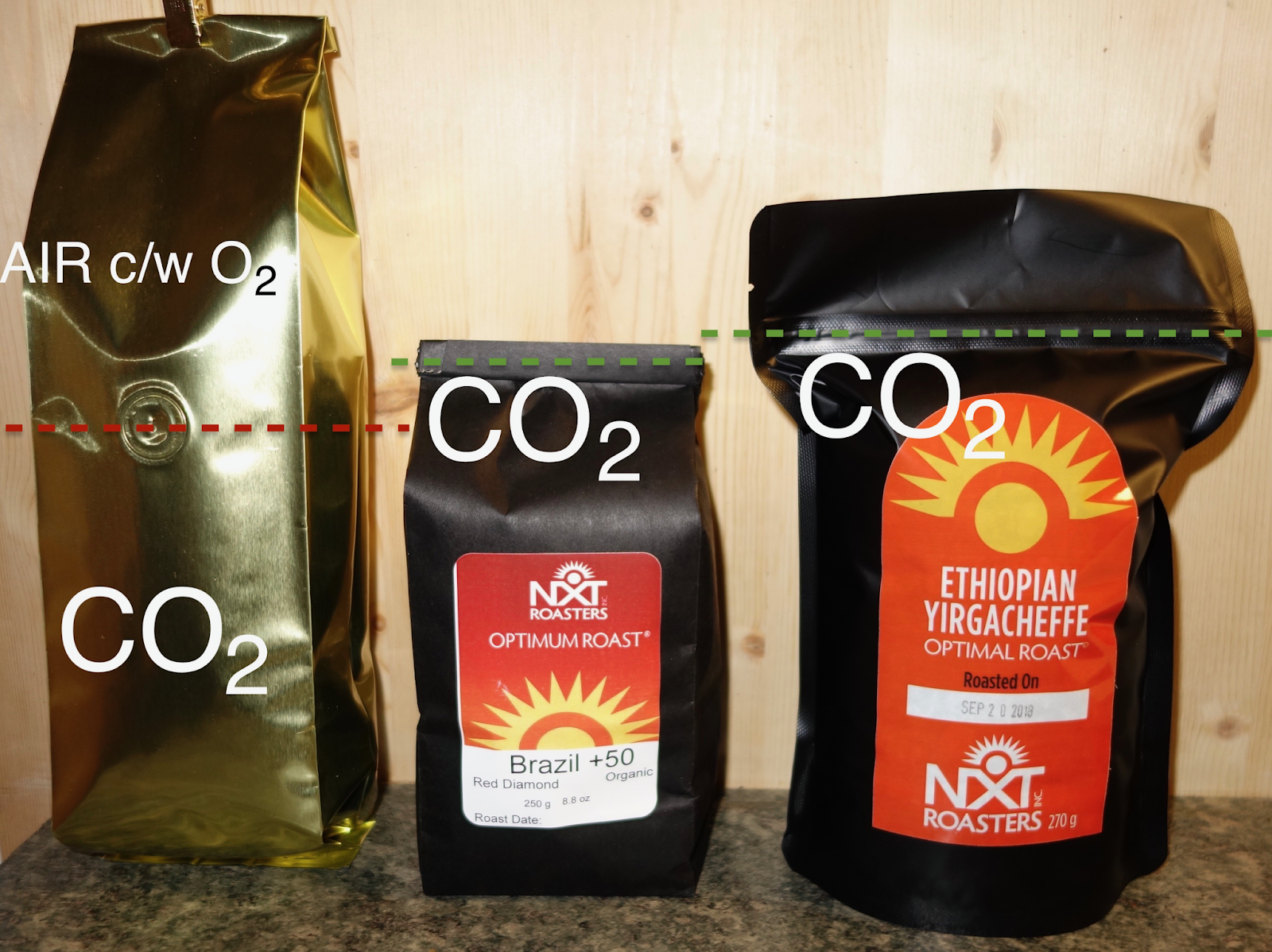
It is possible that the valve is a single solution to burst bags when with a little more thought it could have also help to extend the freshness of coffee beans.

The CO2 is roughly 50% denser than the air we breathe, which consists of about 21% Oxygen.  This means when packaged, on the first day, beans emit CO2 that gas drops to the lowest level in the container and pushes the existing air upwards.  Surrounded the Freshly Roasted Coffee Beans with CO2 retards the oxidation process, hence, slows down the staling process.  How well and for how long the freshness is preserved is much more difficult to assess and beyond the limits of a one page blog entry.  For arguments sake I say it gives an extra week.  This process exists for the beans that are continually bathed in CO2 which is not the case when there is a venting valve.  As shown in the photo the CO2 will rise up to the valve then exit rather than flush out the air above the valve.  That means that, as the photo illustrates, that only 2/3 of the beans are in CO2 providing the bag is not tilted.  If the bag was laid on it back so that the valve was at the high point of the bag then there would be a different outcome but bags are not stored, shipped, or displayed laying down.  That scenario would be improved by moving the valve upwards to minimize the amount of air in the bag.

Using a valve does allow the roaster to degas in the heat sealed bag which offers the consumers the security and assurance that the bag contents have not been tampered with.

Alternatives:

The NXT solution to this dilemma is to use a ziplock bag which presents more flexible packaging options.  First, all the oxygenated air is pushed out of the bag when the bag is kept upright.  We recommend that people scoop out the beans for immediate consumption rather than pour them out which would drain much of the CO2.  Leaving CO2 to protect the beans extends the freshness.  Our bags are in a supervised area and they are not opened after closing but for added security, where bags are placed in a public area and a heat seal is required a simple pin prick between the ziplock and the heat seal which will prevent bursting the bag and allow a flushing of the oxygenated air.

NXT advocates degassing in the bag to take advantage of the emitted CO2 to extend the freshness of the coffee beans.

We have a Carbon Dioxide high pressure tank and a regulator to test the effect of giving a shot of CO2 to a bag of beans that are more than a day old when outgassing has mostly ceased.

It might mean some beans will be destroyed with water to determine the volume of the interstitial spaces which will indicate how much CO2 has to be injected to bathe all the beans in a protective gas.

To Do:

Test to determine how CO2 will enhance the life of ground coffee.

Sunday, 8 July 2018

NXT Coffee Roaster Design not "off the shelf"

To Google Maps
Most coffee roasters are heated by  a natural gas flame.  Natural gas is a cheaper form of energy than electricity but it comes with inherent limitations.  Since the flame requires a continual supply of oxygen it requires a lot of air which must be raised from ambient to combustion temperature, this  is not the end of the energy waste.  The coffee roasting is usually done in the exhaust gasses of the flame which, are not hot enough after passing through the Roasting Chamber, to break down the roasting smoke.  That smell is similar to burnt toast, in the later stages, - imagine several kilo grams of burnt toast.  Hence, an Afterburner is required to raise the temperature to over a 1000°F to break down the smoke.  The large amount of air required by the flame means that a large amount of air must be raised from ambient temperature to over 1000°F.  Consequently, the Afterburner burns, depending on the model,  three times as much energy as the roaster (the equivalence of 6 home furnaces) just so that the neighbourhood will not see nor smell the roaster emissions.  Of course the emissions from such burners are always present but the operators hope that they become sufficiently diluted by the outside air that they will not trigger calls to the environmental agency.  Pollution awareness is upon us and some areas already require permits for coffee roasters with 5 kg or more capacity.

Are there alternatives?
There is, if the fabricator begins with a clean design slate rather than use off the shelf technologies.  First, the amount of air needs to be reduced to greatly reduce the waste of energy.  It is true that often the electricity is generated by the combustion of natural gas but the electrical companies have specialized equipment to remove and neutralize gas volatiles that individual roasters do not use.  Nevertheless, the electrical Roastaire™'s biggest advantage is virtually eliminating the continual feeding of air to the roasting process.  It is possible to recirculate the air with electrical heating because you do not need to feed a flame.  The advantage, is that less energy is required to heat the returning air than to heat room temperature air (ambient) to roasting temperatures.  There is less air to treat when neutralizing the emissions therefore it can be done on a continual basis. A minor advantage is that the oily smoke, as part of the re-circulation process, is burnt which helps to heat the roaster.

Does the design work?
 Below is a photo of the tubing that guides the re-circulated air to the Roasting Chamber.  The roaster was in service for 5 years before this photo was taken.  It had roasted about 30 tonnes of coffee.  It does illustrate why Fresh Cup Roastery Café (Saanichton & Vancouver) clients refer to it as  "Clean Air Roasting"

5 yrs of roasting = clean air duct


 Now compare the above photo with one taken of a drum roaster after one year of service.


There wasn't a copyright on the photo but I am not attributing the photo because there is little benefit to kicking a hornet's nest.

In 2010, it is reported that there were 1800 chimney fires, in the USA, that were attributed to coffee roasters.  What heating method do you think was responsible for this incredible statistic?


                                                ------------------------------------------
In the Roastaire the exhaust is passed through a second SmokEater© before it is discharged.  It roasted hundreds of batches inside the Toronto and Vancouver convention centres without the use of a vent or chimney.

What is exhausted?
 Only the air cooling the roasted coffee is exhausted after scrubbing it twice.  More details about the design reasoning will be forthcoming when the topic of Bean Cooling is approached.  In the interim here is some more information on an earlier NXT    blogspot page.


Saturday, 12 May 2018

Off the Shelf Machines

My perception is that most companies are buying off the shelf devices which were built without their input.  In other words they are saddled with the compromises without having the opportunity of prioritizing them.  Buying a known technology does defer to the manufacturing company goals rather than to those of the end user.  Of course the manufacturing company wants their clients to succeed but the manufacturer's survival is viewed as being way more important.

Certainly we have purchased off the shelf technology but the moment we took possession of it the discussion began on improving the device to meet our needs.  Control systems were bypassed in favour of Labview based data acquisition and controls.  The equipment claims were compared to the measured performance then we searched for better and more effective ways to enhance the process.

Sometimes we contacted the evaluated equipment's manufacturer to test the waters about incorporating what we considered to be improvements while at other times we either kept the results in house or dropped the project in favour of a fresh approach.

It is possible to learn by analyzing existing machines.  Rarely will they prove to be an ideal fit to your needs but if you are attentive in its usage you will make up a list of Pros & Cons.  That conclusion will at least give you concepts to analyze and sometimes an appreciation for the work that went into the original design.  Falling into the trap of flippant analysis often leads in the wrong direction because it fails to take into consideration the battles of formulating the original design which after all usually achieved commercial status.  "Armchair quarterbacks" are known for their 20/20 hindsight  vision which does not make room for the Law of Unintended Consequences or even a thoughtful analysis.  Having said that sometimes a fresh look does provide insight because the person is not constrained by the history of the project or the emotional aspect of the design.

Modifying machines can mean living with the Law of Unintended Consequences especially in complex systems where there is interaction between many elements.  I think of it as the battle of the laws of physics which can be predictable or result in a complete surprise that should be explored or abandoned.  Abandoned projects can be revived when new techniques or solutions are found but until that moment manifests itself they are on the back burner if not in the deep freeze so to say.

Concluding now, for the sake of brevity, first; formulate an analysis plan by listing the requirements in order of priority, second; decide on the evaluation criterea, third; pay hommage to Genrikh Altshuller and examine patents to understand how others might have tackled the problem, fourth; undertake the challenge of melding the many ideas into a workable solution so that you can build your prototype.

Monday, 31 October 2016

NXT Fluidized Bed Roaster


AT NXT ROASTERS INC. WE USE THE WORD “INNOVATIVE” AS DISTINCT FROM “IMITATIVE” TO DESCRIBE OUR APPROACH TO DESIGN.


The NXT Roaster Design

We selected the fluidized bed technology for our roasting process because it provides even heat distribution, which results in product uniformity. The bean chaff is continually removed from the roasting chamber, eliminating the fire potential. 

To increase roaster efficiency we re-circulate hot air, reducing power consumption by about 75 percent.  To prevent tar deposits on roasted beans (from circulated air), we incorporate a primary afterburner, which burns away the smoke every time the air is reheated.  This arrangement increases the temperature of circulating air, which further reduces overall power consumption.

By circulating hot air in the roaster, we are open to the atmosphere only thirty seconds at the end of the roasting cycle when hot coffee beans are quenched by a blast of cool air, which is vented through our “SmokEater”.  (As an option, we deliver a roasting system that can vent to a room/space.) Loading green beans and unloading of roasted beans is done pneumatically.

The Roasting Process

Roasting requires considerable control of the process to continually achieve a given degree of roast.  In any chemical engineering, operation controls address heat requirements, actual heat balances in roasting, and various heat transfer factors to determine the time required for roasting.   Many of the variables are beyond the control, of the Roast Master but it is possible to tame the process and reliably produce consistent roasts.

The NXT Roaster and its Roasting Process Controls include features that optimize process parameters such that the quality of roasted coffee delivered remains on target and is unaffected by factors beyond one’s control.


Roaster Description

The NXT Fluidized Bed 3 kg Roaster, is now in it's third generation.  The complete system comprises of: process controls, a primary after-burner, a SmokEater, Heating and Roasting Chambers, a chaff removal Cyclone and a pneumatic control system to operate the valves, which automatically load green beans, and transport roasted beans to the Packaging Silo at the end of the roasting process.

 Sequence of Operation

The Roasting Chamber is a cylindrical vessel that has at the chamber’s bottom a Butterfly Valve with Perforated Gate. Air enters the roasting chamber and simultaneously fluidizes and heats, or cools the coffee beans.  When roasting is finished, a blast of ambient air stops the pyrolysis by cooling the beans to below 150º C (320º F). When this temperature is reached, the Butterfly Valve opens and discharges roasted beans through the Poppet Valve and beans are then pneumatically transported to a Packaging Silo.

After-Burner System

The roaster is equipped with a primary after-burner and a secondary “SmokEater”.  The primary after-burner scrubs the hot air of volatiles and tar before these enter the Roasting Chamber.

The “SmokEater” is used at the end of the roasting process to scrub the smoke-laden cooling air from the roasted beans before it is vented to the atmosphere.

Comparing NXT Roaster roasteries with  and Drum Roasters 


          NXT    Roaster
   
                 Drum               Roaster
Batch capacity
kg
3

5
Hourly output
kg
18

14.7
Average time per batch
min
10

20
Power consumption with afterburners
kW/hour
6

64.5
Air required for roasting  process
CFM
80

300
Exhaust gas vented per batch
Cubic Feet
40

6000
Exhaust gas vented per hour
Cubic Feet
240

18000


Annual output


Roasting days per year
300
16200

13230
Roasting hours per day
3


Power consumption
kWh
5400

58050
Exhaust gas vented to atmosphere Annually
Cubic Feet
216,000

        16,200,000


Monday, 2 September 2013

French Press Grind

The picture links were removed because Photobucket decided to change the terms of usage in mid stream, so to say,  It is inconvenient for viewers but it is better to rid yourself of such people as soon as possible.  It is the attitude as much as the action.   We will try to repair that mess at NXTroasters.com

The French Press is a classical brewer that has garnered many comments.  Often it is used for comparisons when authors are promoting a new device.   Many instructions and guides have been published yet there are recurring themes i.e. the medium grind with less than boiling temperature water.


Of course these demonstrations use freshly roasted coffee, otherwise what is the point of drinking coffee.

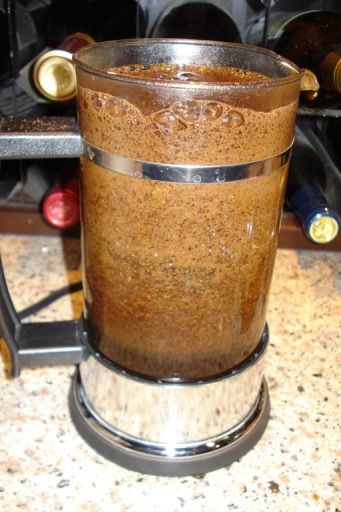
To the left the coffee beans were ground with a blade type grinder which is unable to attain the finer grinds.  The larger particles initially contain a lot of CO2 hence the large amount of foam.  I hesitate to call this crema because it is a mixture of foam and coffee grounds.

The foam develops very quickly when the nearly boiling water (that point will be argued later) is poured into the container.  Much of that is likely due to the sudden rise in temperature which causes the CO2 and other gases to rapidly expand, in the bean, when immersed in the hot water.

In the first minutes much of the coffee grounds are buoyed by the foam therefore they do not absorb sufficient liquid to decant.


Relying on the Mesh Plunger to do the solids / liquid separation will not give satisfactory results. Either the screen will plug with grounds and/or the screen  will deflect inwards let the ground migrate to the top of the mesh.
The argument that the grind has to be sufficiently coarse that the Mesh Plunger is not plugged ignores the importance of the extraction.  I maintain that the purpose of the Mesh Plunger is to keep the decanted coffee grounds on the bottom of the container when the coffee is poured into the cups.  The aim is to drink coffee not to have coffee grounds for breakfast.

The picture to the right was taken 1.5 minutes later.  We can see that the liquid line has risen but that more water will have to be added if the vessel needs to be full.  Very likely it will have to be filled twice to prevent the foam from overflowing.

In this case the Mesh Plunger was depressed 4 minutes after pouring the water.


To the left is a coffee  ground with a  burr grinder using  a very fine setting which usually makes a variation of in the cup Turkish coffee.  The Mesh Plunger  only comes into play once the grounds have decanted.  The settling process is greatly accelerated by the fine grind which  yields grounds that have a high ratio of surface area to volume, hence a rapid and thorough extraction.

The crema, discerned from foam by the size of the gas bubbles, is similar to an espresso shot.  The brewing was well behaved therefore no water had to be added.  The brew decanted within seconds and was served sooner than the coarser grind.

The water was brought to a boil then poured over the coffee.  The comments about near boiling water scalding the beans must originate with manufacturers and distributors of machines that are unable to heat water over 85°C.  

The roasting chemical process is halted when the beans are cooled below approximately 150°C which hardly supports the claims that 90°C water scalds the beans.  On the contrary experiments show that the extraction is better developed at higher temperatures. 

Do your own experiments and note the observations.  If possible measure the temperature of the water for different extractions so that you can optimize your procedure.  In the meantime enjoy the fruits of your experiments.


Saturday, 16 March 2013

This is Crema !

Crema !!
There are few "honest" ways to get great Crema.  The first one is Freshly Roasted Coffee in a tuned Espresso Machine.  Of course that is also how you maximize the sweetness of high quality Arabica beans.

The quantity of Crema rapidly decreases as the roasted coffee ages.  The taste is also greatly affected by the staling that begins to make itself noticeable within one week after roasting.

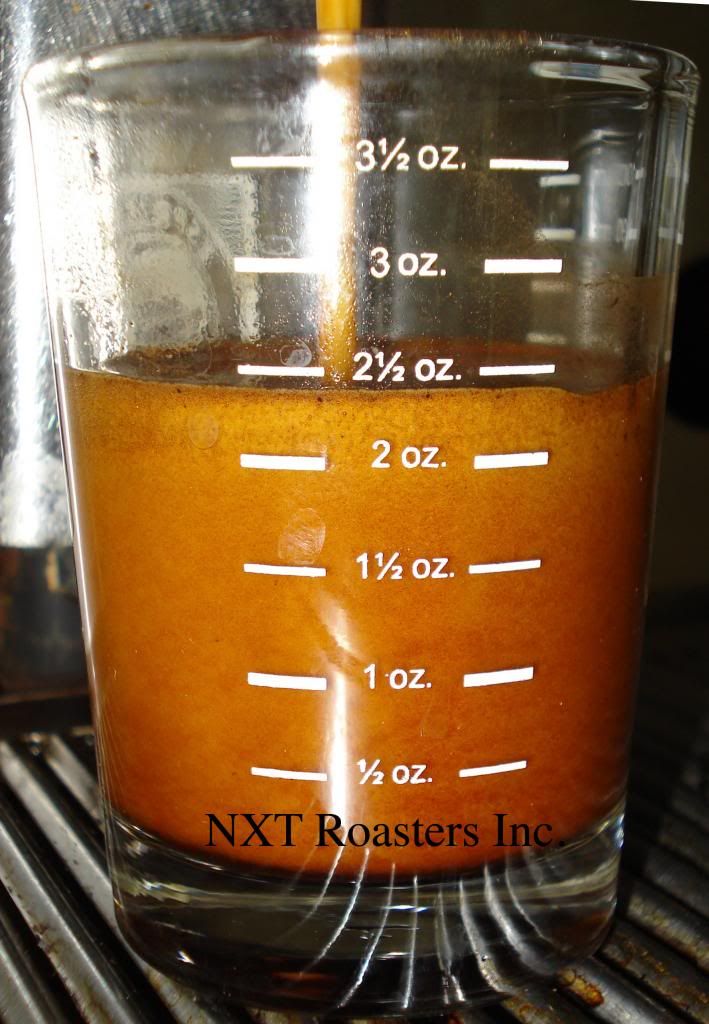
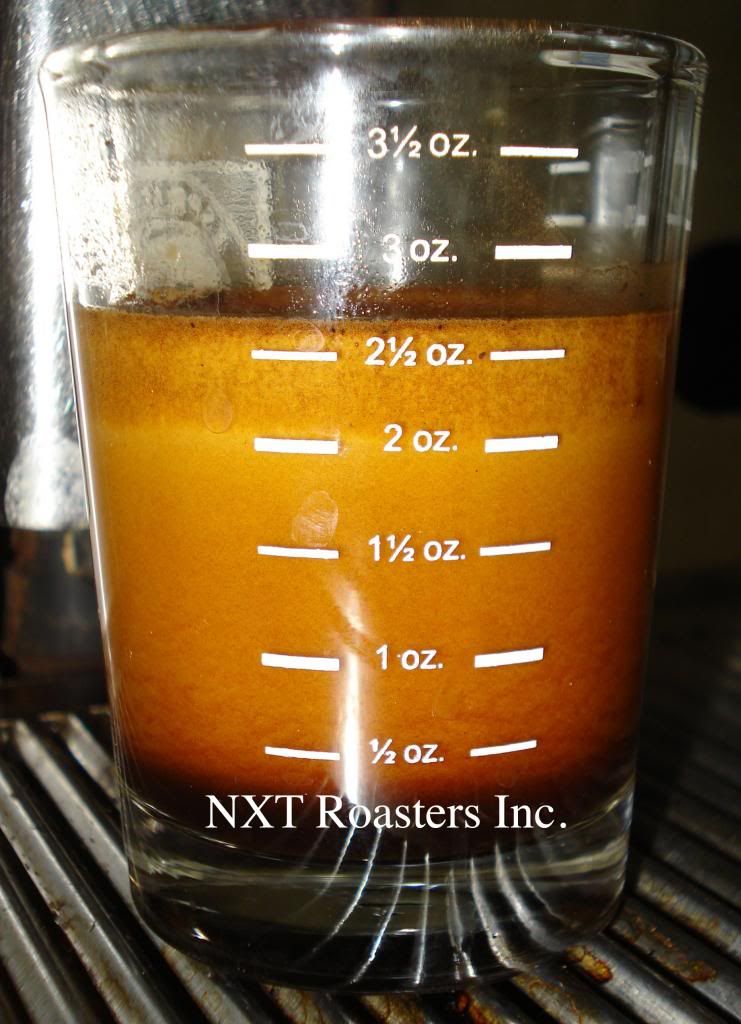
In the first two pictures the Arabica beans were roasted four days previously.

The crema to liquid coffee conversion starts towards the end of the brewing process it is not so fast that the client would be deprived of a significant amount of Crema.


Crema has been viewed by many as an indicator of freshness.  Unfortunately some people think that it is clever to deliver Crema without the freshness.  Common techniques are to add chemical foamers or to add Robusta beans to a blend of Arabica beans because the Robusta beans yield a greater amount of Crema even when it is stale.  At one time the Robusta beans were considerably cheaper but the price increased when too many people started to add Robusta to the Arabica beans.   Adding bitterness for the sake of looks is not a good trade - for the client.  

Though it is possible for anyone to add Robusta beans it is less likely when a roaster is serving freshly roasted coffee, because their brew will naturally have the great indicator of freshness.  After all, a local roaster does not have a long supply chain which requires months to complete the distribution process.

Do yourself a great "flavour" by sourcing beans from a local roaster or someone who can deliver them within 2-3 days from the roasting date.

The brew in this French Press was prepared two days after Roasting.  It is also significant that the beans were ground with a blade type grinder which yields a coarser ground that yields  impressive results but is inconvenient because water will have to be added and the particles take longer to decant.  If the Plunger is pushed too quickly the Screen will plug and a hydraulic lock will occur.                                                        
A burr style grinder yields finer and more consistent results.  The finer grounds will infuse more quickly and will decant reasonably quickly.  The screen is then pushed down to prevent the grounds from being poured into the cup.  The solids do not add to the pleasant experience.                                   

Develop a personal coffee ceremony to consistently get great results.  If the results are not the best then try one thing differently and note if it is better or worse.

Hopefully there will be many improvements because well prepared freshly roasted coffee is so sublime.


Monday, 21 May 2012

Vented Bags Revisited

The original blog of  Do Coffee Bags "Lock in the Flavour" ?   and Packaging Optimism gathered the most visits.  Does this mean that those people believe or want to believe that there is a magical way to preserve roasted coffee.  Well, apparently there is but it involves a -273°C or -459°F refrigerator.  That is no ordinary ice box.  Even then the degrading chemical reaction is only slowed down not stopped.


This little valve is, in my view, good engineering. The object can be mass produced cheaply and there is much more to the design than the average coffee drinker pays attention to. Notice the fiber filter which is backed by a plastic frame to give it strength. I assume that the purpose is to keep coffee particles away from the sealing lip but then it may also keep small life forms out of the bag.
Interestingly, the valve is required to preserve the bag rather than the coffee.  In the days after roasting the coffee beans will produce enough CO2 to burst the bag ( it depends on the bag material but I found that 250 to 350 grams was the limit for un-vented vacuum packed bags).  I suspect that the "longevity improving" aspect was more an invention of the marketing department than an engineering criteria. 

A marginal improvement in longevity might be possible with vacuum packed vented bags.  If the bags are packed within the hour after roasting they will need the valve even if they are vacuum packed.  The porosity of the bean is relatively low and it takes time for the CO2  to migrate from the bean.  Without a vent even vacuum packed packages look like overstuffed pillows.  Obviously that would not allow efficient boxing of the bags.  

Rather than believe that the bag was not kept in a warehouse for months and or spending days in truck trailers I prefer to buy from a local roastery or from Fresh Cup because they expedite the order on the day it is roasted.  Oh well, that offer is only for Canada which means that more than Alaska and Hawaii are hit by the shipping restriction.

Wednesday, 16 May 2012

The Importance of Timely Bean Cooling

Coffee is roasted by way of an exothermic reaction.  Without cooling, the beans would invariably burn because they reach the combustion point.   Roasting consistency can only be achieved through the timely introduction of the cooling air, which halts the roasting, to all the beans.

Drum roasting requires well developed skills because there is an extended lag between the moment the RoastMaster views the beans in the Bean Sampler and the termination of the exothermic reaction.  Several factors affect the degree of roast in a drum roaster; the air temperature is considerably higher than what is required for roasting  ("Espresso Coffee" R. Eggers writes the typical gas temperature of a drum roaster is 400° - 550°C. ), using a Bean Sampler is a relatively slow procedure, and the Cooling fans are relatively inefficient at moving air through several layers of beans.  Sucking the air downwards through the beans is also bad design because it packs beans together which greatly hinders air flow.  Many drum roasters spray water on the beans to cool them more quickly.  This is not good nor is it a measured cooling method.

The high temperature cooking analogy for beans hit by the super hot air is cooking Scrambled Eggs while using the stoves highest heat setting.   Even if they are continually mixed the heat is much higher than the egg can transmit to the interior.  The higher heat of the drum roaster still yields a relatively slow roast which highlights the inefficient transfer of energy.         For more details see "" and "Heating Coffee Beans to Roasting Temperature"

It is said that every second counts when "calling the roast" yet it takes many seconds to determine the degree of roast using a Bean Sampler especially if multiple readings have to be taken to follow the progression.

Many roasters are  stressed  by "calling the roast" even after they have been roasting for nine months.  The beans continue to roast during the dumping process and at the beginning of the air cooling cycle.  It is a common drum roasting technique that water is sprayed unto the beans to soak up heat.  It is impossible to accurately meter water coming from a garden hose.  Moisture is the #1 enemy of roasted coffee.  That lingering roast period means the drum RoastMaster must anticipate the roast quite a bit in advance of the required roast level.  An appropriate analogy is shooting ducks; the expert hunter aims for the position where the duck will be when the buckshot arrives.  The hunter must compensate for altitude, shell powder load, temperature, duck speed, and probably many other things that only a good hunter would know. For various reasons a lot of people have a problem with duck hunting (no ducks were harmed for this analogy).  The drum RoastMaster does not deal with less variables.

 To this end the NXT aka Roastaire uses a fluidized bed in which 240°C (adjustable as required) air is pushed, under pressure, through the beans.  This significantly increases the heat transferred to the entire batch of beans.  The beans have a limited ability to absorb the heat therefore the temperature gradient is more uniform throughout the batch with the forced air stream.  The added benefit is that the air flow continually churns the beans and carries away the chaff.

 The beans are cooled within the Roasting Chamber therefore "calling the roast" is done in real time.  The blast of cooling air also churns the beans so that there is even and rapid cooling.  The Roast Monitor communicates to the RoastMaster the roasting progress so that the Cooling Cycle is started at the proper moment.  It only takes a few seconds to cool the beans ( below 180°C according to R.Eggers and below 200°C according to Clarke & Macrae) to stop the roasting process.  After this 30 second Cool Mode the beans are transported to the Packaging Hopper while the NXT aka Roastaire loads nother batch freeing the RoastMaster to appreciate a freshly roasted coffee.

Friday, 30 December 2011

Roaster Carbon Calculations

The good people at Fresh Cup used the U.S. EPA Carbon Calculator to compare the Roastaire Carbon Footprint with that of a gas roaster.   


A 100 lbs.  of roasted coffee = 1 car off the road for 16 days  


This is how our roasting method impacts the environment. The energy ratio is  2 light bulbs versus the drum roasters 48 light bulbs.  Gas is a cheaper form of energy therefore in dollar terms the approximate heating cost of a gas fired roaster with afterburner is 16¢ per pound vs. the 2.5¢ for the recirculating Roastaire.


Evidently the Roastaire is way more environmentally friendly and cheaper to operate.  


The 100 lbs. of roasted beans represents about 3 hours of roasting, depending on the degree of roast.  Think of the savings to the environment and to the owner.  


It's time for a cup of freshly roasted coffee and a read about selling carbon credits.


Saturday, 10 December 2011

Packaging - Optimism


Packaging attempts to circumvent or overcome the stalling of coffee.   It does not keep old coffee fresh though it is claimed that it slows down the staling for an unbelievably long time.  Most of the advantages are perceived by the consumer based on sizeable advertising programs.  Though it appears that a valve, at least under ideal conditions, lets little air into the bag.  Well, less than the bag would have had when it was sealed.  Vacuum sealing reduces the air and moisture in the bags but that requires more equipment and time.  The valve does let out the CO2 but it also lets the aroma escape.  The vented bag will have a lower internal pressure, than say a metal container.  The lower pressure exacerbates the loss of volatile compounds which are the reason for that olfactory experience.  To circumvent that loss some companies replace the vent by Oxygen and/or CO2 scavengers.

"Espresso Coffee" by Illy & Viani states that the spoilage rate increases by 7 fold with every 10°C increase in temperature.  Unfortunately there is no mention if that calculation starts at absolute zero. It is an unmeasured and uncontrolled variable that very much affects the coffee experience.


A lot of money was invested into the marketing of various types of packages because the business model of central roasters depends on convincing customers that coffee that is more than a year old still has the freshness of yesterday's roast.

I view the valve as a packaging solution which does not contribute much to maintaining the roasted bean's fresh taste.  My only acceptable solution is to buy the freshest coffee from a local roaster.  An exception, in Canada, is Freshcup.ca which ships, via expedited post, the day the coffee is roasted.  On several occasions I have sent some much appreciated coffee gifts.  It could be perceived that I am biased because they use our roaster though I maintain that the long relationship has allowed me to observe closely the organization and witness their commitment to delivering the freshest great tasting organic coffee to their customers.

Wednesday, 7 December 2011

Do Coffee Bags "Lock in the Flavour" ?

The test will be posted in a few phases, perhaps more if there are leakage problems around the valve, such as the testing apparatus, results, and implications of the findings.
To the left is the inside part of a Check Valve that is incorporated on many coffee bags.  It permits the coffee roaster to bag the coffee very soon after roasting.

For those who may not be aware, freshly roasted coffee releases CO2 (Carbon Dioxide) in the days that follow the roasting session.  The pressure is sufficient to burst bags.  Initially the coffee was packaged in various media such as paper and consequently not hermetically sealed.  Some roasters "aged" the coffee and packaged it several days later when the CO2 had been dissipated.  The Check Valve is a more recent development which allows the CO2 to escape without splitting the bag.  There could be an advantage to this method if the valve is placed such that when the filled bag is stored the valve is the highest point of the bag.  CO2 is heavier than air therefore it will gravitate to the bottom of the bag forcing out the lighter air first.  Technically it is possible that all the oxygen could be forced out in this way.

The purpose of this test is to verify the premise that the Check Valves are more important to the marketing campaigns than to preserve coffee or "locking in the flavour".  Does a valve costing about a penny do the work of precision devices?  If the bag is not hermetically sealed the constantly changing atmospheric pressure will make the bag "breathe" which will introduce oxygen to the contents. 

The apparatus is quite simple and will involve measuring a Control to be certain that the test equipment is leak proof.  The upper left barbed fitting will be connected to a vacuum pump then the valve will be closed.  The Needle Valve is rated at 6,000 psi therefore it should not be harmed by this test.  The vacuum will be measured by water movement in a U tube.  The picture shows two devices that can be sealed to the bag.  The preferred socket is the one to the right which is machined with steps that will fit just over the valve so that it is not distorted or twisted.  This is better than in reality where the valve is pushed by the beans.  Several different sealing materials may be required before a good seal is established between the socket and the plastic check valve.

Plotting the height of the water column should be a good indicator of the leakage rate, if present.

Marketing departments are notorious for making unsubstantiated claims.  Rather than admit error the trend is to spend more money to embellish their fabrication.  Let's check the foundation to the claims.

Freshly roasted coffee does its own marketing.

                                           -------------------------------------------------


The first phase is Testing the bag's Venting Valve in Ideal Conditions.  


The venting valve was cut from a new bag (unfortunately that is a sacrificial test) but a lots of material was left on either side of the valve.  The valve was then mounted to the socket and sealed with a thin layer of silicone adhesive on the periphery.  The adhesive cured overnight. 
A slight vacuum ( 33.5" H2O or 851 mm of H2O) was drawn against the valve.  That is P1-P2 = 67" H2O (1.702 m) in the U tube manometer.

After an hour the water column was 1" (25.4 mm) lower which represents 1.81 cc of water.

After an 2:45 hours the water column was 1.5" (38 mm) lower which represents .165 in3  (2.7 cc) of water.

After an 6:00 hours the water column was 3" (76.2 mm) lower which represents .33 in3  (5.43 cc) of water.

After an 47:00 hours the water column was 9.25" (235 mm) lower which represents 1.022 in3  (16.74 cc) of water.

After an 70:00 hours the water column was 9.88" (251 mm) lower which represents 1.091 in3  (17.89 cc) of water.

Granted the Control Run has not been done.  Under ideal conditions it is little leakage but then it is over a short period.  The pressure, however, is considerably higher than the barometric fluctuations.  So far it can be established that it is not a hermetic seal.  To reflect the packaging role the pressure may have to be reduced, the time period increased, and the valve will have to be pushed against beans rather than held flat in a socket.

                                                 --------------------------
More on a newer blogs Vented Bags Revisited  and Packaging - Optimism

Wednesday, 16 November 2011

Staling of Roasted Coffee

Coffee stales much faster than it is commonly perceived.  An extreme example is noted in "Coffee Technology"by Michael Sivetz where he mentions that moisture absorption from the air or due to water quenching need only to be 1% to noticeably stale coffee within the hour.  This represents 30 cc (1 fluid ounce ) per 3 kg ( 6.6 lb ) batch which,  considering that the beans lost 12 to 20 times that much moisture when roasting, is quite significant.  Advocates of water quenching claim that all the water evaporates as it hits the bean.  I am not so certain that this is so because after roasting the bean is very porous which means that the water will quickly cool the outside layer the bean will then have difficulty conducting the heat to the surface to evaporate 100% of the moisture.  The increased porosity will help draw the moisture inside.

Each opening of the container allows more moist air to reach the roasted coffee.   Sivetz writes that the beans are "moderately stale" within a week, more stale within two weeks and stale in three weeks.  Greater surface area i.e. ground beans significantly increases the absorption of air and moisture.

Vacuum packaging does remove most of the air but if it is done within a few hours of roasting it can create problems because of the high pressure CO2 will be released from the beans and inflate the bag.  If the coffee is ground the CO2 will be mostly released within the hour.

In theory the Valve on the Bag permits a longer storage time but I am sceptical about that valve working perfectly.  The changes in air pressure are small and applied over long periods of time as the barometric pressure changes which causes the bag to breathe.  The valves are attached to a bag that is filled with coffee beans which is not a flat surface hence I am thinking that it leaks and that it's purpose is to prevent the bag from bursting from C02 pressure.  Before going further that has to be tested.  I reiterate that the only safe bet is buy Freshly Roasted coffee.

Wednesday, 9 November 2011

No Carbon Credits Required !


November 1st, 2011 – Victoria, B.C.
Many coffee roasting companies across Canada claim 'carbon neutral' status these days, however, consumers are encouraged to look closely at their labels to find out 'how' they achieve this. Carbon credits are being bought by a number of roasting companies whose technology is outdated and continues to pollute the environment. Many companies are folding the costs of carbon credits into their cost of goods. 'If you look closely, many coffee companies are claiming carbon neutral status, but all they're doing is buying credits to offset their emissions', states Fresh Cup President, Jim Townley. 'The truth is, the consumer is likely paying a higher price for a product without even knowing it'. No matter how you slice buying carbon credits, they are a cost to any company and many companies are buying them more for their marketing value than the purpose that they were intended for. 'Whether you plant a tree, or buy credits to off-set the carbon emissions produced in making a product, it costs money', notes Townley. That cost has to show up somewhere along the line, and if the cost to buy credits is left low like it currently is, many companies will continue to pollute and make consumers pay the price. 'What's the point of low cost credits, if the cost can be added to the product for the consumer to pay ? Where's the motivation for companies to change their business practices to minimize the impact on the environment', asks Townley. 'Our approach is simple…be sustainable in how we roast coffee by reusing the heat, while drastically minimizing the emissions, then there's no carbon credits required'.


---------------------------------------------------------------------------------------------------------------
There is even more to the story !
The unfortunate part about marketing claims vs. true development and technical improvements is that the marketing claims focus on changing perception rather improving the equipment.  It is the easy way out which in this case does nothing for the local air quality if someone planted trees hundreds of kilometres away.  The article above does not mention that it took a decade to reduce the Roastaire emissions to a small fraction of conventional roasters.  In the process the energy required to roast was reduced to about 1/6 of a conventional coffee roaster.

The Roastaire™ was designed for the Café environment where people can observe the roasting process.  We refer to that as the "theatre of roasting".  The roaster is a compact unit that includes Chaff Cyclone, SmokEater™ (pollution controls), Pneumatic Bean Conveyor, and a Packaging Silo.  The roaster is approximately 6.5 feet high.  The roaster is controlled by a computer based Roast Monitor which  also configures the roaster, through the use of pneumatic valves, for the various modes in the roasting process.

More information is given in the post "Sustainable Design Follows Function"  such as the attention given to ergonomics.  An obvious example is the placement of the Loading Hopper which is placed at counter height rather than above the RoastMasters head.  The roasted beans are quickly cooled internally so that the smoke can be neutralized before it is vented.  The aim has been to improve and streamline the roasting session.

Café owners that buy roasted beans see " FRESH Coffee! " post are simply paying for someone else's roaster without getting all the benefits.

Friday, 4 November 2011

FRESHLY Roasted Coffee!

FRESHNESS is a contentious topic.  Groups that can't provide fresh coffee because of their long supply chain attempt to ignore this essential factor when selling a perishable food.  Cafés that Roast OnSite say that coffee staling begins to be noticeable one week after roasting.  They aim to sell "take home coffee beans" within the week and to serve all coffee within 1 1/2 weeks.  The question they ask is "Would you buy 10 day old bread?".  We attempt to bolster this strategy by providing an efficient small batch 3 kg roaster which makes it easy for the café to roast only the coffee beans that are required for the next few days.  This roaster benefits from the advantages of using electric heating which allows the re-circulation of the heated air after it is scrubbed of the smoke particles.  The built-in SmokEater™breaks down the exhaust gasses which otherwise cause neighbours to complain about roasting odours.

Café owners that buy from a local roaster sometimes do have fresh coffee but, obviously, they can't proudly serve their own creation.  The passion of creation communicates very well at the counter.  Perhaps they do not really know when the coffee beans were roasted.  One RoastMaster explained it like this: we put it for sale as an estate arabica, after some time we make blends, and if we still have some left we wet a cloth with some flavouring and tumble it and the beans in a small drum.  Is that flavouring to enhance or mask?  To the Café owner "Does the cost of your coffee pay for your roaster or your supplier's?"

A lot of lobbying dollars were spent to convince governments that coffee beans last more than 18 months therefore did not require expiry dates, in other words they concluded that roasted beans were non perishable.  This decision was required by centralized roasters and grocery chains because they cannot transport the beans to client coffee pots within two weeks.  Consequently, they promote peripheral messages such as freshly ground, freshly brewed, consistency, convenience, low price, contests, etc.   They can accessorize the product as much as they want but if you start with stale beans you can't make a quality drink.  Coffee parallels the preparation of food in that increased processing equals diminished quality.  Some of the tricks are to add cheaper robusta beans, which are more bitter than arabica beans, to the blend so that the espresso will have more crema like freshly roasted coffee.  It is not a great espresso and most likely they will suggest that you give it some zing with a flavouring.  Freshly roasted coffee has plenty of zing plus it has complexity that a flavouring does not even try to achieve.

Out of curiosity two books were consulted; one by a large Italian central roaster and other by UK specialists.  The first only mentions "freshness" as it pertains to serving it quickly after it is brewed.  The second book does not mention freshness.  Freshness is not part of the centralized roasting business model.  As a consumer the choice is yours "Do you wish to pay for freshness or warehousing?".

Packaging is often ascribed miracle properties.  In the first day(s) following roasting the beans emit a lot of carbon dioxide which can burst bags.  Hence, the use of the valve.  If the valve is the highest point in the bag the CO2 will force out the lighter gases such as air which is beneficial but it is hardly locking the flavour in.  One web site says that packaged coffee lasts a few months until the bag is opened but a little further down they claimHow long does coffee last? Coffee packaged with a freshness valve = 12 months then add a little further Ground coffee once the bag is opened = 2 weeks.  Check for consistency of message and verify that information.  Your priority is taste or the coffee experience theirs is sales.  Studies have been done about slowing down the degradation through cold storage but that requires colder deep freezers than those in homes.  An additional problem is that, due to the pressure differential, the deep freeze is the area with the highest humidity in a house.  Moisture accelerates staleness.

If possible observe a roasting session, you will learn.  You may find that some of the urban based coffee roasters are not used because of pollution complaints and that some RoastMasters , that do not have Afterburners, roast during the night. 

To improve the roasted beans' relatively short lifespan they should be ground just before brewing.  Make a comparison with beans that have been ground for half an hour. I expect that after half an hour the finely ground beans will make a flat coffee.  An espresso will have greatly reduced crema.  You will then be in a position to judge the statement "Ground coffee once the bag is opened = 2 weeks"

My mantra is "Buy from the roaster".