Pages

Showing posts with label efficiency. Show all posts

Friday, 21 September 2018

Extending Freshly Roasted Coffee Lifespan

The main enemies of Freshly Roasted Coffee are Time, Oxygen, and Moisture.

A solution has been presented to the public that is more beneficial to the manufacturers than to the end user.

Background info:

Immediately after roasting the coffee beans begin to emit carbon dioxide in sufficient volume and pressure to burst a hermetically sealed bag.  Some roasters opted to degas the beans for one to three days to alleviate this problem while manufacturers came up with a new product, the valve.
http://nxt-roasters.blogspot.com/2011/12/do-coffee-bag-valves-leak-1.html
http://nxt-roasters.blogspot.com/2012/05/revisited.html

Valve Limitation - as currently used:
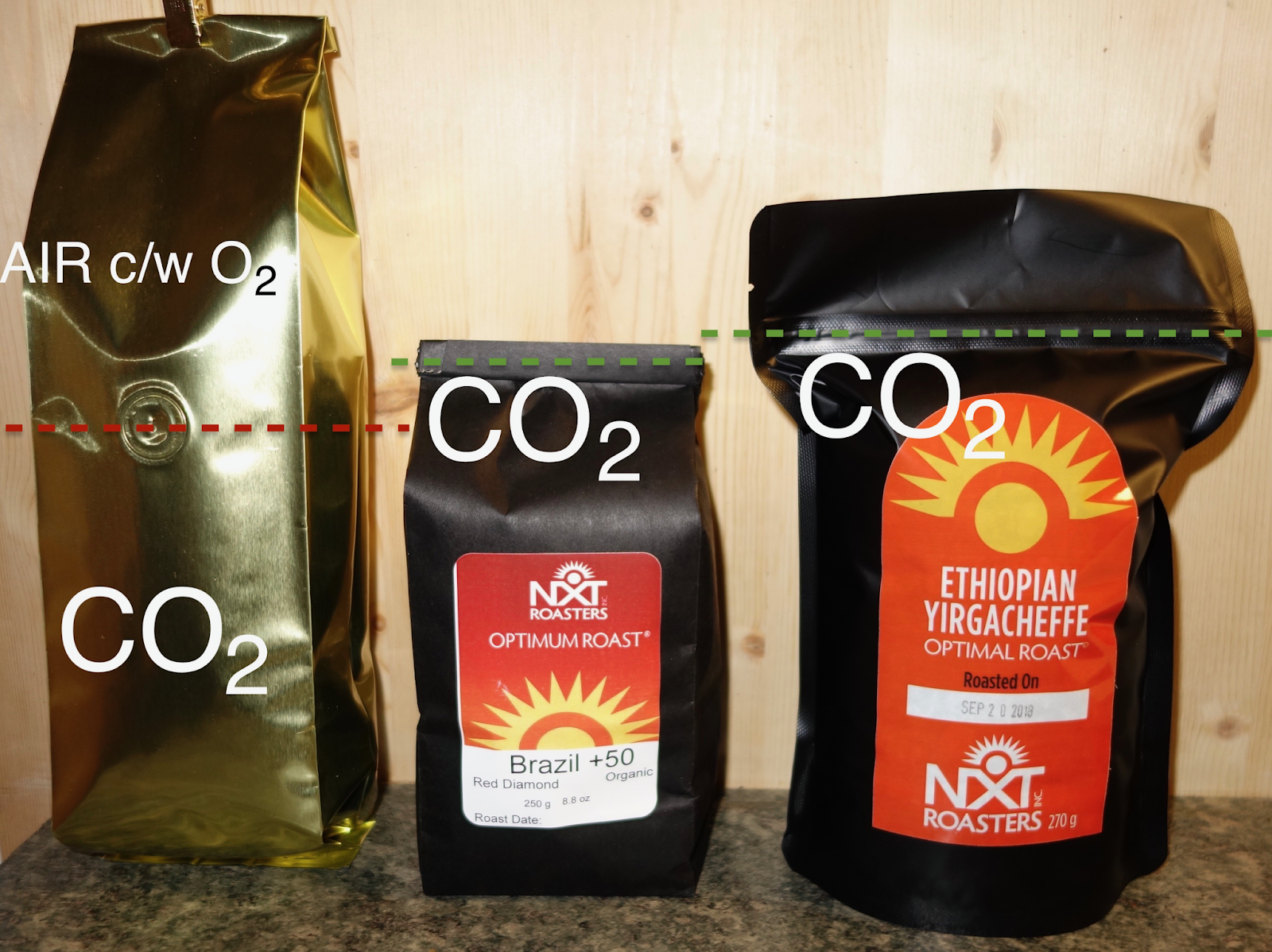
It is possible that the valve is a single solution to burst bags when with a little more thought it could have also help to extend the freshness of coffee beans.

The CO2 is roughly 50% denser than the air we breathe, which consists of about 21% Oxygen.  This means when packaged, on the first day, beans emit CO2 that gas drops to the lowest level in the container and pushes the existing air upwards.  Surrounded the Freshly Roasted Coffee Beans with CO2 retards the oxidation process, hence, slows down the staling process.  How well and for how long the freshness is preserved is much more difficult to assess and beyond the limits of a one page blog entry.  For arguments sake I say it gives an extra week.  This process exists for the beans that are continually bathed in CO2 which is not the case when there is a venting valve.  As shown in the photo the CO2 will rise up to the valve then exit rather than flush out the air above the valve.  That means that, as the photo illustrates, that only 2/3 of the beans are in CO2 providing the bag is not tilted.  If the bag was laid on it back so that the valve was at the high point of the bag then there would be a different outcome but bags are not stored, shipped, or displayed laying down.  That scenario would be improved by moving the valve upwards to minimize the amount of air in the bag.

Using a valve does allow the roaster to degas in the heat sealed bag which offers the consumers the security and assurance that the bag contents have not been tampered with.

Alternatives:

The NXT solution to this dilemma is to use a ziplock bag which presents more flexible packaging options.  First, all the oxygenated air is pushed out of the bag when the bag is kept upright.  We recommend that people scoop out the beans for immediate consumption rather than pour them out which would drain much of the CO2.  Leaving CO2 to protect the beans extends the freshness.  Our bags are in a supervised area and they are not opened after closing but for added security, where bags are placed in a public area and a heat seal is required a simple pin prick between the ziplock and the heat seal which will prevent bursting the bag and allow a flushing of the oxygenated air.

NXT advocates degassing in the bag to take advantage of the emitted CO2 to extend the freshness of the coffee beans.

We have a Carbon Dioxide high pressure tank and a regulator to test the effect of giving a shot of CO2 to a bag of beans that are more than a day old when outgassing has mostly ceased.

It might mean some beans will be destroyed with water to determine the volume of the interstitial spaces which will indicate how much CO2 has to be injected to bathe all the beans in a protective gas.

To Do:

Test to determine how CO2 will enhance the life of ground coffee.

Friday, 15 June 2018

Question and Challenge What you Read

Company Blogs which very often are prone to being commercials should not be taken at face value or believed without reflection and sometimes, some research.  

One blogger (Blogger B) submitted a comment to a competitor " I read with interest your article entitled “Roasting with Hot Air: Benefits of Air Roasters” in your company’s newsletter."  He then proceeds to authoritatively expound on his own lack of knowledge in the roasting process.  The complication here is that the article, by Blogger A, he refers to has some rather glaring falsehoods i.e. "During the roasting process, the green coffee beans go through two major “pops” or “cracks” The first occurs when the internal temperature of the bean reaches approximately 356 degrees fahrenheit.".  The problem here is that no matter how long you boil water the temperature remains no higher than 212°F or 100°C.  The evaporative process greatly slows the bean from continually increasing in temperature until virtually all the moisture is evaporated.

It appears that Blogger B then proceeds to confuse degrees Fahrenheit with degrees Centigrade.  Blogger A writes "This hot air reaches temperatures of between 450 and 485 degrees fahrenheit" (232°C to 251°C) which is slightly above the 195°C to 205°C where the beans undergo an exothermic reaction.  A much lower temperature would essentially bake the beans.  Despite Blogger B's assertion that the air roaster is way too hot it is 100°C to 200°C less hot than a typical gas fired drum roaster.  It is true that the air roaster has a faster roast cycle but 4 minutes is absurd while 11 minutes is quite normal because the heat is quite evenly applied to all sides of the bean as they are churned in the fluidized bead.  Drum roasters only have fans which are incapable of pushing the air through the batch of beans therefore they only heat the top layer, the beans touching the drum, and beans that are falling off the rotating blades.  Blogger B's comments "Regardless of how heat is applied to the outside of the beans, heat reaches the insides of the beans by conduction. And, when it comes to heat conduction, coffee beans are not very good at it. Therefore the development of the insides of the beans always trails the development of the outsides of the beans."  Ironically he is presenting a case that favours the lower temperature of the air roaster (for the same reason you do not fry eggs on high settings).  This, however, is not true for the entire roasting session.  The heat moves inwards in the endothermic phase until the bean enters the exothermic phase.  

Think of lighting a damp piece of paper.  There is a reason why you can boil water, on a flame, inside a paper bag.  It is because the water seeping through the material prevents the paper from reaching its combustion point.  However remove that water, the paper will dry, and will then burst into flames.

Blogger B apparently does not realize that a full roast includes the exothermic phase where the heat is generated inside the bean.  See sectioned bean photo.  At this point the roasting process has to be monitored closely to "kill the roast" at the right time.  We prefer to cool within the Roasting Chamber because it is quicker and easily repeatable.  At this stage the transformation is very rapid therefore it is challenging to guess "the kill point" half a minute to a minute in advance because it takes that long to dump the beans never mind cool them.

Blogger B also comments on the single pass air roaster even though his system not only is a single pass air supply but it is roasting with the exhaust of the flame.  Imagine cooking supper with the car exhaust (maybe a propane powered vehicle is slightly more appropriate", it will certainly contribute all kinds of flavour.  Recirculating hot air cannot be done with a gas fired roaster because it starves the flame.  We do it in an electric roaster but it took five years to develop a blower that would survive the temperature.   Re-circulation improves the efficiency and makes it possible to significantly cut emissions.  

A gas fired Afterburner burns on average 3 times more gas than the roaster.  It decreases the visible smoke but really loads the exhaust with volatile organic compounds known as pollution.

Sunday, 15 November 2015

High Temperature Blower II

                                                High Temp. & High Pressure Blower II


Further to the 2012 post "High Temperature Blower at Work"and 2011 post "High Pressure & High Temperature Industrial Blower"; NXT Roasters has been working on an air bearing package that will deliver the same pressure and volume but at higher temperatures.

High temperatures create a hostile environment especially to an object that must turn at high speeds.  Materials must be carefully chosen so that they will maintain their strength and hardness at the elevated temperatures.  Thermal expansion creates problems as well because not only do different materials expand at different rates but various components operate at different temperatures.  That "constant" X 10-6 per °C can really bite you.

Common bearings can handle high temperatures and high speeds but rarely can they do both in the same application.  The high speeds (above 10,000 rpm) mean that the components have to be dynamically balanced plus tight tolerances have to be maintained.

The initial goal was to place the Blower in the coffee roasters where it should easily cope with the 250°C recirculated air.  Curiosity drove the project to higher and higher temperatures.  The current temperature ceiling will remain until a stainless steel housing is fabricated.


Earlier this week a blog reader  requested information on a blower capable of moving flue gases.  Unfortunately the 800°C flue gasses are 300° higher than we have been running the Blower, that temperature is beyond the capacity of the 6061 Blower Housing.  

There are some obvious applications for the Blower but it would be interesting to find out if it is able to solve or enhance some industrial processes.  Email your suggestions and requests to main@nxtroasters.com  .  Perhaps our development plans will coincide.

In the meantime we will continue to accumulate operating hours.


Sunday, 1 June 2014

Improving a Working Device

The picture links were removed because Photobucket decided to change the terms of usage in mid stream, so to say,  It is inconvenient for viewers but it is better to rid yourself of such people as soon as possible.  It is the attitude as much as the action.   We will try to repair that mess at NXTroasters.com

Unlike a painting a machine can be tuned to new requirements without changing its fundamental reason of being.

An interesting book A Culture of Improvement: Technology and the Western Millennium written by Robert Friedel in 2007, reviews the invention and evolution of many technologies.  He certainly highlights that many factors determine the course of an idea and that it is not always the best idea that dominates.  In school,  history classes often gave the impression that there were technological leaps whereas this informed text demonstrates that more often than not inventors or the mechanically inclined stood on the shoulders of others, so to say.  Often people that leaped too far did not succeed for various reasons; people did not accept such a change, existing materials did not have the required properties, incompatibility  with existing technology, competitors sidetracked "message" etc.  In essence many aspects of a development have to be "done right" to assure success.

It is baffling that the author chooses to dismiss the work of Tesla while he lauds laboratory managers who were often credited with the inventions of employees.  Design of the distribution infrastructure of alternating current is only stated not credited.  Marconi's patent applications were turned down for years because of Tesla's existing patents.  His patent was only granted when well connected wealthy business people employed their power to influence.  It is not too different to where a federal government  concluded that the tomato is a vegetable that is subject to import regulations.
Meanwhile back in the present the challenge is to find an acceptable balance between the best technology and the price of implementing the solution.  To improve the efficiency and greatly reduce pollution the roasting air is recirculated after purging it of nearly all the smoke.  Sounds simple enough but the reality of working in a hostile environment is challenging.  

Fluidizing the bed of coffee beans is essential to the proper mixing and even distribution of heat.  In the upgrade shown on the right the Blower bearings have a lubrication system to improve the Mean Time Before Failure which usually happened too soon at roasting temperatures.

The continual cleaning of the recirculated air means that the roaster does not emit smoke during the hot weather roasting process.  A distinction is made regarding the weather because when it is cooler steam is vented during the bean cooling process.  Such a roaster can be used in higher density areas thanks to the built in pollution controls.

Of course the great smell of coffee is not to be wasted therefore we vent the air used to cool the coffee beans straight to the street to act as an olfactory business sign.


Tuesday, 26 November 2013

Improving the Roasting Efficiency.

There are several aspects to be considered before a process can be implemented to improve a design.   Often it is possible to identify, let's say for the sake of discussion, 10 variables that will affect the process.  What is usually impossible to predict is the rank or the level of dominance of each variable unless you are really really really a gifted analyzer or clairvoyant.  Personally I resort to testing a few variables at a time to better understand their effect.  There will undoubtedly be surprises and inconsistencies when various variables are tested together but it is simpler to test in parts than in whole.

The testing results are unlikely to produce a clear graph such are joys of solving problems with multiple unknowns.  The results will give a better idea about the trade-offs that are required before a process can be adopted.  We maintained that coffee beans should be uniformly heated so that the chemical reactions that occur within the beans progress evenly.  It was also deemed important that the beans not be thermally overloaded.  To clarify; the bean has a certain capacity to transmit heat to its interior, if the heat applied is greater than what can be evenly distributed the exterior surface becomes much hotter  and creates a risk of scorching.  It is also for this reason that we roast at a relatively lower temperatures of 240°C to 250°C instead of ...  In "Espresso Coffee" R. Eggers writes the typical gas temperature of a drum roaster is 400° - 550°C.  The high temperature cooking analogy for beans hit by the super hot air is frying eggs while using the stoves highest heat setting.  Yet this fluidized bed roaster has a cycle time of less than 12 minutes versus up to 20 minutes in a drum roaster.   That  is Better Efficiency! 

The even distribution of heat is critical to preparing the beans for the roasting process.  We force heated air between the beans so that they are all heated, not just the outside layer.  There are small domestic roasters that also use air to create a fountain of beans.  It is quite dramatic but if the air flows through a narrow passageway then the remaining beans are not being heated until they gradually make it to the fountain.  Consequently, if you are looking for a home roaster look for one that pushes the air through all the beans.  Typically, the batch will move upwards as the beans are levitated by the flowing air then the air will break through and mix the beans.  The release of air pressure allows them to drop within the chamber but are then suspended again.  The air cushion has the added advantage of keeping the beans off the hot metal which often causes tipping which appear as little pieces of the exterior wall that leave behind a shallow cavity.

It is a simple concept that is regulated by many variables which turn it into a complex process.  

There is more to the efficiency quest than even thermal transfer and the recycling of air mentioned in the previous blog which leaves something to write about later.  Now it is time for an espresso.

Monday, 21 October 2013

Improving Roasting Technology

The picture links were removed because Photobucket decided to change the terms of usage in mid stream, so to say,  It is inconvenient for viewers but it is better to rid yourself of such people as soon as possible.  It is the attitude as much as the action.   We will try to repair that mess at NXTroasters.com

 The conventional approach appears to be - buy a roaster and endure its limitations.  Most conventional roaster owners spend more time developing marketing spin than improving their coffee roaster.   The deficiencies i.e. emissions are already the focus of some legislative bodies which require permits for roasters in their jurisdictions.   Oil burning engines, showing that blue smoke, are rarely seen on the road today yet many owners are complacent about roasting without pollution controls.

The roaster owners who are concerned that large plumes of smoke coming from their chimney are bad for their community image have purchased large gas fired after-burners that burn approximately three times more gas than the roaster itself.  Imagine if automobile pollution controls involved using three times more gasoline than the engine.

Rather than maintain the polluting status quo which may or may not have visible smoke, NXT Roasters Inc., have developed an alternative (branded the Roastaire in Canada) approach that uses the smoke generated as a source of roasting heat rather than expend large amounts of additional energy to thermally neutralize the smoke.   Both 15 Kg/hour concepts thermally treat the pollutants but one system uses a 400,000 to 700,000 BTU after-burner  to accomplish the task.

The first picture is of the main air passageway of a Roastaire after five years of full time roasting.  This revealing photo demonstrates the reason for their motto of "Clean Air Roasting".  This illustrates how efficient and effective the air is scrubbed clean as it is re-circulated during the roasting process.   This closed loop roasting process means that the air only has to be heated 20° to 40°C to return it to the roasting temperature.  Compare that to a single pass air supply that is continually heated from ambient temperature then sent to the chimney.   In "Espresso Coffee" R. Eggers writes the typical gas temperature of a drum roaster is 400° - 550°C.   What a wasteful process.


In comparison,
one drum roasters Maintenance Manual draws attention to the chimney,  "Even if residue build-ups do not exceed 1/8 inch (.3 cm) per year, clean system annually ".    The quotation is not properly cited nor acknowledged but I will do so if the manufacturer requests it.

They also have this picture of a drum roaster fan as a warning about the residue that coats some of their components.  Roast Magazine had the following quotation "It's not IF you're going to have a roaster fire, but WHEN."  Which roaster do you think requires the most maintenance?  Which type of roaster do you think was responsible for nearly 1,800 chimney fires in the USA in 2010?


Which roaster do you think roasted hundreds of pounds of green beans inside the exhibition hall of the last four annual 
Canadian Coffee & Tea Shows?

Wednesday, 17 October 2012

High Temperature Blower at Work


Highly reflective insulation is not an ideal material to photograph but it is easier to blow clean, reflective surfaces do reflect heat, and it effectively contains the ceramic insulation.

The testing has showed that the highest gains in efficiency were made with recirculation of the heated air.  Of course that does create some challenges especially if high pressures are required.  High pressures require positive displacement or high speeds.   Design solutions involve benefit tradeoffs.  A really good design makes use of the component's strengths without being penalized for its shortcomings.

Improving the insulation involves preserving the heated area, facilitating the application of the insulation, and reusing the heat that does escape i.e. air that is used to cool the high speed belt.   To effectively utilize that cooling air there has to be a sufficient temperature differential between it and the item to be heated.  It does work well in preheating a batch because the 70°C flowing air can impart energy to ambient temperature batches.

The air is used to preheat diverse products in order to reduce the load on the main system.  The temperature is too low to create a moisture problem therefore condensation requirements are reserved to the main circuit.  Another efficiency gain would be to use the processed batch to raise the temperature of incoming batch.  Direct contact risks contaminating both batches but heat exchangers have become very efficient providing the throughput is sufficiently high.

Apart from the coffee roasting application we are involved in fluidized bed drying.  A high pressure and high temperature convection oven that can also distribute super heated steam is only in the testing stage.

NOTE: Regarding the comments that this is an old Blower; the Blower is new but the Belt Cover has been repurposed.  The original cover was made from sheet metal only, while this one, had some vibration dampening bars inside.  Further testing showed that noise dampening material was lighter and more effective.  We just kept the old cover for testing prototypes.  Time for a coffee.

Sunday, 1 July 2012

After Burners and Greener Roasting !

The car market illustrates a large selection of solutions to what at first appears to be a transportation problem.  Such a wide scope of solutions implies that much more is in play than moving passengers from A to B.  Some features are at the expense of others such as high performance usually eliminates the possibility of incredible fuel savings.   Maximizing nearly all characteristics usually implies a large financial outlay whether it is comfort, performance, or low fuel consumption.

Some people wish to believe that their "prized possession" is simply the best.  That is usually more than a subjective analysis or wishful dreaming where the shortcomings are deemed unimportant.  The Internet provides, sometimes humourous, pictures of people "stretching" the capability of their vehicle such as cars that are  given the role of heavy transporters which is a usage not foreseen by the designers.  Of course the danger, failure, and wear rate is abnormally high.

The same occurs in industrial machinery which is usually characterized by a design that has been optimized to solve a well defined problem.  Better equipment has many of these features; consistent, reliable, efficient, clean, predictable, safe, repairable, and of course they tend to be more expensive.  The expense of a heavy duty design sometimes requires the marketers of lesser units to "upgrade" the features and to declare that shortcomings are really features that were not understood.

Clean technology should mean more than "not visible to the naked eye". A 400,000 BTU Afterburner does virtually eliminate the coffee roasting odours and visible smoke but it can hardly be considered green technology.  The 400,000 BTU/hr  signifies 400,000 BTU/(114,000 BTU per US Gallon of gasoline) or 3.5 US gallons per hour of operation.  Consumed in a car traveling at 55 mph that represents 15.5 miles per gallon, not really in the Prius performance standard.

Some natural gas roasters have countered with the claim that they recycle 100% of their air.  That must be a statement originating in the marketing department because engineering has not figured out how to sustain a flame with air depleted of its oxygen.

Design involves more than covering up the problem, it is turning a problem into part of the solution.  Good design is using the energy within the problem process to eliminate it and if possible to use the excess energy of that destruction to reduce the roasting energy cost.

Monday, 21 May 2012

Vented Bags Revisited

The original blog of  Do Coffee Bags "Lock in the Flavour" ?   and Packaging Optimism gathered the most visits.  Does this mean that those people believe or want to believe that there is a magical way to preserve roasted coffee.  Well, apparently there is but it involves a -273°C or -459°F refrigerator.  That is no ordinary ice box.  Even then the degrading chemical reaction is only slowed down not stopped.


This little valve is, in my view, good engineering. The object can be mass produced cheaply and there is much more to the design than the average coffee drinker pays attention to. Notice the fiber filter which is backed by a plastic frame to give it strength. I assume that the purpose is to keep coffee particles away from the sealing lip but then it may also keep small life forms out of the bag.
Interestingly, the valve is required to preserve the bag rather than the coffee.  In the days after roasting the coffee beans will produce enough CO2 to burst the bag ( it depends on the bag material but I found that 250 to 350 grams was the limit for un-vented vacuum packed bags).  I suspect that the "longevity improving" aspect was more an invention of the marketing department than an engineering criteria. 

A marginal improvement in longevity might be possible with vacuum packed vented bags.  If the bags are packed within the hour after roasting they will need the valve even if they are vacuum packed.  The porosity of the bean is relatively low and it takes time for the CO2  to migrate from the bean.  Without a vent even vacuum packed packages look like overstuffed pillows.  Obviously that would not allow efficient boxing of the bags.  

Rather than believe that the bag was not kept in a warehouse for months and or spending days in truck trailers I prefer to buy from a local roastery or from Fresh Cup because they expedite the order on the day it is roasted.  Oh well, that offer is only for Canada which means that more than Alaska and Hawaii are hit by the shipping restriction.

Wednesday, 16 May 2012

The Importance of Timely Bean Cooling

Coffee is roasted by way of an exothermic reaction.  Without cooling, the beans would invariably burn because they reach the combustion point.   Roasting consistency can only be achieved through the timely introduction of the cooling air, which halts the roasting, to all the beans.

Drum roasting requires well developed skills because there is an extended lag between the moment the RoastMaster views the beans in the Bean Sampler and the termination of the exothermic reaction.  Several factors affect the degree of roast in a drum roaster; the air temperature is considerably higher than what is required for roasting  ("Espresso Coffee" R. Eggers writes the typical gas temperature of a drum roaster is 400° - 550°C. ), using a Bean Sampler is a relatively slow procedure, and the Cooling fans are relatively inefficient at moving air through several layers of beans.  Sucking the air downwards through the beans is also bad design because it packs beans together which greatly hinders air flow.  Many drum roasters spray water on the beans to cool them more quickly.  This is not good nor is it a measured cooling method.

The high temperature cooking analogy for beans hit by the super hot air is cooking Scrambled Eggs while using the stoves highest heat setting.   Even if they are continually mixed the heat is much higher than the egg can transmit to the interior.  The higher heat of the drum roaster still yields a relatively slow roast which highlights the inefficient transfer of energy.         For more details see "" and "Heating Coffee Beans to Roasting Temperature"

It is said that every second counts when "calling the roast" yet it takes many seconds to determine the degree of roast using a Bean Sampler especially if multiple readings have to be taken to follow the progression.

Many roasters are  stressed  by "calling the roast" even after they have been roasting for nine months.  The beans continue to roast during the dumping process and at the beginning of the air cooling cycle.  It is a common drum roasting technique that water is sprayed unto the beans to soak up heat.  It is impossible to accurately meter water coming from a garden hose.  Moisture is the #1 enemy of roasted coffee.  That lingering roast period means the drum RoastMaster must anticipate the roast quite a bit in advance of the required roast level.  An appropriate analogy is shooting ducks; the expert hunter aims for the position where the duck will be when the buckshot arrives.  The hunter must compensate for altitude, shell powder load, temperature, duck speed, and probably many other things that only a good hunter would know. For various reasons a lot of people have a problem with duck hunting (no ducks were harmed for this analogy).  The drum RoastMaster does not deal with less variables.

 To this end the NXT aka Roastaire uses a fluidized bed in which 240°C (adjustable as required) air is pushed, under pressure, through the beans.  This significantly increases the heat transferred to the entire batch of beans.  The beans have a limited ability to absorb the heat therefore the temperature gradient is more uniform throughout the batch with the forced air stream.  The added benefit is that the air flow continually churns the beans and carries away the chaff.

 The beans are cooled within the Roasting Chamber therefore "calling the roast" is done in real time.  The blast of cooling air also churns the beans so that there is even and rapid cooling.  The Roast Monitor communicates to the RoastMaster the roasting progress so that the Cooling Cycle is started at the proper moment.  It only takes a few seconds to cool the beans ( below 180°C according to R.Eggers and below 200°C according to Clarke & Macrae) to stop the roasting process.  After this 30 second Cool Mode the beans are transported to the Packaging Hopper while the NXT aka Roastaire loads nother batch freeing the RoastMaster to appreciate a freshly roasted coffee.

Thursday, 10 May 2012

Carbon reduction or is it just "horse trading"*

There is even more to the story !
The unfortunate part about marketing claims vs. true development and technical improvements is that the marketing claims focus on changing perception rather improving the equipment.  It is the easy way out which in this case does nothing for the local air quality if someone planted trees hundreds of kilometres away.  The article cited does not mention that it took a decade to reduce the Roastaire emissions to a small fraction of conventional roasters.  In the process the energy required to roast was reduced to about 1/6 of a conventional coffee roaster.

The Roastaire™ was designed for the Café environment where people can observe the roasting process.  We refer to that as the "theatre of roasting".  The roaster is a compact unit that includes Chaff Cyclone, SmokEater™ (pollution controls), Pneumatic Bean Conveyor, and a Packaging Silo.  The roaster is approximately 6.5 feet high.  The roaster is controlled by a computer based Roast Monitor which  also configures the roaster, through the use of pneumatic valves, for the various modes in the roasting process.

More information is given in the post "Sustainable Design Follows Function"  such as the attention given to ergonomics.  An obvious example is the placement of the Loading Hopper which is placed at counter height rather than above the RoastMasters head.  The roasted beans are quickly cooled internally so that the smoke can be neutralized before it is vented.  The aim has been to improve and streamline the roasting session.  Cooling with a sustained blast of cool air within the Roasting Chamber means that the RoastMaster does not need to compensate for the roasting that takes place between the time of the decision and the moment that the beans are lowered below their combustion point.  The sum of the drum RoastMaster's reaction time, Roasting Chamber evacuation time, plus the actual time it takes to sufficiently cool the beans to stop the roasting process means that the RoastMaster must anticipate the final roast a minute or more in advance.  In drum roasting the process is analogous to "duck hunting";  if the hunter aims for the duck they will miss.  The hunter must shoot ahead of the duck by a distance that varies with variables such as height and speed of the duck.   Similarly skill and much training is required to anticipate the time required to get the correct drum roast.  The drum concept does not make it easier for the RoastMaster but that analysis will have to wait.
To help improve the efficiency of the Roastery the roasted beans are pneumatically conveyed to the packaging area where they can be weighed and placed directly in the bins. 


The Packaging Hopper can be mounted to the wall or placed on a table or counter.  It can be placed directly over the scale if the RoastMaster finds it more convenient.

Café owners that buy roasted beans see " FRESH Coffee! " post are simply paying for someone else's roaster without getting all the benefits.


* Horse trading is an idiom used to describe negotiations, especially where these are difficult and involve a lot of compromise.

Friday, 30 December 2011

Roaster Carbon Calculations

The good people at Fresh Cup used the U.S. EPA Carbon Calculator to compare the Roastaire Carbon Footprint with that of a gas roaster.   


A 100 lbs.  of roasted coffee = 1 car off the road for 16 days  


This is how our roasting method impacts the environment. The energy ratio is  2 light bulbs versus the drum roasters 48 light bulbs.  Gas is a cheaper form of energy therefore in dollar terms the approximate heating cost of a gas fired roaster with afterburner is 16¢ per pound vs. the 2.5¢ for the recirculating Roastaire.


Evidently the Roastaire is way more environmentally friendly and cheaper to operate.  


The 100 lbs. of roasted beans represents about 3 hours of roasting, depending on the degree of roast.  Think of the savings to the environment and to the owner.  


It's time for a cup of freshly roasted coffee and a read about selling carbon credits.


Thursday, 1 December 2011

High Temperature Industrial Blower

"Delivering the air with sufficient pressure at 240°C is a challenge that will be addressed in a later post.  Sufficient to say that no off the shelf hot air blowers were found, resulting in another product development." from the earlier post Heating Coffee Beans to Roasting Temperature.


Note:  A fan generally turns slower than a blower and therefore cannot reach the same pressure differential (inlet / outlet).  Fluidizing a batch of coffee requires more pressure than a fan delivers.


The easy, but wasteful, way to circulate hot air is to heat it after it passes through the blower.  This means that all the air has to be heated from ambient temperature to final temperature before it is vented while, if the air is recirculated, only the lost heat needs to be replaced.  The higher the temperature the more efficient the recirculation process becomes.  The advantage is not a few percentage points but rather tens of percentage points.


Our prime interest is roasting coffee which becomes much more efficient when the heated air is recirculated.  No off the shelf unit could be purchased.  Initially we tried then modified an existing name brand blower.  The MTBF (mean time before failures) improved from the initial few hours to over 1,500 hours but the maintenance and problems required a new solution.  The concept was simple but mastering the quirks was not always a linear process.


The designed temperature ceiling for the current model is 300°C but it has only been operated up to 270°C.  Since we did not find this to be an optimum roasting temperature the importance of establishing a higher operating threshold lost its urgency.  There is reason to believe that the upper temperature limit can be raised significantly.


Apart from surviving the high temperature the priority is to develop sufficient pressure to create a fluidized bed so that the coffee beans are evenly heated and continually mixed.  The pressure, while roasting, is just under 1 psi (approximately 6 kPa).  This is the flowing pressure not dead head pressure.  


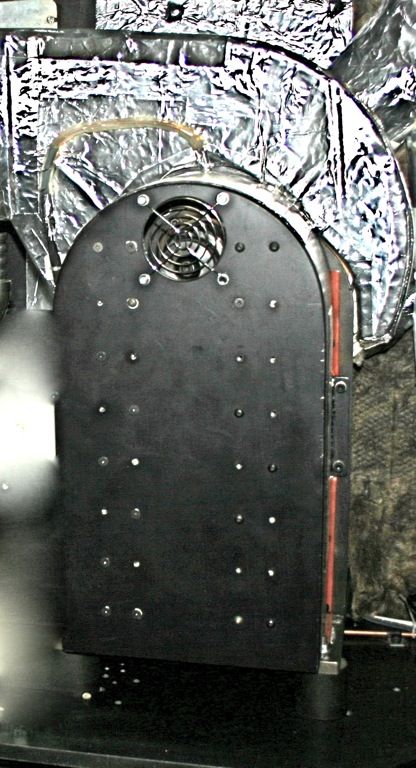
The current blower configuration is driven by a 3 Hp electrical motor connected to a three phase contactor based motor controller.  The Belt Guard Cover was removed for the photo.


Have a freshly roasted coffee and think of another application for the unit.