Pages

Showing posts with label high temperature air. Show all posts

Sunday, 8 April 2018

Experiment With Unintended Consequence

It has been a longtime between updates.  A NXT Roasters search and highly placed search links in Google which are mostly attributable to this blogger or blogspot site tells me that it is a good idea to "feed the beast".  OK, I know, The Filter Bubble has been playing on the car sound system for the past couple weeks which certainly warns about the pervasiveness of Googles' data collection and data sales.  I don't like it but there is no better strategy at hand for the moment.

The original intent was to move the content to   nxtroasters.com   but the great positioning of a search results for "Freshly roasted coffee" Edmonton led me to reconsider.

The insulation experiment was to be a "quick & dirty" evaluation of the insulation value of a potting additive.  A light bulb was buried 25 mm below the surface and switched on.  The curious thing was that the light was getting brighter and brighter.  It did not make sense that the heat of the lamp was melting the insulation so the test continued to gain some conclusive insight.  In addition to observing the tests, measurements were taken with an infrared thermometer.  That was failing miserably because the surface was getting progressively hotter at an increasing rate.

 The test lasted less than 15 minutes giving enough time for wild speculation.  I often find that it is possible to guess most of the forces that will come into play when running an experiment BUT it takes a clairvoyant to rank the influencing laws of physics that are at play in the experiment.

Though I have melted wine bottles in the past this experiment was to be done at a much lower temperature.  The small glass finger broke off from the stresses that were not dissipated during a long cool down period.  The detail was nevertheless quite impressive though, I digress.


The experiment was stopped when the light bulb was obviously close to the surface.  Apparently it had for some reason moved upwards 25 mm.  After the "test bed" cooled down it was time for the autopsy.  Digging out the bulb made it clear that only the top of the bulb had moved and that the experiment was stopped in time, though the light was still functional it would hardly fit in a trouble light cage.

In conclusion the radiated heat of the element and the rising hot gasses is quite high and of course the heated gasses pushed outwards the glass were it was softest.  If the method is used again the voltage will be lowered if it is still possible to find an incandescent lamp.

Sunday, 27 May 2012

High Pressure Hot Air Blower - Sound Containment.

NXT Roasters started with off-the-shelf centrifugal blowers of which we got to know the internals too intimately.  There were no guarantees that they would handle the temperature but the salesperson thought that we should get a reasonable MTBF (Mean Time Before Failure).  At the beginning, it was only 25 hours on average!

Virtually every manufacturer claimed that their composite bearings would work at the 250°C air temperature.  They must not have realized that 18,000 rpm was on the faster side which greatly reduced the life of their product.  Regular bearing races are too soft for this temperature and speed combination.  It takes very little Brinelling which creates a looseness that, at 18K rpm, allows  the shaft to vibrate and the bearings self destruct.  Note: the faster the speed the smaller the movement of the vibration, all other things being equal.  Bearings were repacked with high temperature grease that was measured out in milligrams.  Oil bathed bearings were tried.  Many iterations of new seals had to be turned because the stock items were intended for ambient temperatures. Most modifications succeeded in improving the longevity; 25 hrs, 55 hrs, 125 hrs, 225 hrs, 320 hrs, and after a couple years it was over 1300 hrs.  Not that great, but the client could live with it while we were working on a new blower that is featured in the other blog pages.  A specialized bearing manufacturer made a bearing for us that goes like the proverbial bunny.  All we have to do is pay them a lot of money.  The switch over to our blower design started two years ago.  We do not know the MTBF because of the lack of failures (no! no! that is good).

The aim of this blog is to discuss the blower noise that was generated by that first blower compared to what we have today.

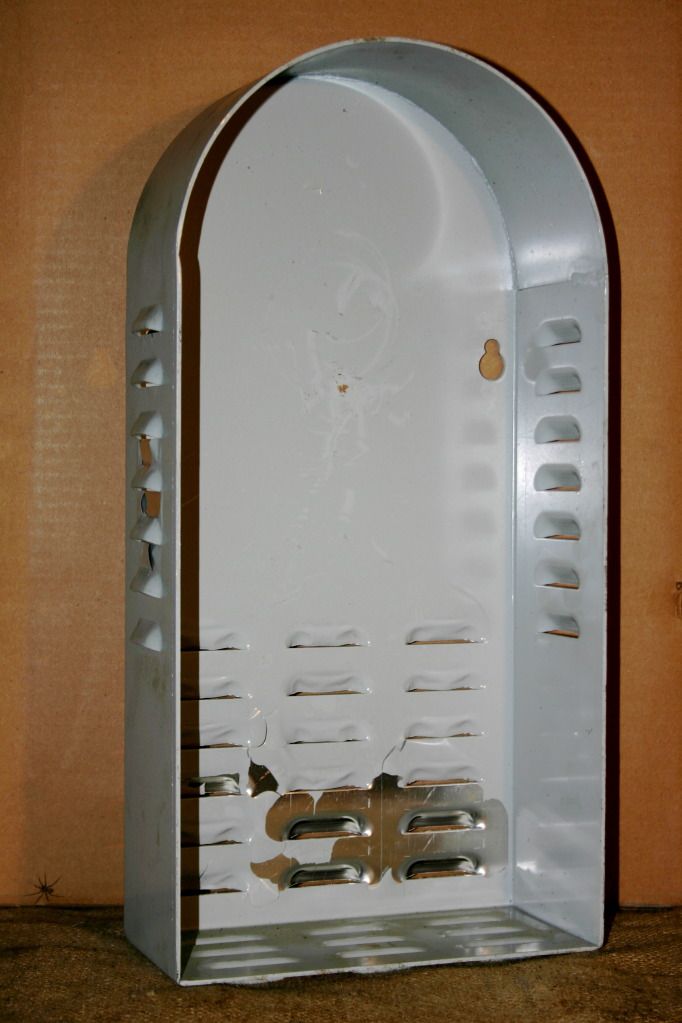
The off the shelf blower had an aluminum Belt Guard with a rubber lip that is not shown.  The guard resonated and the RoastMaster wore Ear Protectors.  Obviously the level of balance is greatly affected by the speed of the 6" Rotor.  If that manufacturer recognizes his cover they will realize that they have a problem and then see the solution.  Well, they have more problems than that which is why they do well to focus on ambient temperatures.  The paint has flaked which reflects badly on the quality of the work.

The output of our design was better than expected therefore we were able to reduce the speed.  To improve upon the case design, first, we increased the mass by making the Belt Guard from steel sheet.  It was better, or as they say, "Good, but not so good".


Heavier bar stock was screwed to the front and sides to increase the mass and reduce the amplitude of the resonance.  The roaster was delivered with that modification but the client still found the noise to be disturbing to the working environment.

In his youth the client was a hot rodder and had some experience with taming unwanted frequencies though I suspect that most of his energy went into making the engine louder.


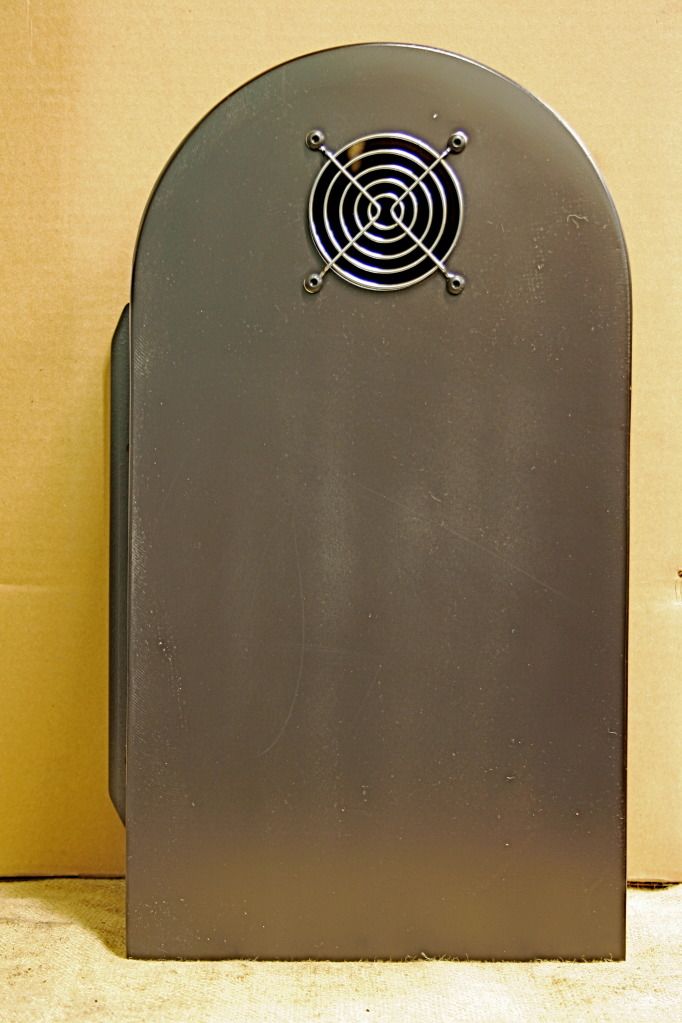
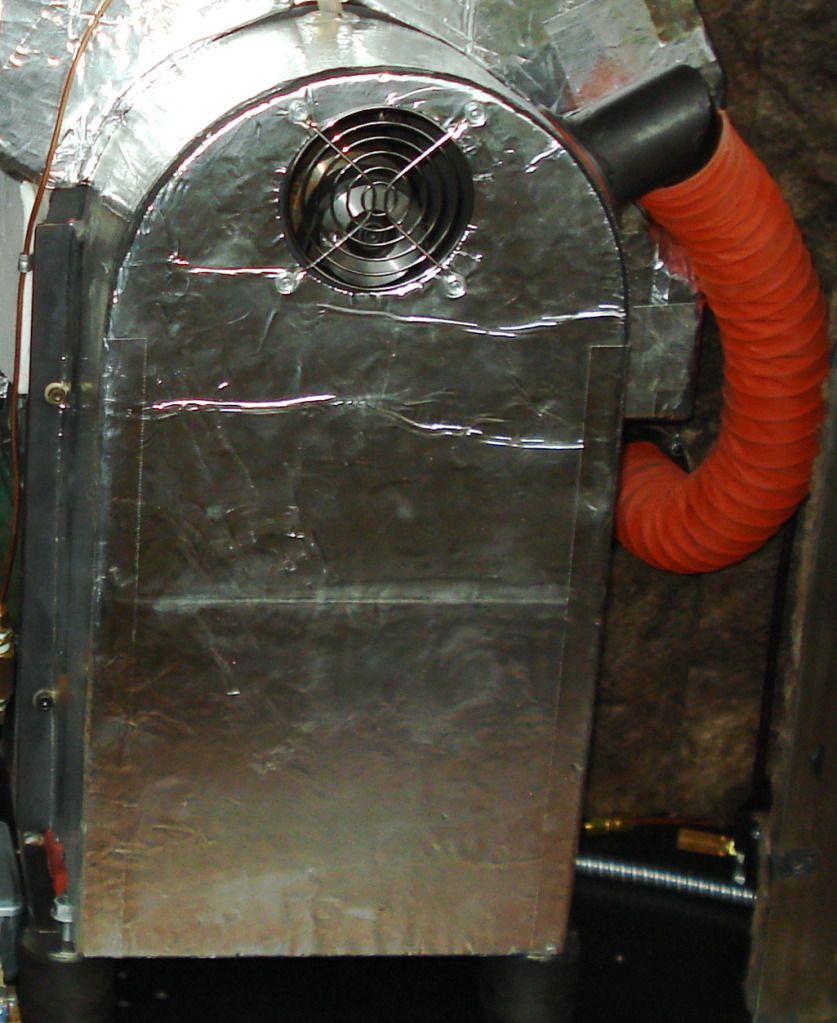
He covered the Roastaire Belt Guard with an aluminized Butyl Rubber sheet product.  It worked so well that the covering panels got the same treatment.  The "sound treatment" was so effective that CBC Radio did part of "On the Island"  Roastery Interview in front of the working Roastaire.

At the Eptech show Ampco's Rick Gagne discussed such a product that they carry.  It is not necessary to cover much more than 25% of the surface to stop the ringing but esthetics would take a beating with less than full coverage.  The alternative was to place strips on the interior walls but if the bond fails after a while then that will certainly lead to belt failure.   Perhaps we can revisit and find a conclusion after a year - with the help of a freshly roasted coffee.

Wednesday, 16 May 2012

The Importance of Timely Bean Cooling

Coffee is roasted by way of an exothermic reaction.  Without cooling, the beans would invariably burn because they reach the combustion point.   Roasting consistency can only be achieved through the timely introduction of the cooling air, which halts the roasting, to all the beans.

Drum roasting requires well developed skills because there is an extended lag between the moment the RoastMaster views the beans in the Bean Sampler and the termination of the exothermic reaction.  Several factors affect the degree of roast in a drum roaster; the air temperature is considerably higher than what is required for roasting  ("Espresso Coffee" R. Eggers writes the typical gas temperature of a drum roaster is 400° - 550°C. ), using a Bean Sampler is a relatively slow procedure, and the Cooling fans are relatively inefficient at moving air through several layers of beans.  Sucking the air downwards through the beans is also bad design because it packs beans together which greatly hinders air flow.  Many drum roasters spray water on the beans to cool them more quickly.  This is not good nor is it a measured cooling method.

The high temperature cooking analogy for beans hit by the super hot air is cooking Scrambled Eggs while using the stoves highest heat setting.   Even if they are continually mixed the heat is much higher than the egg can transmit to the interior.  The higher heat of the drum roaster still yields a relatively slow roast which highlights the inefficient transfer of energy.         For more details see "" and "Heating Coffee Beans to Roasting Temperature"

It is said that every second counts when "calling the roast" yet it takes many seconds to determine the degree of roast using a Bean Sampler especially if multiple readings have to be taken to follow the progression.

Many roasters are  stressed  by "calling the roast" even after they have been roasting for nine months.  The beans continue to roast during the dumping process and at the beginning of the air cooling cycle.  It is a common drum roasting technique that water is sprayed unto the beans to soak up heat.  It is impossible to accurately meter water coming from a garden hose.  Moisture is the #1 enemy of roasted coffee.  That lingering roast period means the drum RoastMaster must anticipate the roast quite a bit in advance of the required roast level.  An appropriate analogy is shooting ducks; the expert hunter aims for the position where the duck will be when the buckshot arrives.  The hunter must compensate for altitude, shell powder load, temperature, duck speed, and probably many other things that only a good hunter would know. For various reasons a lot of people have a problem with duck hunting (no ducks were harmed for this analogy).  The drum RoastMaster does not deal with less variables.

 To this end the NXT aka Roastaire uses a fluidized bed in which 240°C (adjustable as required) air is pushed, under pressure, through the beans.  This significantly increases the heat transferred to the entire batch of beans.  The beans have a limited ability to absorb the heat therefore the temperature gradient is more uniform throughout the batch with the forced air stream.  The added benefit is that the air flow continually churns the beans and carries away the chaff.

 The beans are cooled within the Roasting Chamber therefore "calling the roast" is done in real time.  The blast of cooling air also churns the beans so that there is even and rapid cooling.  The Roast Monitor communicates to the RoastMaster the roasting progress so that the Cooling Cycle is started at the proper moment.  It only takes a few seconds to cool the beans ( below 180°C according to R.Eggers and below 200°C according to Clarke & Macrae) to stop the roasting process.  After this 30 second Cool Mode the beans are transported to the Packaging Hopper while the NXT aka Roastaire loads nother batch freeing the RoastMaster to appreciate a freshly roasted coffee.

Sunday, 6 May 2012

High Temperature Pressure Gaskets

Several factors have increased the sealing challenges:
- temperature of 250ºC
- a system pressure of 1.1 psi when at roasting temperature
- Hot rolled flanges, not machined surfaces
- it must provide a barrier to very acrid smoke
- must resist suction
- must not out gas after burn in


Silicone sheet was touted to withstand the temperatures but over the years it crystallized and became brittle.  Some Teflons have a fairly high temperature ceiling but most are not nearly as capable and durable as the claims make them out to be.  We attempted to use high temperature ceramic paper but by itself it turned out to be too porous.


Out of curiosity we added a ring of packing material which would further compress the ceramic fibers but it still leaked.

It was possible to seal machined faces with High Temperature paste, some of which was "scaringly" smelly but most of the flanges are cut from hot rolled sheet material.  Better sealing capacity was required over a slightly wavy surface which is exacerbated by the weld to the tubing. 

Samples were cut from various materials that were either on the shelf or purchased.  The initial tests consisted of about four times as many gaskets as shown in the picture above.  A rather simple device was salvaged from the "steel pile" to pressurize the gaskets.  An arbitrary 1.5 atmospheres was selected as the testing pressure.  A soap mixture (sorry I forget the soap's brand-name  which pretty well ruins an endorsement contract) was used to dramatize the results for the camera.  The relative size of the bubbles is proportional to the size of the leak.

We looked for sealing ability especially after being subjected to repeated hot/cool cycles but also the material had to resist extrusion.

Many of the gaskets sealed until they were subjected to periods at 325°C a temperature that was also arbitrarily chosen to represent heat damage over an extended period.  Some people might complain that this is not a fair test.  It might not be but since their product is not named they will not know that they should complain about the procedures.

To the left is a Silicone product that is resistant to 350°C** (you have to search the fine print for the limiting conditions of only being flashed to the temperature on a Wednesday morning between 9:03 and 9:08 AM".  The extruding material created an even greater problem and it was discarded.


To the right is the outside view of the testing oven.  A PID Autonics temperature controller was added with a RTD sensor.  As mentioned above the Set Point is 325°C.  This little throw together may not win an award (it is from the same design studio as the testing jig to the left) but it keeps a stable temperature. 

Seal progress was made through the combination of various products but further work is required to determine the mixture and the method of application so that a uniform gasket is produced.
Personally - I prefer to drink freshly roasted coffee!

Friday, 4 May 2012

High Temperature Blower - Streamlined Inlet

This is another picture of the back of the High Temperature Blower which better shows the Inlet Flange.  In this version the Inlet is attached from inside of the case.   We are currently fabricating an updated version which will be fastened from the outside.

We are working on moulded ceramic insulation but those efforts are not yet worthy of a picture.  To date we have used Cerawool Blanket, ceramic hardboard, and aluminized high temperature fiberglass.  The process is tedious because of the numerous cuts (not all on the insulation) and the challenge to fitting the material to such a "curvy" object.

The unit pictured below has been working 8 hours at 250°C  nearly everyday.  The version, not using the Curved Inlet, is nearly two years old but is used more lightly, though at the same temperature.  A third unit has been used for testing purposes but will soon be used on a nearly daily basis.

A new Inlet Flex Connector has been fabricated and it will soon be tested.  The aim is keep the sound level as low as possible.  We have had a measure of success in accomplishing that.  Last week CBC Radio aired an interview that was done just in front of the working Roastaire.   Obviously more improvements will be implemented to make the work area as pleasant as possible.


Sunday, 22 April 2012

High Pressure Hot Air Blower - Add-ons

We have been reworking the Blower Inlet to improve the air flow and to make the design more compact.  The picture does not show that the Air Inlet has a circular flange but upcoming pictures will better demonstrate those features.

The Air Inlet can be rotated in 45° increments to accommodate various applications.


The Impeller is balanced to better than G.4 standard which is often referred to as gyroscopic level.  The Blower in our application is nevertheless mounted on 2" Rubber Mounts while the Inlet and Outlet are equipped with Flex Pipe to reduce the transmission of vibration from the turning components.  The Flex Pipe photo, above, is the Outlet Connector.  It is rather short due to a constrained space available. Where more space is available a longer Flex Connector can be supplied to add flexibility in the connection to off angle sources or destinations.

Previous attempts to use rolled Flexible Exhaust Pipe resulted in leakage especially at the flange connection.

The Blower output was higher than the expected requirement therefore we were able to reduce the Blower speed to approximately 12,500 rpm.  It is an approximate number due to memory rather than ability to measure accurately.  This modification significantly reduced the background noise generated within the workspace.  The vacuum pulling capacity is still fulfilling the requirements.

Thursday, 1 December 2011

High Temperature Industrial Blower

"Delivering the air with sufficient pressure at 240°C is a challenge that will be addressed in a later post.  Sufficient to say that no off the shelf hot air blowers were found, resulting in another product development." from the earlier post Heating Coffee Beans to Roasting Temperature.


Note:  A fan generally turns slower than a blower and therefore cannot reach the same pressure differential (inlet / outlet).  Fluidizing a batch of coffee requires more pressure than a fan delivers.


The easy, but wasteful, way to circulate hot air is to heat it after it passes through the blower.  This means that all the air has to be heated from ambient temperature to final temperature before it is vented while, if the air is recirculated, only the lost heat needs to be replaced.  The higher the temperature the more efficient the recirculation process becomes.  The advantage is not a few percentage points but rather tens of percentage points.


Our prime interest is roasting coffee which becomes much more efficient when the heated air is recirculated.  No off the shelf unit could be purchased.  Initially we tried then modified an existing name brand blower.  The MTBF (mean time before failures) improved from the initial few hours to over 1,500 hours but the maintenance and problems required a new solution.  The concept was simple but mastering the quirks was not always a linear process.


The designed temperature ceiling for the current model is 300°C but it has only been operated up to 270°C.  Since we did not find this to be an optimum roasting temperature the importance of establishing a higher operating threshold lost its urgency.  There is reason to believe that the upper temperature limit can be raised significantly.


Apart from surviving the high temperature the priority is to develop sufficient pressure to create a fluidized bed so that the coffee beans are evenly heated and continually mixed.  The pressure, while roasting, is just under 1 psi (approximately 6 kPa).  This is the flowing pressure not dead head pressure.  


The current blower configuration is driven by a 3 Hp electrical motor connected to a three phase contactor based motor controller.  The Belt Guard Cover was removed for the photo.


Have a freshly roasted coffee and think of another application for the unit.