Pages

Showing posts with label clean coffee. Show all posts

Friday, 15 June 2018

Question and Challenge What you Read

Company Blogs which very often are prone to being commercials should not be taken at face value or believed without reflection and sometimes, some research.  

One blogger (Blogger B) submitted a comment to a competitor " I read with interest your article entitled “Roasting with Hot Air: Benefits of Air Roasters” in your company’s newsletter."  He then proceeds to authoritatively expound on his own lack of knowledge in the roasting process.  The complication here is that the article, by Blogger A, he refers to has some rather glaring falsehoods i.e. "During the roasting process, the green coffee beans go through two major “pops” or “cracks” The first occurs when the internal temperature of the bean reaches approximately 356 degrees fahrenheit.".  The problem here is that no matter how long you boil water the temperature remains no higher than 212°F or 100°C.  The evaporative process greatly slows the bean from continually increasing in temperature until virtually all the moisture is evaporated.

It appears that Blogger B then proceeds to confuse degrees Fahrenheit with degrees Centigrade.  Blogger A writes "This hot air reaches temperatures of between 450 and 485 degrees fahrenheit" (232°C to 251°C) which is slightly above the 195°C to 205°C where the beans undergo an exothermic reaction.  A much lower temperature would essentially bake the beans.  Despite Blogger B's assertion that the air roaster is way too hot it is 100°C to 200°C less hot than a typical gas fired drum roaster.  It is true that the air roaster has a faster roast cycle but 4 minutes is absurd while 11 minutes is quite normal because the heat is quite evenly applied to all sides of the bean as they are churned in the fluidized bead.  Drum roasters only have fans which are incapable of pushing the air through the batch of beans therefore they only heat the top layer, the beans touching the drum, and beans that are falling off the rotating blades.  Blogger B's comments "Regardless of how heat is applied to the outside of the beans, heat reaches the insides of the beans by conduction. And, when it comes to heat conduction, coffee beans are not very good at it. Therefore the development of the insides of the beans always trails the development of the outsides of the beans."  Ironically he is presenting a case that favours the lower temperature of the air roaster (for the same reason you do not fry eggs on high settings).  This, however, is not true for the entire roasting session.  The heat moves inwards in the endothermic phase until the bean enters the exothermic phase.  

Think of lighting a damp piece of paper.  There is a reason why you can boil water, on a flame, inside a paper bag.  It is because the water seeping through the material prevents the paper from reaching its combustion point.  However remove that water, the paper will dry, and will then burst into flames.

Blogger B apparently does not realize that a full roast includes the exothermic phase where the heat is generated inside the bean.  See sectioned bean photo.  At this point the roasting process has to be monitored closely to "kill the roast" at the right time.  We prefer to cool within the Roasting Chamber because it is quicker and easily repeatable.  At this stage the transformation is very rapid therefore it is challenging to guess "the kill point" half a minute to a minute in advance because it takes that long to dump the beans never mind cool them.

Blogger B also comments on the single pass air roaster even though his system not only is a single pass air supply but it is roasting with the exhaust of the flame.  Imagine cooking supper with the car exhaust (maybe a propane powered vehicle is slightly more appropriate", it will certainly contribute all kinds of flavour.  Recirculating hot air cannot be done with a gas fired roaster because it starves the flame.  We do it in an electric roaster but it took five years to develop a blower that would survive the temperature.   Re-circulation improves the efficiency and makes it possible to significantly cut emissions.  

A gas fired Afterburner burns on average 3 times more gas than the roaster.  It decreases the visible smoke but really loads the exhaust with volatile organic compounds known as pollution.

Monday, 31 October 2016

NXT Fluidized Bed Roaster


AT NXT ROASTERS INC. WE USE THE WORD “INNOVATIVE” AS DISTINCT FROM “IMITATIVE” TO DESCRIBE OUR APPROACH TO DESIGN.


The NXT Roaster Design

We selected the fluidized bed technology for our roasting process because it provides even heat distribution, which results in product uniformity. The bean chaff is continually removed from the roasting chamber, eliminating the fire potential. 

To increase roaster efficiency we re-circulate hot air, reducing power consumption by about 75 percent.  To prevent tar deposits on roasted beans (from circulated air), we incorporate a primary afterburner, which burns away the smoke every time the air is reheated.  This arrangement increases the temperature of circulating air, which further reduces overall power consumption.

By circulating hot air in the roaster, we are open to the atmosphere only thirty seconds at the end of the roasting cycle when hot coffee beans are quenched by a blast of cool air, which is vented through our “SmokEater”.  (As an option, we deliver a roasting system that can vent to a room/space.) Loading green beans and unloading of roasted beans is done pneumatically.

The Roasting Process

Roasting requires considerable control of the process to continually achieve a given degree of roast.  In any chemical engineering, operation controls address heat requirements, actual heat balances in roasting, and various heat transfer factors to determine the time required for roasting.   Many of the variables are beyond the control, of the Roast Master but it is possible to tame the process and reliably produce consistent roasts.

The NXT Roaster and its Roasting Process Controls include features that optimize process parameters such that the quality of roasted coffee delivered remains on target and is unaffected by factors beyond one’s control.


Roaster Description

The NXT Fluidized Bed 3 kg Roaster, is now in it's third generation.  The complete system comprises of: process controls, a primary after-burner, a SmokEater, Heating and Roasting Chambers, a chaff removal Cyclone and a pneumatic control system to operate the valves, which automatically load green beans, and transport roasted beans to the Packaging Silo at the end of the roasting process.

 Sequence of Operation

The Roasting Chamber is a cylindrical vessel that has at the chamber’s bottom a Butterfly Valve with Perforated Gate. Air enters the roasting chamber and simultaneously fluidizes and heats, or cools the coffee beans.  When roasting is finished, a blast of ambient air stops the pyrolysis by cooling the beans to below 150º C (320º F). When this temperature is reached, the Butterfly Valve opens and discharges roasted beans through the Poppet Valve and beans are then pneumatically transported to a Packaging Silo.

After-Burner System

The roaster is equipped with a primary after-burner and a secondary “SmokEater”.  The primary after-burner scrubs the hot air of volatiles and tar before these enter the Roasting Chamber.

The “SmokEater” is used at the end of the roasting process to scrub the smoke-laden cooling air from the roasted beans before it is vented to the atmosphere.

Comparing NXT Roaster roasteries with  and Drum Roasters 


          NXT    Roaster
   
                 Drum               Roaster
Batch capacity
kg
3

5
Hourly output
kg
18

14.7
Average time per batch
min
10

20
Power consumption with afterburners
kW/hour
6

64.5
Air required for roasting  process
CFM
80

300
Exhaust gas vented per batch
Cubic Feet
40

6000
Exhaust gas vented per hour
Cubic Feet
240

18000


Annual output


Roasting days per year
300
16200

13230
Roasting hours per day
3


Power consumption
kWh
5400

58050
Exhaust gas vented to atmosphere Annually
Cubic Feet
216,000

        16,200,000


Friday, 27 March 2015

NXT Generation III Roaster

 
NXTRoasters Inc. is introducing its third generation advanced roasting system, which protects the purchaser’s investment, consumes the lowest possible energy, and exceed strictest air pollution standards Training time to roast is finished in days instead of months!  Its two-step roasted coffee bean cooling system provides outstanding repeatability of roast degree.

The System combines in a single unit:
  • A roasting and a heating chamber,
  • A chaff catcher,
  • Two afterburners,
  • Pneumatic conveyor to load green beans into roasting chamber, and transfer roasted beans to the packaging hopper

The NXT roaster is practically maintenance free, with threat of fire nonexistent!  Chaff from the air stream is separated prior air entering the heating chamber.  Roaster develops no tar deposits.


Specifications:

Batch capacity: 3 kg (green beans)
14.4 kg/Hr (roasted coffee beans)

Motor horsepower:
Main blower:                         2.2 kW
Pneumatic conveyor:             1.5 kW

Temperatures: Adjustable
Roasting: 235°C – 265°C

Heating:
Main heater:                           10 kW
Smoke Eater:                         1.5 kW  
Power consumption:      6.0 kW / Hr.
Including Built-in Afterburners!

Cycle Times: 8 – 12 minutes

Dimensions: 50” x 36” x 80

Sunday, 1 June 2014

Improving a Working Device

The picture links were removed because Photobucket decided to change the terms of usage in mid stream, so to say,  It is inconvenient for viewers but it is better to rid yourself of such people as soon as possible.  It is the attitude as much as the action.   We will try to repair that mess at NXTroasters.com

Unlike a painting a machine can be tuned to new requirements without changing its fundamental reason of being.

An interesting book A Culture of Improvement: Technology and the Western Millennium written by Robert Friedel in 2007, reviews the invention and evolution of many technologies.  He certainly highlights that many factors determine the course of an idea and that it is not always the best idea that dominates.  In school,  history classes often gave the impression that there were technological leaps whereas this informed text demonstrates that more often than not inventors or the mechanically inclined stood on the shoulders of others, so to say.  Often people that leaped too far did not succeed for various reasons; people did not accept such a change, existing materials did not have the required properties, incompatibility  with existing technology, competitors sidetracked "message" etc.  In essence many aspects of a development have to be "done right" to assure success.

It is baffling that the author chooses to dismiss the work of Tesla while he lauds laboratory managers who were often credited with the inventions of employees.  Design of the distribution infrastructure of alternating current is only stated not credited.  Marconi's patent applications were turned down for years because of Tesla's existing patents.  His patent was only granted when well connected wealthy business people employed their power to influence.  It is not too different to where a federal government  concluded that the tomato is a vegetable that is subject to import regulations.
Meanwhile back in the present the challenge is to find an acceptable balance between the best technology and the price of implementing the solution.  To improve the efficiency and greatly reduce pollution the roasting air is recirculated after purging it of nearly all the smoke.  Sounds simple enough but the reality of working in a hostile environment is challenging.  

Fluidizing the bed of coffee beans is essential to the proper mixing and even distribution of heat.  In the upgrade shown on the right the Blower bearings have a lubrication system to improve the Mean Time Before Failure which usually happened too soon at roasting temperatures.

The continual cleaning of the recirculated air means that the roaster does not emit smoke during the hot weather roasting process.  A distinction is made regarding the weather because when it is cooler steam is vented during the bean cooling process.  Such a roaster can be used in higher density areas thanks to the built in pollution controls.

Of course the great smell of coffee is not to be wasted therefore we vent the air used to cool the coffee beans straight to the street to act as an olfactory business sign.


Tuesday, 26 November 2013

Improving the Roasting Efficiency.

There are several aspects to be considered before a process can be implemented to improve a design.   Often it is possible to identify, let's say for the sake of discussion, 10 variables that will affect the process.  What is usually impossible to predict is the rank or the level of dominance of each variable unless you are really really really a gifted analyzer or clairvoyant.  Personally I resort to testing a few variables at a time to better understand their effect.  There will undoubtedly be surprises and inconsistencies when various variables are tested together but it is simpler to test in parts than in whole.

The testing results are unlikely to produce a clear graph such are joys of solving problems with multiple unknowns.  The results will give a better idea about the trade-offs that are required before a process can be adopted.  We maintained that coffee beans should be uniformly heated so that the chemical reactions that occur within the beans progress evenly.  It was also deemed important that the beans not be thermally overloaded.  To clarify; the bean has a certain capacity to transmit heat to its interior, if the heat applied is greater than what can be evenly distributed the exterior surface becomes much hotter  and creates a risk of scorching.  It is also for this reason that we roast at a relatively lower temperatures of 240°C to 250°C instead of ...  In "Espresso Coffee" R. Eggers writes the typical gas temperature of a drum roaster is 400° - 550°C.  The high temperature cooking analogy for beans hit by the super hot air is frying eggs while using the stoves highest heat setting.  Yet this fluidized bed roaster has a cycle time of less than 12 minutes versus up to 20 minutes in a drum roaster.   That  is Better Efficiency! 

The even distribution of heat is critical to preparing the beans for the roasting process.  We force heated air between the beans so that they are all heated, not just the outside layer.  There are small domestic roasters that also use air to create a fountain of beans.  It is quite dramatic but if the air flows through a narrow passageway then the remaining beans are not being heated until they gradually make it to the fountain.  Consequently, if you are looking for a home roaster look for one that pushes the air through all the beans.  Typically, the batch will move upwards as the beans are levitated by the flowing air then the air will break through and mix the beans.  The release of air pressure allows them to drop within the chamber but are then suspended again.  The air cushion has the added advantage of keeping the beans off the hot metal which often causes tipping which appear as little pieces of the exterior wall that leave behind a shallow cavity.

It is a simple concept that is regulated by many variables which turn it into a complex process.  

There is more to the efficiency quest than even thermal transfer and the recycling of air mentioned in the previous blog which leaves something to write about later.  Now it is time for an espresso.

Monday, 21 October 2013

Improving Roasting Technology

The picture links were removed because Photobucket decided to change the terms of usage in mid stream, so to say,  It is inconvenient for viewers but it is better to rid yourself of such people as soon as possible.  It is the attitude as much as the action.   We will try to repair that mess at NXTroasters.com

 The conventional approach appears to be - buy a roaster and endure its limitations.  Most conventional roaster owners spend more time developing marketing spin than improving their coffee roaster.   The deficiencies i.e. emissions are already the focus of some legislative bodies which require permits for roasters in their jurisdictions.   Oil burning engines, showing that blue smoke, are rarely seen on the road today yet many owners are complacent about roasting without pollution controls.

The roaster owners who are concerned that large plumes of smoke coming from their chimney are bad for their community image have purchased large gas fired after-burners that burn approximately three times more gas than the roaster itself.  Imagine if automobile pollution controls involved using three times more gasoline than the engine.

Rather than maintain the polluting status quo which may or may not have visible smoke, NXT Roasters Inc., have developed an alternative (branded the Roastaire in Canada) approach that uses the smoke generated as a source of roasting heat rather than expend large amounts of additional energy to thermally neutralize the smoke.   Both 15 Kg/hour concepts thermally treat the pollutants but one system uses a 400,000 to 700,000 BTU after-burner  to accomplish the task.

The first picture is of the main air passageway of a Roastaire after five years of full time roasting.  This revealing photo demonstrates the reason for their motto of "Clean Air Roasting".  This illustrates how efficient and effective the air is scrubbed clean as it is re-circulated during the roasting process.   This closed loop roasting process means that the air only has to be heated 20° to 40°C to return it to the roasting temperature.  Compare that to a single pass air supply that is continually heated from ambient temperature then sent to the chimney.   In "Espresso Coffee" R. Eggers writes the typical gas temperature of a drum roaster is 400° - 550°C.   What a wasteful process.


In comparison,
one drum roasters Maintenance Manual draws attention to the chimney,  "Even if residue build-ups do not exceed 1/8 inch (.3 cm) per year, clean system annually ".    The quotation is not properly cited nor acknowledged but I will do so if the manufacturer requests it.

They also have this picture of a drum roaster fan as a warning about the residue that coats some of their components.  Roast Magazine had the following quotation "It's not IF you're going to have a roaster fire, but WHEN."  Which roaster do you think requires the most maintenance?  Which type of roaster do you think was responsible for nearly 1,800 chimney fires in the USA in 2010?


Which roaster do you think roasted hundreds of pounds of green beans inside the exhibition hall of the last four annual 
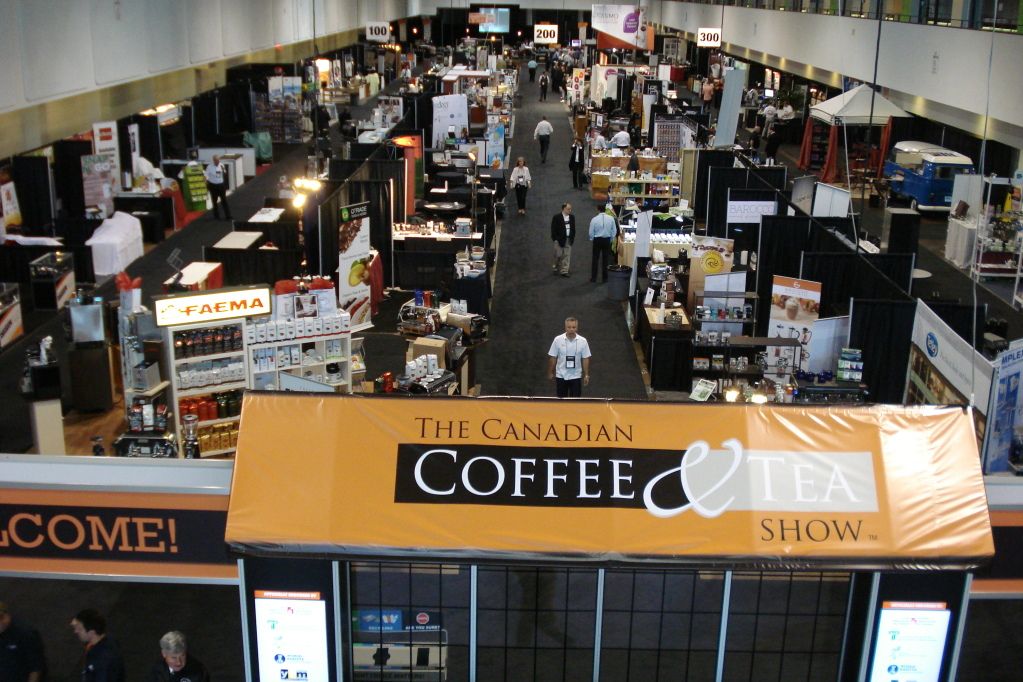
Canadian Coffee & Tea Shows?

Monday, 2 September 2013

French Press Grind

The picture links were removed because Photobucket decided to change the terms of usage in mid stream, so to say,  It is inconvenient for viewers but it is better to rid yourself of such people as soon as possible.  It is the attitude as much as the action.   We will try to repair that mess at NXTroasters.com

The French Press is a classical brewer that has garnered many comments.  Often it is used for comparisons when authors are promoting a new device.   Many instructions and guides have been published yet there are recurring themes i.e. the medium grind with less than boiling temperature water.


Of course these demonstrations use freshly roasted coffee, otherwise what is the point of drinking coffee.

To the left the coffee beans were ground with a blade type grinder which is unable to attain the finer grinds.  The larger particles initially contain a lot of CO2 hence the large amount of foam.  I hesitate to call this crema because it is a mixture of foam and coffee grounds.

The foam develops very quickly when the nearly boiling water (that point will be argued later) is poured into the container.  Much of that is likely due to the sudden rise in temperature which causes the CO2 and other gases to rapidly expand, in the bean, when immersed in the hot water.

In the first minutes much of the coffee grounds are buoyed by the foam therefore they do not absorb sufficient liquid to decant.


Relying on the Mesh Plunger to do the solids / liquid separation will not give satisfactory results. Either the screen will plug with grounds and/or the screen  will deflect inwards let the ground migrate to the top of the mesh.
The argument that the grind has to be sufficiently coarse that the Mesh Plunger is not plugged ignores the importance of the extraction.  I maintain that the purpose of the Mesh Plunger is to keep the decanted coffee grounds on the bottom of the container when the coffee is poured into the cups.  The aim is to drink coffee not to have coffee grounds for breakfast.

The picture to the right was taken 1.5 minutes later.  We can see that the liquid line has risen but that more water will have to be added if the vessel needs to be full.  Very likely it will have to be filled twice to prevent the foam from overflowing.

In this case the Mesh Plunger was depressed 4 minutes after pouring the water.


To the left is a coffee  ground with a  burr grinder using  a very fine setting which usually makes a variation of in the cup Turkish coffee.  The Mesh Plunger  only comes into play once the grounds have decanted.  The settling process is greatly accelerated by the fine grind which  yields grounds that have a high ratio of surface area to volume, hence a rapid and thorough extraction.

The crema, discerned from foam by the size of the gas bubbles, is similar to an espresso shot.  The brewing was well behaved therefore no water had to be added.  The brew decanted within seconds and was served sooner than the coarser grind.

The water was brought to a boil then poured over the coffee.  The comments about near boiling water scalding the beans must originate with manufacturers and distributors of machines that are unable to heat water over 85°C.  

The roasting chemical process is halted when the beans are cooled below approximately 150°C which hardly supports the claims that 90°C water scalds the beans.  On the contrary experiments show that the extraction is better developed at higher temperatures. 

Do your own experiments and note the observations.  If possible measure the temperature of the water for different extractions so that you can optimize your procedure.  In the meantime enjoy the fruits of your experiments.


Friday, 2 August 2013

Aeropress - Well Designed & Good Value

NXT Roasters has a Coffee and Aeropress bundle in limited quantities available at our Roastery.

The picture links were removed because Photobucket decided to change the terms of usage in mid stream, so to say,  It is inconvenient for viewers but it is better to rid yourself of such people as soon as possible.  It is the attitude as much as the action.

Freshly Roasted coffee enhances the Aeropress and vis versa.   This brewer does not require an electric brewer which may bring you better coffee since all decent kettles can boil water but not all electric brewers can deliver water at 90°C or higher.

The coffee is Freshly Roasted On-Site in a roaster of our design that has achieved new levels of consistency and pollution controls.  We are very proud of the taste.


 This is the Aeropress package which consists of the brewer and some handy accessories.  The previous blog links to two videos that demonstrate how to prepare coffee with this unit.

We have found that a fine grind enhances the extraction and quite likely gives you a better exercise.  It is difficult to establish if more calories are "burnt off" during the press.

There has been some controversy about paper filters versus perforated stainless steel discs in the domains of tasted and environment.  The stainless steel discs are nearly the price of the entire unit therefore we opted to make the bundle more affordable rather than a high end offer that would cause many to hesitate.

The coffee is less "strong" than an espresso but stronger than drip.  People adjust to their preference by adding water to the final brew and call it an Americano.

There is a challenge for those who appreciate the espresso because the Aeropress cannot be placed on a demi-tasse, well not yet.  Extracting a small volume into a large cup is not satisfactory so we must accept some limits.  However, before discounting the unit try what it does best which is a smaller cup of coffee.

Scoop:
The Scoop contains about 12 grams of coffee depending on how the coffee is scooped and packed.  The preparation of coffee depends more on consistency than an absolute number because other variables often compensate.  Just don't consistently use stale coffee - nothing compensates for that.


Funnel:
Might also be useful in the kitchen but in this case it helps assure that the caffeine deprived person gets most of the coffee grind inside the brewing chamber.

Stirrer:
This is used to be certain that the grind is dispersed in the hot water (remember the key word is hot).  The top has "wings" which prevent the blade from reaching the bottom and tearing the Paper Filter.  Of course this is a moot point when using the Inverted Method.


 Paper Filter:
This is placed inside the Cap to stop the sediment from reaching your cup.  The Paper Filter can be replaced by a stainless steel perforated disc for the people who feel that the paper absorbs essential oils that rightfully should be in their cup.


                          Brewing Chamber et al.:

                       Brewing Chamber                     Plunger                    Filter Cap                    Paper Filter

Inverted style brewing: This is mentioned first because everyone reads the instructions which illustrate the conventional way of using the brewer.

 Place the Plunger inside the Brewing Chamber. 

The internal volume increases approximately 60cc for every number the Plunger is pulled down. Therefore for those without a calculator:
- 60cc X 4 units X .03519 = 8.4 Canadian ounces
- 60cc X 4 units X .03381 = 8.1 US ounces

Unless you know all about compensating for the meniscus let's call it 8 ounces no matter where you live is the maximum capacity.

For a good Plunger seal keep both components vertical.  We cannot accept responsibility for spillage and "accidents" so we count on your diligence in keeping the hole towards the top.

Pour in the ground coffee without resting on the containers. Use one or two Scoops depending on the concentration your body requires.

Add the hot water without resting on the Brewing Chamber.

NOTE:  If there is unsteadiness or it is a challenge to manipulate these devices when they are full of scaldingly hot water you should resort to the conventional method.  Leave this method to the adventurous who thrive on danger.

Mix the water and coffee with the Stirrer to facilitate the extraction.

Place the Filter Paper in the Filter Cap (it will hold better if wet) and screw it to the top of the Brewing Chamber.  Hold the top of the Brewing Chamber.  Just remember the caveats - the liquid is very hot but bliss is now near.

Turn over the Aeropress and place it on a cup (please use a cup that is big enough for the contents). 

Push down on the Plunger.

It should now look something like the photo to the right.

Most people will now drink the coffee before extruding the Coffee Puck which is visible after removing the Filter Cap.

Wednesday, 31 July 2013

NXT Roasters has the Aeropress brewer

There are several brewing options available to the consumer but only a few have a "freshly roasted" priority mostly because they cannot deliver their coffee in a timely manner.

We searched  the Internet and wrote many emails to source the brewer that would give the best value to our customers.  The Aeropress is a well designed and built device which does not require an expensive electric brewer.

There are countless videos that address brewing with the Aeropress but most of them are not worth a mention because they exhort what I consider a faux pas i.e.
- advocating coffee is ok up to 40 days after roasting
- coffee should be used within 10 days of grinding
- a presenter attempts to explain how they defy the laws of physics by building unbelievable pressure
- another has concluded that the pressure pushing out the coffee is a vacuum
- for some reason some equate hot water with bitterness rather than improper roasting and staleness
Critical thinking is required on the Internet.  Yes, even now!

The Aeropress is versatile and has well designed accessories.  It can be used in two ways which are best explained by way of videos followed by pictures and explanations.

The KPCC Radio video demonstrates the Filter Down Method (photo to the left).  The temperature is important, it affects the extraction and should be above 90°C  (194°F).  The low temperature advocates probably make or sell machines that are unable to serve hot water.  The simplicity of the electric kettle is not to be scoffed at.  In an anecdotal observation a few tablespoons of coffee are placed on the bottom of your sink (especially appropriate experiment for those that have weeks old coffee but want to move to freshly roasted delights).  Allow some warm water to flow gently against the mini mound (gently - don't power wash it away) then increase the temperature.  You will find that the hot water dissolves while warm water agglomerates.

The Atomic Way video demonstrates the Inverted Method (photo below) which eliminates the dripping into the cup while mixing.


THE GRIND.  We often drink a modified Turkish style coffee where all the ingredients are mixed in the cup.  The finely ground coffee is only produced by a burr style grinder.  A finely ground coffee has a large surface area proportional to its volume which means a rapid extraction and that the grains soak up the water and decant quickly.  A fine grind like this creates a mini disaster in the gravity drained brewers because the water is poured onto the grind faster than the permeability allows it to go through, resulting in the dreaded overflow.  The plunger pressure in the Aeropress appears to circumvent that problem and yields a better extraction.

The end user has to determine the grind by experimentation.   A coarse grind will under extract and the water will be pushed through too quickly.


The Aeropress is then flipped over and placed
on a cup and the process continues as in the
conventional method.


FRESHNESS IS #1  The staling process starts after
roasting and begins to be detected at the end of one week.  Grinding the coffee accelerates the staling process.  The high surface area proportional to the content of a coffee ground means that it is more rapidly affected by oxygen and moisture.  Grind at the last minute.

More will follow shortly when the pictures of the various Aeropress components are taken or downloaded.

Sunday, 21 April 2013

Updating our Roastery


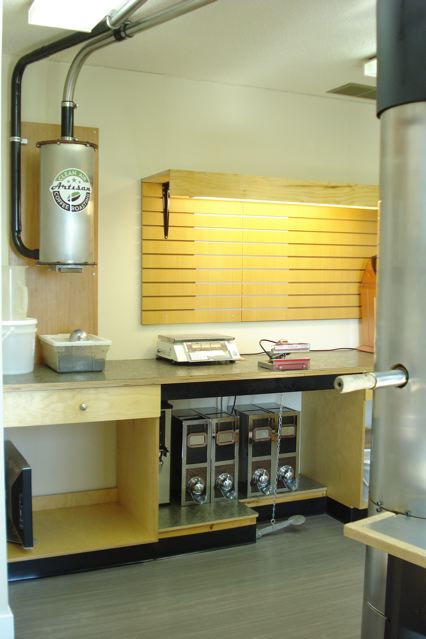
We updated our Roastery and reception area so that it would not be confused with the workshop.


It is slightly more pleasant to sit down at a Granite table for the morning Espresso than a work bench.  Well, there is the optional bar height table for the devotees of the fitness club.

The main goal is to show that our roaster does not require a lot of room.   There is a full glass door that encourages observation though a full glass wall would yield a better view of the Roasting Theatre.


The coffee roaster is the focal point and the "raison d'être".  The green beans are loaded into the counter height Bean Loader Hopper.  the design of which expresses our opinion about overhead bean loading.  After roasting the beans are pneumatically conveyed to the Packaging area which saves the Roast Master from picking up roasted coffee from the floor area.  It appears that drum roaster designers just do not think of ergonomics and Roast Master comfort. These are important considerations when the Roast Master does sessions of over 20 roasts.

The previous post has some pictures of some of our morning Espresso shots.  Not all shots are photographed since pictures are secondary to tasting.  That series of pictures were intended to illustrate the Crema obtained with Freshly Roasted coffee.

The Coffee Roaster is labelled "Roastaire" which is the distributor for NXT Roasters in Canada.  Check out their site for information about roasting, energy conversion efficiency, and roasting pollution controls.


Sunday, 24 March 2013

Maturing Espresso


The Espresso Transformation

Few people see the Espresso when it is all Crema.  You could be tricked into believing that it is an "air head".        Perhaps the roasting method deserves consideration but for now let's say that Freshly Roasted Coffee is the key which of course has to be supported by a well adjusted Espresso Machine.  This topic was also mentioned in a previous post.   The evolution is followed more closely this time. 
The first picture was taken 26 seconds into the extraction which continued for another two seconds.  The coffee is Cocamu (COCAMU is a coffee growers cooperative located in the district of Kirehe in the eastern province of Rwanda) roasted three days earlier.  The picture to the left was taken at the 4 second mark (after extraction).
 The Crema transforms into the liquid elixir.  The glorious description often depends on how badly the observer requires that first coffee.  The third photo, taken at the 11 second mark, is an indicator of the Crema to liquid conversion.  Unfortunately the graduated glass has rather coarse markings but they can be overcome by overlaying a grid on a printed picture.


Photo #4 is from the 20 second mark.  This is about when the client first sees the "magic potion".  Some may opine that a blend with a healthy Sumatran representation would be more appropriate.  That may be but it is outside the scope of this post.
 Photo #5, taken at the 34 second mark, is reasonably close to the typical serving time unless you yanked it out of the hands of the Barista which would only gain you three seconds and a frown. 
When are you served your Espresso?

Wednesday, 12 September 2012

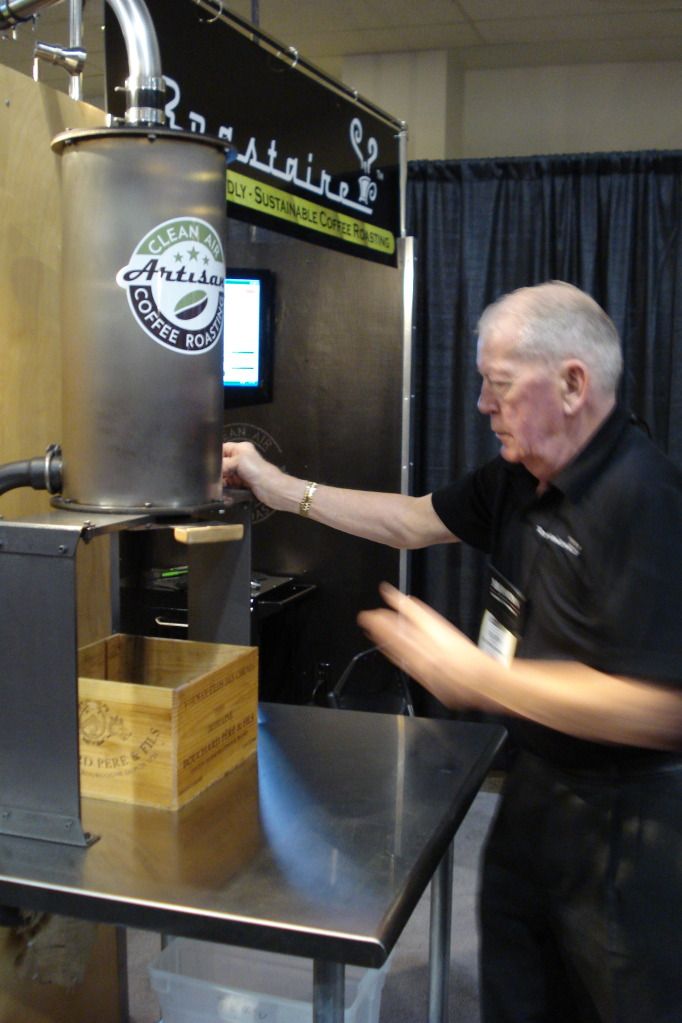
The Roastaire™ visits Canadian Coffee & Tea Show

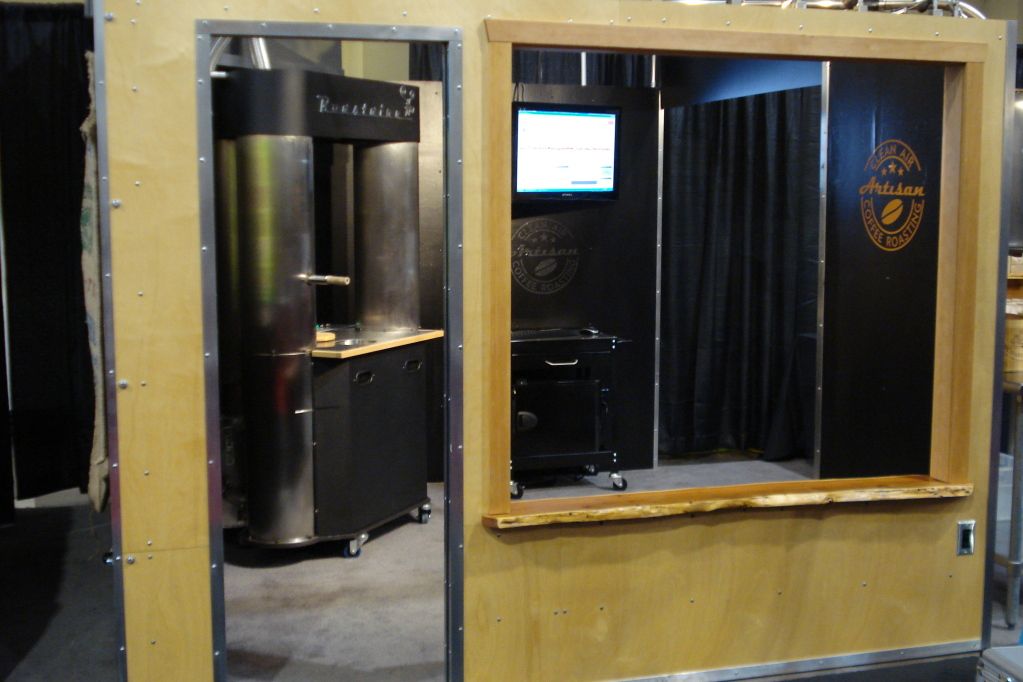
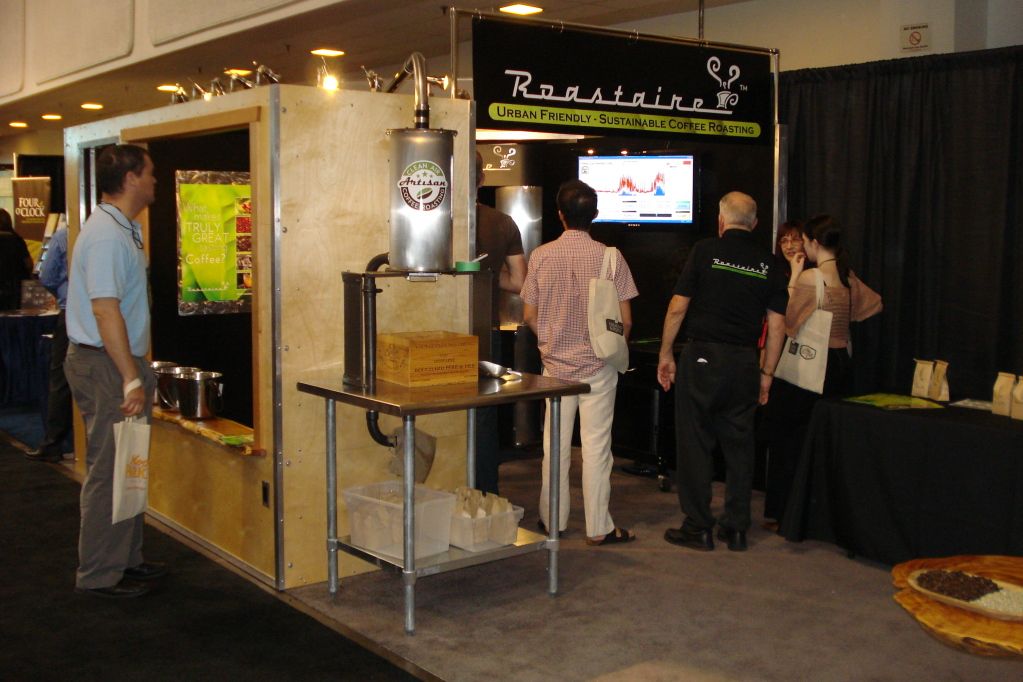
The Roastaire™ was the only functioning coffee roaster at the Canadian Coffee & Tea Show in Toronto.


The booth was near the Canadian Barista Championships but we were so busy that it was impossible to attend the skill demonstrations.

The Roastaire™ booth was designed to emulate the look of a Roastaire, coffee roaster, in a roastery café.  This layout favours the Theatre of Roasting which invites clients to observe the roasting process.  The clientele is able to pose questions to the Roastmaster without having the liability of having someone brush against hot surfaces.


The "roast is arrested" in the Roasting Chamber within seconds then is pneumatically conveyed to the Packaging Area where the beans are cooled for an additional three minutes while the Roastaire™ roasts another batch of beans.

In the picture below Mel, the Roastmaster, is removing the roasted beans from the Cooling Hopper (usually located in the packaging area).  The beans are cooled while another batch is roasting.  Many people dropped in to view the only functioning Coffee Roaster at the Coffee & Tea Show.


So very close now to a Freshly Roasted cup of coffee.

 The tiff to jpg conversion is off which emulates working before enjoying a Freshly Roasted cup of coffee.


After a Freshly Roasted cup of coffee everything just works better.   Even technology is receptive!

Friday, 7 September 2012

The Canadian Coffee & Tea Show

Well we are on our way to The Canadian Coffee & Tea Show in Toronto.


The trailer was packed with the Roastaire and the booth earlier in the week.  We expect to be roasting 3 kg batches in the conference hall without a chimney.  We did this at two earlier Canadian Coffee & Tea Shows in Toronto and Vancouver therefore it is not a new experience.  No other roaster appears to have the pollution controls to attempt this.

It will be a rather hectic event with many seminars, presentations, and discussions therefore there will most likely only be a recap after the show.  Perhaps Roastaire will be updating their blog during the event .

Saturday, 16 June 2012

Does Food Processing reduce nutrition ?

The distilled opinion is "the more you process the less the consumer receives".

For various reasons the most common vehicle for food delivery has been perverted.  Perhaps "Extra Virginity"  The Sublime and Scandalous World of Olive Oil by Tom Mueller shows that number cruncher executives care not a wit about their product, the well being of their customers, and sometimes the law.   People that are passionate about their product will bring the best to the customers sometimes at a great sacrifice.

Reuters had an article, a few days ago, to this effect: ...Coffee roasters quietly pulled off a financial feat last year that went unnoticed by most customers: Adding a higher proportion of cheaper, lower-grade robusta to their grounds as the price of top-notch arabica beans surged...  Not only are the beans cheaper but Robusta creates substantial crema even when it is stale therefore it gives a visual indicator of freshness even when it is not.

In response to "manufactured food", fresh food advocates are informing the public about  real food and real food costs.  
Living on the 100-Mile Diet , Revisiting Carrying Capacity:, Natural Foods, Organic Foods, etc.  It appears that greater "inputs" yield less nutrition.  Large marketing budgets promote convenience and "filling the belly" instead of feeding the body for growth and health.  Increased time spent transporting food means, as well, increased food degradation time.  Industry will typically attempt to address product appearance indicators that influence a consumer.  Unfortunately nutrition is sacrificed for the sake of colour and appearance.  

Before focusing on one product not usually covered in the fresh food debates I would like to add that I believe that the movement advocating quality food is gaining membership.  

My interest is the freshness of coffee.  Of course people do not live by freshness of coffee alone.  That would be silly because it mostly feeds the soul, the well being, the disposition, etc. Coffee has undergone a centralizing process which exchanged convenience for quality.  Bigger is not better if the product is lessened.  We have not developed Star Trek transporters to move food instantly to the consumer while maintaining the product integrity.  If the past is any indicator this futuristic device would further degrade the food.  Warehousing roasted coffee decreases the value to the end user.

I advocate that the coffee roaster, grinder, espresso machine, and brewer should be at the same site.  Nothing gives more credibility to the freshness of the product as when the consumer can observe the preparation.  To this end Jim Townley uses the moniker of "the Theatre of Roasting".  It encourages clients to learn about the process while it reinforces the artisanal qualities of freshness and caring preparation.  Small batch roasting, in our case 2 to 3 kg batches, allows the RoastMaster to roast the requirements of the next few days.  Most likely more than one batch of each coffee will be roasted but that is a choice based on sales.

This is a simple food preparation model even though it appears to counter the produced locally mantra of some of the above links.  We are not blessed with local coffee plantations but because the coffee bean is a seed which is designed by nature for long term storage it may be consumed at a distance from its origins with a certain proviso.  So where is the Freshness Challenge?  Roasting transforms the bean and creates havoc with the storage capability of the bean.  Roasted Coffee degrades quickly despite touted storage "solutions".   Freshly ground stale beans is an advertising distraction which offers no benefit to the consumer.  The analogy of the weak chain link is true.  Nothing will resurrect stale coffee, not milk, not sugar, not artificial liquids, not even a marketing campaign.  

For the best cup of coffee start with a freshly roasted high mountain grown Arabica bean that is ground just before brewing.