Pages

Showing posts with label coffee packaging. Show all posts

Friday, 21 September 2018

Extending Freshly Roasted Coffee Lifespan

The main enemies of Freshly Roasted Coffee are Time, Oxygen, and Moisture.

A solution has been presented to the public that is more beneficial to the manufacturers than to the end user.

Background info:

Immediately after roasting the coffee beans begin to emit carbon dioxide in sufficient volume and pressure to burst a hermetically sealed bag.  Some roasters opted to degas the beans for one to three days to alleviate this problem while manufacturers came up with a new product, the valve.
http://nxt-roasters.blogspot.com/2011/12/do-coffee-bag-valves-leak-1.html
http://nxt-roasters.blogspot.com/2012/05/revisited.html

Valve Limitation - as currently used:
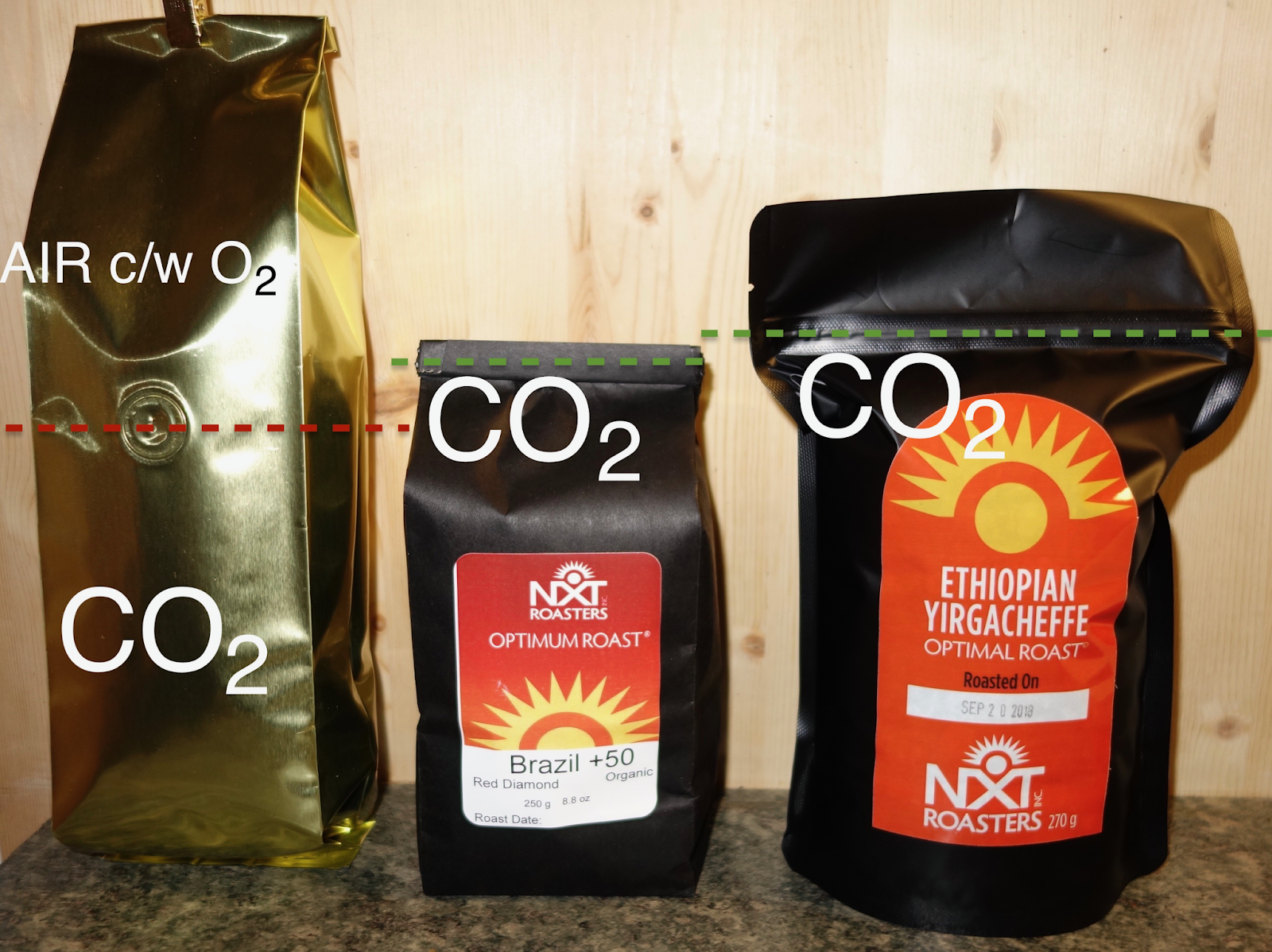
It is possible that the valve is a single solution to burst bags when with a little more thought it could have also help to extend the freshness of coffee beans.

The CO2 is roughly 50% denser than the air we breathe, which consists of about 21% Oxygen.  This means when packaged, on the first day, beans emit CO2 that gas drops to the lowest level in the container and pushes the existing air upwards.  Surrounded the Freshly Roasted Coffee Beans with CO2 retards the oxidation process, hence, slows down the staling process.  How well and for how long the freshness is preserved is much more difficult to assess and beyond the limits of a one page blog entry.  For arguments sake I say it gives an extra week.  This process exists for the beans that are continually bathed in CO2 which is not the case when there is a venting valve.  As shown in the photo the CO2 will rise up to the valve then exit rather than flush out the air above the valve.  That means that, as the photo illustrates, that only 2/3 of the beans are in CO2 providing the bag is not tilted.  If the bag was laid on it back so that the valve was at the high point of the bag then there would be a different outcome but bags are not stored, shipped, or displayed laying down.  That scenario would be improved by moving the valve upwards to minimize the amount of air in the bag.

Using a valve does allow the roaster to degas in the heat sealed bag which offers the consumers the security and assurance that the bag contents have not been tampered with.

Alternatives:

The NXT solution to this dilemma is to use a ziplock bag which presents more flexible packaging options.  First, all the oxygenated air is pushed out of the bag when the bag is kept upright.  We recommend that people scoop out the beans for immediate consumption rather than pour them out which would drain much of the CO2.  Leaving CO2 to protect the beans extends the freshness.  Our bags are in a supervised area and they are not opened after closing but for added security, where bags are placed in a public area and a heat seal is required a simple pin prick between the ziplock and the heat seal which will prevent bursting the bag and allow a flushing of the oxygenated air.

NXT advocates degassing in the bag to take advantage of the emitted CO2 to extend the freshness of the coffee beans.

We have a Carbon Dioxide high pressure tank and a regulator to test the effect of giving a shot of CO2 to a bag of beans that are more than a day old when outgassing has mostly ceased.

It might mean some beans will be destroyed with water to determine the volume of the interstitial spaces which will indicate how much CO2 has to be injected to bathe all the beans in a protective gas.

To Do:

Test to determine how CO2 will enhance the life of ground coffee.

Monday, 21 May 2012

Vented Bags Revisited

The original blog of  Do Coffee Bags "Lock in the Flavour" ?   and Packaging Optimism gathered the most visits.  Does this mean that those people believe or want to believe that there is a magical way to preserve roasted coffee.  Well, apparently there is but it involves a -273°C or -459°F refrigerator.  That is no ordinary ice box.  Even then the degrading chemical reaction is only slowed down not stopped.


This little valve is, in my view, good engineering. The object can be mass produced cheaply and there is much more to the design than the average coffee drinker pays attention to. Notice the fiber filter which is backed by a plastic frame to give it strength. I assume that the purpose is to keep coffee particles away from the sealing lip but then it may also keep small life forms out of the bag.
Interestingly, the valve is required to preserve the bag rather than the coffee.  In the days after roasting the coffee beans will produce enough CO2 to burst the bag ( it depends on the bag material but I found that 250 to 350 grams was the limit for un-vented vacuum packed bags).  I suspect that the "longevity improving" aspect was more an invention of the marketing department than an engineering criteria. 

A marginal improvement in longevity might be possible with vacuum packed vented bags.  If the bags are packed within the hour after roasting they will need the valve even if they are vacuum packed.  The porosity of the bean is relatively low and it takes time for the CO2  to migrate from the bean.  Without a vent even vacuum packed packages look like overstuffed pillows.  Obviously that would not allow efficient boxing of the bags.  

Rather than believe that the bag was not kept in a warehouse for months and or spending days in truck trailers I prefer to buy from a local roastery or from Fresh Cup because they expedite the order on the day it is roasted.  Oh well, that offer is only for Canada which means that more than Alaska and Hawaii are hit by the shipping restriction.

Thursday, 10 May 2012

Carbon reduction or is it just "horse trading"*

There is even more to the story !
The unfortunate part about marketing claims vs. true development and technical improvements is that the marketing claims focus on changing perception rather improving the equipment.  It is the easy way out which in this case does nothing for the local air quality if someone planted trees hundreds of kilometres away.  The article cited does not mention that it took a decade to reduce the Roastaire emissions to a small fraction of conventional roasters.  In the process the energy required to roast was reduced to about 1/6 of a conventional coffee roaster.

The Roastaire™ was designed for the Café environment where people can observe the roasting process.  We refer to that as the "theatre of roasting".  The roaster is a compact unit that includes Chaff Cyclone, SmokEater™ (pollution controls), Pneumatic Bean Conveyor, and a Packaging Silo.  The roaster is approximately 6.5 feet high.  The roaster is controlled by a computer based Roast Monitor which  also configures the roaster, through the use of pneumatic valves, for the various modes in the roasting process.

More information is given in the post "Sustainable Design Follows Function"  such as the attention given to ergonomics.  An obvious example is the placement of the Loading Hopper which is placed at counter height rather than above the RoastMasters head.  The roasted beans are quickly cooled internally so that the smoke can be neutralized before it is vented.  The aim has been to improve and streamline the roasting session.  Cooling with a sustained blast of cool air within the Roasting Chamber means that the RoastMaster does not need to compensate for the roasting that takes place between the time of the decision and the moment that the beans are lowered below their combustion point.  The sum of the drum RoastMaster's reaction time, Roasting Chamber evacuation time, plus the actual time it takes to sufficiently cool the beans to stop the roasting process means that the RoastMaster must anticipate the final roast a minute or more in advance.  In drum roasting the process is analogous to "duck hunting";  if the hunter aims for the duck they will miss.  The hunter must shoot ahead of the duck by a distance that varies with variables such as height and speed of the duck.   Similarly skill and much training is required to anticipate the time required to get the correct drum roast.  The drum concept does not make it easier for the RoastMaster but that analysis will have to wait.
To help improve the efficiency of the Roastery the roasted beans are pneumatically conveyed to the packaging area where they can be weighed and placed directly in the bins. 


The Packaging Hopper can be mounted to the wall or placed on a table or counter.  It can be placed directly over the scale if the RoastMaster finds it more convenient.

Café owners that buy roasted beans see " FRESH Coffee! " post are simply paying for someone else's roaster without getting all the benefits.


* Horse trading is an idiom used to describe negotiations, especially where these are difficult and involve a lot of compromise.

Saturday, 10 December 2011

Packaging - Optimism


Packaging attempts to circumvent or overcome the stalling of coffee.   It does not keep old coffee fresh though it is claimed that it slows down the staling for an unbelievably long time.  Most of the advantages are perceived by the consumer based on sizeable advertising programs.  Though it appears that a valve, at least under ideal conditions, lets little air into the bag.  Well, less than the bag would have had when it was sealed.  Vacuum sealing reduces the air and moisture in the bags but that requires more equipment and time.  The valve does let out the CO2 but it also lets the aroma escape.  The vented bag will have a lower internal pressure, than say a metal container.  The lower pressure exacerbates the loss of volatile compounds which are the reason for that olfactory experience.  To circumvent that loss some companies replace the vent by Oxygen and/or CO2 scavengers.

"Espresso Coffee" by Illy & Viani states that the spoilage rate increases by 7 fold with every 10°C increase in temperature.  Unfortunately there is no mention if that calculation starts at absolute zero. It is an unmeasured and uncontrolled variable that very much affects the coffee experience.


A lot of money was invested into the marketing of various types of packages because the business model of central roasters depends on convincing customers that coffee that is more than a year old still has the freshness of yesterday's roast.

I view the valve as a packaging solution which does not contribute much to maintaining the roasted bean's fresh taste.  My only acceptable solution is to buy the freshest coffee from a local roaster.  An exception, in Canada, is Freshcup.ca which ships, via expedited post, the day the coffee is roasted.  On several occasions I have sent some much appreciated coffee gifts.  It could be perceived that I am biased because they use our roaster though I maintain that the long relationship has allowed me to observe closely the organization and witness their commitment to delivering the freshest great tasting organic coffee to their customers.

Wednesday, 7 December 2011

Do Coffee Bags "Lock in the Flavour" ?

The test will be posted in a few phases, perhaps more if there are leakage problems around the valve, such as the testing apparatus, results, and implications of the findings.
To the left is the inside part of a Check Valve that is incorporated on many coffee bags.  It permits the coffee roaster to bag the coffee very soon after roasting.

For those who may not be aware, freshly roasted coffee releases CO2 (Carbon Dioxide) in the days that follow the roasting session.  The pressure is sufficient to burst bags.  Initially the coffee was packaged in various media such as paper and consequently not hermetically sealed.  Some roasters "aged" the coffee and packaged it several days later when the CO2 had been dissipated.  The Check Valve is a more recent development which allows the CO2 to escape without splitting the bag.  There could be an advantage to this method if the valve is placed such that when the filled bag is stored the valve is the highest point of the bag.  CO2 is heavier than air therefore it will gravitate to the bottom of the bag forcing out the lighter air first.  Technically it is possible that all the oxygen could be forced out in this way.

The purpose of this test is to verify the premise that the Check Valves are more important to the marketing campaigns than to preserve coffee or "locking in the flavour".  Does a valve costing about a penny do the work of precision devices?  If the bag is not hermetically sealed the constantly changing atmospheric pressure will make the bag "breathe" which will introduce oxygen to the contents. 

The apparatus is quite simple and will involve measuring a Control to be certain that the test equipment is leak proof.  The upper left barbed fitting will be connected to a vacuum pump then the valve will be closed.  The Needle Valve is rated at 6,000 psi therefore it should not be harmed by this test.  The vacuum will be measured by water movement in a U tube.  The picture shows two devices that can be sealed to the bag.  The preferred socket is the one to the right which is machined with steps that will fit just over the valve so that it is not distorted or twisted.  This is better than in reality where the valve is pushed by the beans.  Several different sealing materials may be required before a good seal is established between the socket and the plastic check valve.

Plotting the height of the water column should be a good indicator of the leakage rate, if present.

Marketing departments are notorious for making unsubstantiated claims.  Rather than admit error the trend is to spend more money to embellish their fabrication.  Let's check the foundation to the claims.

Freshly roasted coffee does its own marketing.

                                           -------------------------------------------------


The first phase is Testing the bag's Venting Valve in Ideal Conditions.  


The venting valve was cut from a new bag (unfortunately that is a sacrificial test) but a lots of material was left on either side of the valve.  The valve was then mounted to the socket and sealed with a thin layer of silicone adhesive on the periphery.  The adhesive cured overnight. 
A slight vacuum ( 33.5" H2O or 851 mm of H2O) was drawn against the valve.  That is P1-P2 = 67" H2O (1.702 m) in the U tube manometer.

After an hour the water column was 1" (25.4 mm) lower which represents 1.81 cc of water.

After an 2:45 hours the water column was 1.5" (38 mm) lower which represents .165 in3  (2.7 cc) of water.

After an 6:00 hours the water column was 3" (76.2 mm) lower which represents .33 in3  (5.43 cc) of water.

After an 47:00 hours the water column was 9.25" (235 mm) lower which represents 1.022 in3  (16.74 cc) of water.

After an 70:00 hours the water column was 9.88" (251 mm) lower which represents 1.091 in3  (17.89 cc) of water.

Granted the Control Run has not been done.  Under ideal conditions it is little leakage but then it is over a short period.  The pressure, however, is considerably higher than the barometric fluctuations.  So far it can be established that it is not a hermetic seal.  To reflect the packaging role the pressure may have to be reduced, the time period increased, and the valve will have to be pushed against beans rather than held flat in a socket.

                                                 --------------------------
More on a newer blogs Vented Bags Revisited  and Packaging - Optimism