Pages

Showing posts with label sustainable roasting. Show all posts

Sunday, 15 April 2018

NXT Freshly Roasted Coffee vs Marketing Spin

There are a lot of excuses that are generated by the untimely delivery of coffee.  It appears that more effort is made to make up a fanciful story than to deliver freshly roasted coffee.

It is easier to examine process where companies will pronounce certain rules as if they were laws rather than an opinion or marketing ploy.  Grocery stores have convinced the government agencies that coffee is not a perishable or that its shelf life is greater than 18 months.  Why?  I would say that it fits in with their warehousing distribution model rather than their concern for delivering a fresh product.  The economy brand coffee purveyors notably dance around their weakness which is usually centered on freshness.  Most often there is a clash of goals between their purchasing based on price and their desire to sell at a high end price.  Obviously that is not the message they wish to convey so this is where the marketing dance is conjured.
The question "Is your coffee freshly roasted"?  The typical answers:
- we grind it just before brewing
- we brew on the hour
- we serve our coffee when it is at its prime
- our coffee is ground to a different level
- we have a special relationship with our roaster even if it is 500 miles away
- our roaster uses the best beans
In all cases the question is not answered because it is important to circumvent that limitation by presenting a subjective answer (usually missing the point of the question).  It is a chink in their armour that appears to only be visible to those who are passionate about coffee, inquisitive about the claims, and discriminating purchasers.

On that note, a client must judge if coffee beans must degas for one to 5 days.  The beans will degas regardless because the pressure is sufficient to burst a tightly sealed plastic bag.  I prefer to package ASAP after roasting, letting the beans degas in the bag.  To that end we keep the bags closed, but not sealed, and upright so that the carbon dioxide* (which is more dense and heavier than air) will displace the air by pushing it our the top of the bag.  The client is able to decide when to drink the freshly roasted coffee. We have not found a need for valves.  If the valve is kept as the highest point of the bag the interstitial spaces will also be occupied by carbon dioxide instead of oxygen rich air.

Unfortunately most valves are located around the mid-line which means only half of the bag is purged of oxygen.  To purge the air from the valve equipped bag the bag has to be laid down so that the valve is the highest point in the bag.  Emptying the bag requires the same consideration to preserve the CO2 level, while keeping the bag upright scoop out the beans rather than pouring out the beans along with the CO2.  Pouring the entire bag into the grinder will pour in the CO2 as well but I suspect that the CO2 will drain out the bottom of the hopper, through the burrs, and out of the grinder.  That illustrates a grinder limitation which should be examined in another post.

*  Carbon dioxide is a colorless gas with a density about 60% higher than that of dry air. Carbon dioxide consists of a carbon atom double bonded to two oxygen atoms.  Dry ice is the solid version of CO2.  The wafted vapour that we see above the dry ice exposed to room air is actually moisture from the air that has condensed due to the low temperature near the dry ice.

Sunday, 1 June 2014

Improving a Working Device

The picture links were removed because Photobucket decided to change the terms of usage in mid stream, so to say,  It is inconvenient for viewers but it is better to rid yourself of such people as soon as possible.  It is the attitude as much as the action.   We will try to repair that mess at NXTroasters.com

Unlike a painting a machine can be tuned to new requirements without changing its fundamental reason of being.

An interesting book A Culture of Improvement: Technology and the Western Millennium written by Robert Friedel in 2007, reviews the invention and evolution of many technologies.  He certainly highlights that many factors determine the course of an idea and that it is not always the best idea that dominates.  In school,  history classes often gave the impression that there were technological leaps whereas this informed text demonstrates that more often than not inventors or the mechanically inclined stood on the shoulders of others, so to say.  Often people that leaped too far did not succeed for various reasons; people did not accept such a change, existing materials did not have the required properties, incompatibility  with existing technology, competitors sidetracked "message" etc.  In essence many aspects of a development have to be "done right" to assure success.

It is baffling that the author chooses to dismiss the work of Tesla while he lauds laboratory managers who were often credited with the inventions of employees.  Design of the distribution infrastructure of alternating current is only stated not credited.  Marconi's patent applications were turned down for years because of Tesla's existing patents.  His patent was only granted when well connected wealthy business people employed their power to influence.  It is not too different to where a federal government  concluded that the tomato is a vegetable that is subject to import regulations.
Meanwhile back in the present the challenge is to find an acceptable balance between the best technology and the price of implementing the solution.  To improve the efficiency and greatly reduce pollution the roasting air is recirculated after purging it of nearly all the smoke.  Sounds simple enough but the reality of working in a hostile environment is challenging.  

Fluidizing the bed of coffee beans is essential to the proper mixing and even distribution of heat.  In the upgrade shown on the right the Blower bearings have a lubrication system to improve the Mean Time Before Failure which usually happened too soon at roasting temperatures.

The continual cleaning of the recirculated air means that the roaster does not emit smoke during the hot weather roasting process.  A distinction is made regarding the weather because when it is cooler steam is vented during the bean cooling process.  Such a roaster can be used in higher density areas thanks to the built in pollution controls.

Of course the great smell of coffee is not to be wasted therefore we vent the air used to cool the coffee beans straight to the street to act as an olfactory business sign.


Friday, 2 August 2013

Aeropress - Well Designed & Good Value

NXT Roasters has a Coffee and Aeropress bundle in limited quantities available at our Roastery.

The picture links were removed because Photobucket decided to change the terms of usage in mid stream, so to say,  It is inconvenient for viewers but it is better to rid yourself of such people as soon as possible.  It is the attitude as much as the action.

Freshly Roasted coffee enhances the Aeropress and vis versa.   This brewer does not require an electric brewer which may bring you better coffee since all decent kettles can boil water but not all electric brewers can deliver water at 90°C or higher.

The coffee is Freshly Roasted On-Site in a roaster of our design that has achieved new levels of consistency and pollution controls.  We are very proud of the taste.


 This is the Aeropress package which consists of the brewer and some handy accessories.  The previous blog links to two videos that demonstrate how to prepare coffee with this unit.

We have found that a fine grind enhances the extraction and quite likely gives you a better exercise.  It is difficult to establish if more calories are "burnt off" during the press.

There has been some controversy about paper filters versus perforated stainless steel discs in the domains of tasted and environment.  The stainless steel discs are nearly the price of the entire unit therefore we opted to make the bundle more affordable rather than a high end offer that would cause many to hesitate.

The coffee is less "strong" than an espresso but stronger than drip.  People adjust to their preference by adding water to the final brew and call it an Americano.

There is a challenge for those who appreciate the espresso because the Aeropress cannot be placed on a demi-tasse, well not yet.  Extracting a small volume into a large cup is not satisfactory so we must accept some limits.  However, before discounting the unit try what it does best which is a smaller cup of coffee.

Scoop:
The Scoop contains about 12 grams of coffee depending on how the coffee is scooped and packed.  The preparation of coffee depends more on consistency than an absolute number because other variables often compensate.  Just don't consistently use stale coffee - nothing compensates for that.


Funnel:
Might also be useful in the kitchen but in this case it helps assure that the caffeine deprived person gets most of the coffee grind inside the brewing chamber.

Stirrer:
This is used to be certain that the grind is dispersed in the hot water (remember the key word is hot).  The top has "wings" which prevent the blade from reaching the bottom and tearing the Paper Filter.  Of course this is a moot point when using the Inverted Method.


 Paper Filter:
This is placed inside the Cap to stop the sediment from reaching your cup.  The Paper Filter can be replaced by a stainless steel perforated disc for the people who feel that the paper absorbs essential oils that rightfully should be in their cup.


                          Brewing Chamber et al.:

                       Brewing Chamber                     Plunger                    Filter Cap                    Paper Filter

Inverted style brewing: This is mentioned first because everyone reads the instructions which illustrate the conventional way of using the brewer.

 Place the Plunger inside the Brewing Chamber. 

The internal volume increases approximately 60cc for every number the Plunger is pulled down. Therefore for those without a calculator:
- 60cc X 4 units X .03519 = 8.4 Canadian ounces
- 60cc X 4 units X .03381 = 8.1 US ounces

Unless you know all about compensating for the meniscus let's call it 8 ounces no matter where you live is the maximum capacity.

For a good Plunger seal keep both components vertical.  We cannot accept responsibility for spillage and "accidents" so we count on your diligence in keeping the hole towards the top.

Pour in the ground coffee without resting on the containers. Use one or two Scoops depending on the concentration your body requires.

Add the hot water without resting on the Brewing Chamber.

NOTE:  If there is unsteadiness or it is a challenge to manipulate these devices when they are full of scaldingly hot water you should resort to the conventional method.  Leave this method to the adventurous who thrive on danger.

Mix the water and coffee with the Stirrer to facilitate the extraction.

Place the Filter Paper in the Filter Cap (it will hold better if wet) and screw it to the top of the Brewing Chamber.  Hold the top of the Brewing Chamber.  Just remember the caveats - the liquid is very hot but bliss is now near.

Turn over the Aeropress and place it on a cup (please use a cup that is big enough for the contents). 

Push down on the Plunger.

It should now look something like the photo to the right.

Most people will now drink the coffee before extruding the Coffee Puck which is visible after removing the Filter Cap.

Saturday, 16 March 2013

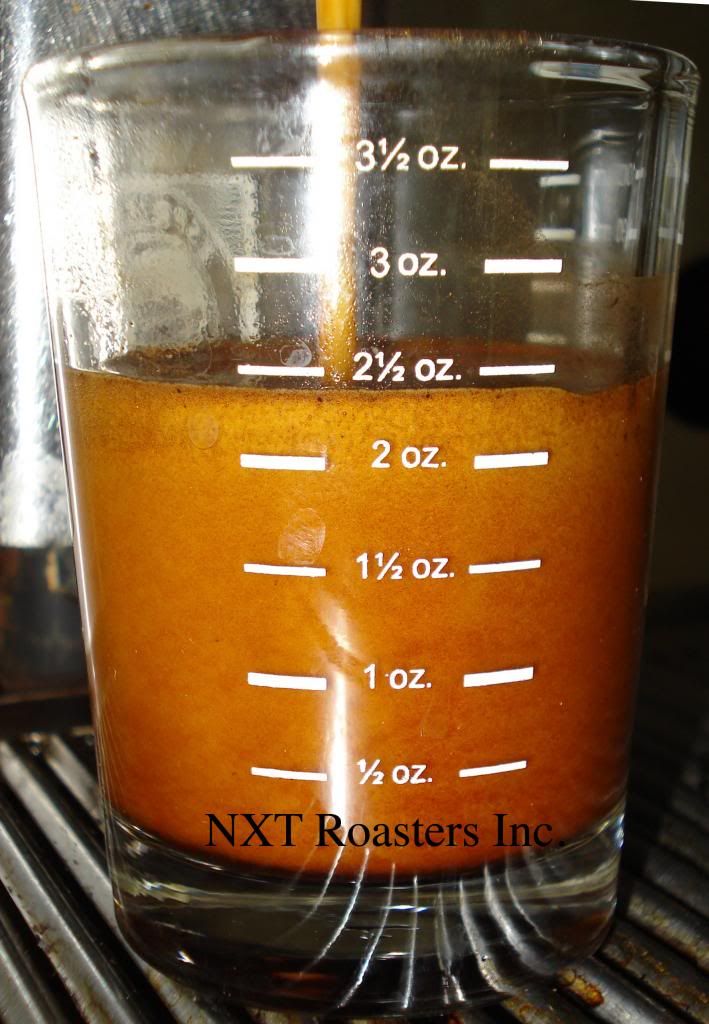
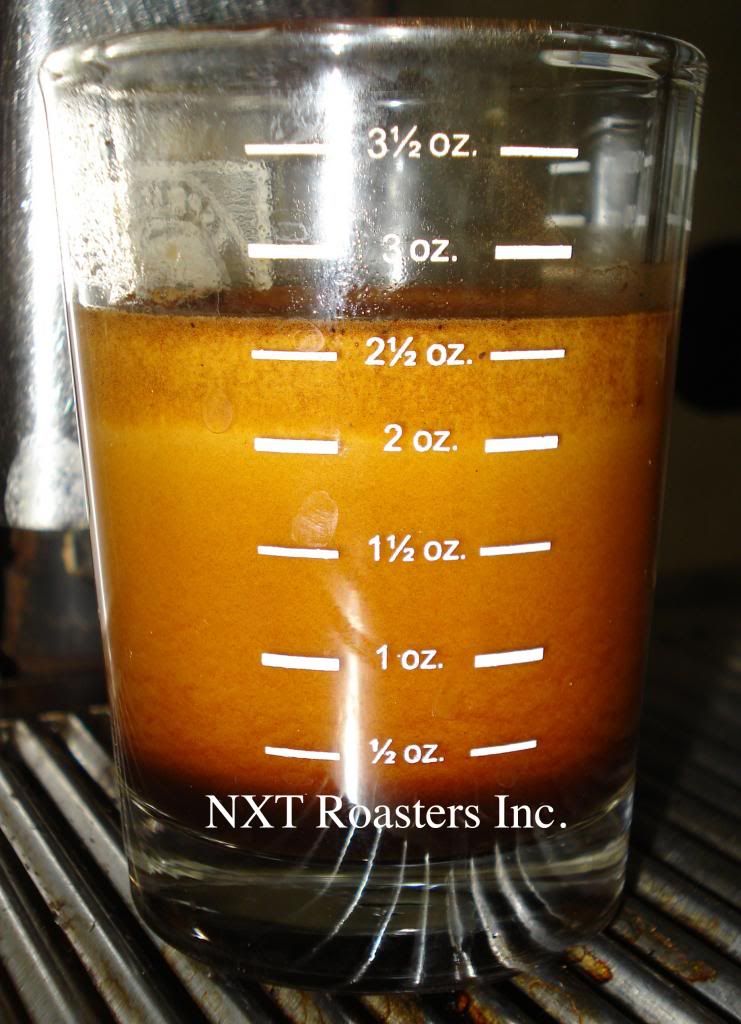
This is Crema !

Crema !!
There are few "honest" ways to get great Crema.  The first one is Freshly Roasted Coffee in a tuned Espresso Machine.  Of course that is also how you maximize the sweetness of high quality Arabica beans.

The quantity of Crema rapidly decreases as the roasted coffee ages.  The taste is also greatly affected by the staling that begins to make itself noticeable within one week after roasting.

In the first two pictures the Arabica beans were roasted four days previously.

The crema to liquid coffee conversion starts towards the end of the brewing process it is not so fast that the client would be deprived of a significant amount of Crema.


Crema has been viewed by many as an indicator of freshness.  Unfortunately some people think that it is clever to deliver Crema without the freshness.  Common techniques are to add chemical foamers or to add Robusta beans to a blend of Arabica beans because the Robusta beans yield a greater amount of Crema even when it is stale.  At one time the Robusta beans were considerably cheaper but the price increased when too many people started to add Robusta to the Arabica beans.   Adding bitterness for the sake of looks is not a good trade - for the client.  

Though it is possible for anyone to add Robusta beans it is less likely when a roaster is serving freshly roasted coffee, because their brew will naturally have the great indicator of freshness.  After all, a local roaster does not have a long supply chain which requires months to complete the distribution process.

Do yourself a great "flavour" by sourcing beans from a local roaster or someone who can deliver them within 2-3 days from the roasting date.

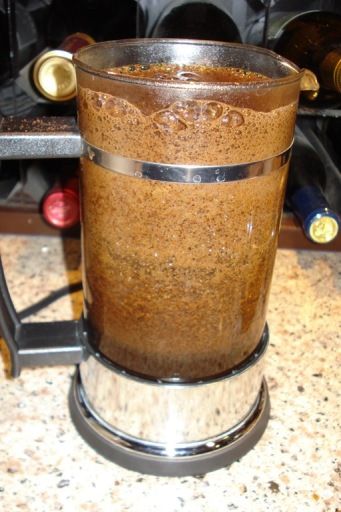
The brew in this French Press was prepared two days after Roasting.  It is also significant that the beans were ground with a blade type grinder which yields a coarser ground that yields  impressive results but is inconvenient because water will have to be added and the particles take longer to decant.  If the Plunger is pushed too quickly the Screen will plug and a hydraulic lock will occur.                                                        
A burr style grinder yields finer and more consistent results.  The finer grounds will infuse more quickly and will decant reasonably quickly.  The screen is then pushed down to prevent the grounds from being poured into the cup.  The solids do not add to the pleasant experience.                                   

Develop a personal coffee ceremony to consistently get great results.  If the results are not the best then try one thing differently and note if it is better or worse.

Hopefully there will be many improvements because well prepared freshly roasted coffee is so sublime.


Sunday, 5 August 2012

Does Extreme Processing Enhance Food visually or nutritionally ?

AKA - Does Processing make it a Lesser Food ?

There is an older blog that has largely gone unread, yet this is a very important topic that affects every ones health.  Is it a lack of interest, poor title, or is it not showing up in the Search Engines ?

The distilled opinion is "the more you process the less the consumer receives".

For various reasons the most common vehicle for food delivery has been perverted.  In response to "manufactured food", fresh food advocates are informing the public about  real food and real food costs.  My assumption is that to benefit from processing the end user must have the same objectives as the processor.  Very often they will share the visual objective but that is often irrelevant to nutrition if not detrimental.

Living on the 100-Mile Diet , Revisiting Carrying Capacity:, Natural Foods, Organic Foods, etc.  It appears that greater "inputs" yield less nutrition.  Large marketing budgets promote convenience and "filling the belly" instead of feeding the body for growth and health.  Increased time spent transporting food means, as well, increased food degradation time.  Industry will typically attempt to address product appearance indicators that influence a consumer.  Unfortunately nutrition is sacrificed for the sake of colour and appearance.  


Before focusing on one product not usually covered in the fresh food debates I would like to add that I believe that the movement advocating quality food is gaining membership.  

My interest is the freshness of coffee.  Of course people do not live by freshness of coffee alone.  That would be silly because it mostly feeds the soul, the well being, the disposition, etc.   Well there have been countless studies about the benefits ...   Coffee has undergone a centralizing process which exchanged convenience for quality.  Bigger is not better if the product is lessened.  We have not developed Star Trek transporters to move food instantly to the consumer while maintaining the product integrity.  If the past is any indicator this futuristic device would further degrade the food.  Warehousing roasted coffee decreases the value to the end user.

I advocate that the coffee roaster, grinder, espresso machine, and brewer should be at the same site.  Nothing gives more credibility to the freshness of the product as when the consumer can observe the preparation.  To this end Jim Townley uses the moniker of "the Theatre of Roasting".  It encourages clients to learn about the process while it reinforces the artisanal qualities of freshness and caring preparation.  Small batch roasting, in our case 3 kg batches, allows the RoastMaster to roast the requirements of the next few days.  Most likely more than one batch of each coffee will be roasted but that is a choice based on sales.

This is a simple food preparation model even though it appears to counter the produced locally mantra of some of the above links.  We are not blessed with local coffee plantations but because the coffee bean is a seed which is designed by nature for long term storage it may be consumed at a distance from its origins with a certain proviso.  So where is the Freshness Challenge?  Roasting transforms the bean and creates havoc with the storage capability of the bean.  Roasted Coffee degrades quickly despite touted storage "solutions".   Freshly ground stale beans is an advertising distraction which offers no benefit to the consumer.  The analogy of the weak chain link is true.  Nothing will resurrect stale coffee not even a marketing campaign.  

For the best cup of coffee start with a freshly roasted high mountain grown Arabica bean that is ground just before brewing.

Sunday, 1 July 2012

After Burners and Greener Roasting !

The car market illustrates a large selection of solutions to what at first appears to be a transportation problem.  Such a wide scope of solutions implies that much more is in play than moving passengers from A to B.  Some features are at the expense of others such as high performance usually eliminates the possibility of incredible fuel savings.   Maximizing nearly all characteristics usually implies a large financial outlay whether it is comfort, performance, or low fuel consumption.

Some people wish to believe that their "prized possession" is simply the best.  That is usually more than a subjective analysis or wishful dreaming where the shortcomings are deemed unimportant.  The Internet provides, sometimes humourous, pictures of people "stretching" the capability of their vehicle such as cars that are  given the role of heavy transporters which is a usage not foreseen by the designers.  Of course the danger, failure, and wear rate is abnormally high.

The same occurs in industrial machinery which is usually characterized by a design that has been optimized to solve a well defined problem.  Better equipment has many of these features; consistent, reliable, efficient, clean, predictable, safe, repairable, and of course they tend to be more expensive.  The expense of a heavy duty design sometimes requires the marketers of lesser units to "upgrade" the features and to declare that shortcomings are really features that were not understood.

Clean technology should mean more than "not visible to the naked eye". A 400,000 BTU Afterburner does virtually eliminate the coffee roasting odours and visible smoke but it can hardly be considered green technology.  The 400,000 BTU/hr  signifies 400,000 BTU/(114,000 BTU per US Gallon of gasoline) or 3.5 US gallons per hour of operation.  Consumed in a car traveling at 55 mph that represents 15.5 miles per gallon, not really in the Prius performance standard.

Some natural gas roasters have countered with the claim that they recycle 100% of their air.  That must be a statement originating in the marketing department because engineering has not figured out how to sustain a flame with air depleted of its oxygen.

Design involves more than covering up the problem, it is turning a problem into part of the solution.  Good design is using the energy within the problem process to eliminate it and if possible to use the excess energy of that destruction to reduce the roasting energy cost.

Saturday, 16 June 2012

Does Food Processing reduce nutrition ?

The distilled opinion is "the more you process the less the consumer receives".

For various reasons the most common vehicle for food delivery has been perverted.  Perhaps "Extra Virginity"  The Sublime and Scandalous World of Olive Oil by Tom Mueller shows that number cruncher executives care not a wit about their product, the well being of their customers, and sometimes the law.   People that are passionate about their product will bring the best to the customers sometimes at a great sacrifice.

Reuters had an article, a few days ago, to this effect: ...Coffee roasters quietly pulled off a financial feat last year that went unnoticed by most customers: Adding a higher proportion of cheaper, lower-grade robusta to their grounds as the price of top-notch arabica beans surged...  Not only are the beans cheaper but Robusta creates substantial crema even when it is stale therefore it gives a visual indicator of freshness even when it is not.

In response to "manufactured food", fresh food advocates are informing the public about  real food and real food costs.  
Living on the 100-Mile Diet , Revisiting Carrying Capacity:, Natural Foods, Organic Foods, etc.  It appears that greater "inputs" yield less nutrition.  Large marketing budgets promote convenience and "filling the belly" instead of feeding the body for growth and health.  Increased time spent transporting food means, as well, increased food degradation time.  Industry will typically attempt to address product appearance indicators that influence a consumer.  Unfortunately nutrition is sacrificed for the sake of colour and appearance.  

Before focusing on one product not usually covered in the fresh food debates I would like to add that I believe that the movement advocating quality food is gaining membership.  

My interest is the freshness of coffee.  Of course people do not live by freshness of coffee alone.  That would be silly because it mostly feeds the soul, the well being, the disposition, etc. Coffee has undergone a centralizing process which exchanged convenience for quality.  Bigger is not better if the product is lessened.  We have not developed Star Trek transporters to move food instantly to the consumer while maintaining the product integrity.  If the past is any indicator this futuristic device would further degrade the food.  Warehousing roasted coffee decreases the value to the end user.

I advocate that the coffee roaster, grinder, espresso machine, and brewer should be at the same site.  Nothing gives more credibility to the freshness of the product as when the consumer can observe the preparation.  To this end Jim Townley uses the moniker of "the Theatre of Roasting".  It encourages clients to learn about the process while it reinforces the artisanal qualities of freshness and caring preparation.  Small batch roasting, in our case 2 to 3 kg batches, allows the RoastMaster to roast the requirements of the next few days.  Most likely more than one batch of each coffee will be roasted but that is a choice based on sales.

This is a simple food preparation model even though it appears to counter the produced locally mantra of some of the above links.  We are not blessed with local coffee plantations but because the coffee bean is a seed which is designed by nature for long term storage it may be consumed at a distance from its origins with a certain proviso.  So where is the Freshness Challenge?  Roasting transforms the bean and creates havoc with the storage capability of the bean.  Roasted Coffee degrades quickly despite touted storage "solutions".   Freshly ground stale beans is an advertising distraction which offers no benefit to the consumer.  The analogy of the weak chain link is true.  Nothing will resurrect stale coffee, not milk, not sugar, not artificial liquids, not even a marketing campaign.  

For the best cup of coffee start with a freshly roasted high mountain grown Arabica bean that is ground just before brewing.

Wednesday, 16 May 2012

The Importance of Timely Bean Cooling

Coffee is roasted by way of an exothermic reaction.  Without cooling, the beans would invariably burn because they reach the combustion point.   Roasting consistency can only be achieved through the timely introduction of the cooling air, which halts the roasting, to all the beans.

Drum roasting requires well developed skills because there is an extended lag between the moment the RoastMaster views the beans in the Bean Sampler and the termination of the exothermic reaction.  Several factors affect the degree of roast in a drum roaster; the air temperature is considerably higher than what is required for roasting  ("Espresso Coffee" R. Eggers writes the typical gas temperature of a drum roaster is 400° - 550°C. ), using a Bean Sampler is a relatively slow procedure, and the Cooling fans are relatively inefficient at moving air through several layers of beans.  Sucking the air downwards through the beans is also bad design because it packs beans together which greatly hinders air flow.  Many drum roasters spray water on the beans to cool them more quickly.  This is not good nor is it a measured cooling method.

The high temperature cooking analogy for beans hit by the super hot air is cooking Scrambled Eggs while using the stoves highest heat setting.   Even if they are continually mixed the heat is much higher than the egg can transmit to the interior.  The higher heat of the drum roaster still yields a relatively slow roast which highlights the inefficient transfer of energy.         For more details see "" and "Heating Coffee Beans to Roasting Temperature"

It is said that every second counts when "calling the roast" yet it takes many seconds to determine the degree of roast using a Bean Sampler especially if multiple readings have to be taken to follow the progression.

Many roasters are  stressed  by "calling the roast" even after they have been roasting for nine months.  The beans continue to roast during the dumping process and at the beginning of the air cooling cycle.  It is a common drum roasting technique that water is sprayed unto the beans to soak up heat.  It is impossible to accurately meter water coming from a garden hose.  Moisture is the #1 enemy of roasted coffee.  That lingering roast period means the drum RoastMaster must anticipate the roast quite a bit in advance of the required roast level.  An appropriate analogy is shooting ducks; the expert hunter aims for the position where the duck will be when the buckshot arrives.  The hunter must compensate for altitude, shell powder load, temperature, duck speed, and probably many other things that only a good hunter would know. For various reasons a lot of people have a problem with duck hunting (no ducks were harmed for this analogy).  The drum RoastMaster does not deal with less variables.

 To this end the NXT aka Roastaire uses a fluidized bed in which 240°C (adjustable as required) air is pushed, under pressure, through the beans.  This significantly increases the heat transferred to the entire batch of beans.  The beans have a limited ability to absorb the heat therefore the temperature gradient is more uniform throughout the batch with the forced air stream.  The added benefit is that the air flow continually churns the beans and carries away the chaff.

 The beans are cooled within the Roasting Chamber therefore "calling the roast" is done in real time.  The blast of cooling air also churns the beans so that there is even and rapid cooling.  The Roast Monitor communicates to the RoastMaster the roasting progress so that the Cooling Cycle is started at the proper moment.  It only takes a few seconds to cool the beans ( below 180°C according to R.Eggers and below 200°C according to Clarke & Macrae) to stop the roasting process.  After this 30 second Cool Mode the beans are transported to the Packaging Hopper while the NXT aka Roastaire loads nother batch freeing the RoastMaster to appreciate a freshly roasted coffee.

Thursday, 10 May 2012

Carbon reduction or is it just "horse trading"*

There is even more to the story !
The unfortunate part about marketing claims vs. true development and technical improvements is that the marketing claims focus on changing perception rather improving the equipment.  It is the easy way out which in this case does nothing for the local air quality if someone planted trees hundreds of kilometres away.  The article cited does not mention that it took a decade to reduce the Roastaire™ emissions to a small fraction of conventional roasters.  In the process the energy required to roast was reduced to about 1/6 of a conventional coffee roaster.

The Roastaire™ was designed for the Café environment where people can observe the roasting process.  We refer to that as the "theatre of roasting".  The roaster is a compact unit that includes Chaff Cyclone, SmokEater™ (pollution controls), Pneumatic Bean Conveyor, and a Packaging Silo.  The roaster is approximately 6.5 feet high.  The roaster is controlled by a computer based Roast Monitor which  also configures the roaster, through the use of pneumatic valves, for the various modes in the roasting process.

More information is given in the post "Sustainable Design Follows Function"  such as the attention given to ergonomics.  An obvious example is the placement of the Loading Hopper which is placed at counter height rather than above the RoastMasters head.  The roasted beans are quickly cooled internally so that the smoke can be neutralized before it is vented.  The aim has been to improve and streamline the roasting session.  Cooling with a sustained blast of cool air within the Roasting Chamber means that the RoastMaster does not need to compensate for the roasting that takes place between the time of the decision and the moment that the beans are lowered below their combustion point.  The sum of the drum RoastMaster's reaction time, Roasting Chamber evacuation time, plus the actual time it takes to sufficiently cool the beans to stop the roasting process means that the RoastMaster must anticipate the final roast a minute or more in advance.  In drum roasting the process is analogous to "duck hunting";  if the hunter aims for the duck they will miss.  The hunter must shoot ahead of the duck by a distance that varies with variables such as height and speed of the duck.   Similarly skill and much training is required to anticipate the time required to get the correct drum roast.  The drum concept does not make it easier for the RoastMaster but that analysis will have to wait.
To help improve the efficiency of the Roastery the roasted beans are pneumatically conveyed to the packaging area where they can be weighed and placed directly in the bins. 


The Packaging Hopper can be mounted to the wall or placed on a table or counter.  It can be placed directly over the scale if the RoastMaster finds it more convenient.

Café owners that buy roasted beans see " FRESH Coffee! " post are simply paying for someone else's roaster without getting all the benefits.


* Horse trading is an idiom used to describe negotiations, especially where these are difficult and involve a lot of compromise.

Sunday, 27 November 2011

Food Processing vs. Nutrition ?

AKA - Does Processing make it a Lesser Food ?

The distilled opinion is "the more you process the less the consumer receives".

For various reasons the most common vehicle for food delivery has been perverted.  In response to "manufactured food", fresh food advocates are informing the public about  real food and real food costs.  

Living on the 100-Mile Diet , Revisiting Carrying Capacity:, Natural Foods, Organic Foods, etc.  It appears that greater "inputs" yield less nutrition.  Large marketing budgets promote convenience and "filling the belly" instead of feeding the body for growth and health.  Increased time spent transporting food means, as well, increased food degradation time.  Industry will typically attempt to address product appearance indicators that influence a consumer.  Unfortunately nutrition is sacrificed for the sake of colour and appearance.  


Before focusing on one product not usually covered in the fresh food debates I would like to add that I believe that the movement advocating quality food is gaining membership.  

My interest is the freshness of coffee.  Of course people do not live by freshness of coffee alone.  That would be silly because it mostly feeds the soul, the well being, the disposition, etc. Coffee has undergone a centralizing process which exchanged convenience for quality.  Bigger is not better if the product is lessened.  We have not developed Star Trek transporters to move food instantly to the consumer while maintaining the product integrity.  If the past is any indicator this futuristic device would further degrade the food.  Warehousing roasted coffee decreases the value to the end user.

I advocate that the coffee roaster, grinder, espresso machine, and brewer should be at the same site.  Nothing gives more credibility to the freshness of the product as when the consumer can observe the preparation.  To this end Jim Townley uses the moniker of "the Theatre of Roasting".  It encourages clients to learn about the process while it reinforces the artisanal qualities of freshness and caring preparation.  Small batch roasting, in our case 3 kg batches, allows the RoastMaster to roast the requirements of the next few days.  Most likely more than one batch of each coffee will be roasted but that is a choice based on sales.

This is a simple food preparation model even though it appears to counter the produced locally mantra of some of the above links.  We are not blessed with local coffee plantations but because the coffee bean is a seed which is designed by nature for long term storage it may be consumed at a distance from its origins with a certain proviso.  So where is the Freshness Challenge?  Roasting transforms the bean and creates havoc with the storage capability of the bean.  Roasted Coffee degrades quickly despite touted storage "solutions".   Freshly ground stale beans is an advertising distraction which offers no benefit to the consumer.  The analogy of the weak chain link is true.  Nothing will resurrect stale coffee not even a marketing campaign.  

For the best cup of coffee start with a freshly roasted high mountain grown Arabica bean that is ground just before brewing.

Wednesday, 16 November 2011

Staling of Roasted Coffee

Coffee stales much faster than it is commonly perceived.  An extreme example is noted in "Coffee Technology"by Michael Sivetz where he mentions that moisture absorption from the air or due to water quenching need only to be 1% to noticeably stale coffee within the hour.  This represents 30 cc (1 fluid ounce ) per 3 kg ( 6.6 lb ) batch which,  considering that the beans lost 12 to 20 times that much moisture when roasting, is quite significant.  Advocates of water quenching claim that all the water evaporates as it hits the bean.  I am not so certain that this is so because after roasting the bean is very porous which means that the water will quickly cool the outside layer the bean will then have difficulty conducting the heat to the surface to evaporate 100% of the moisture.  The increased porosity will help draw the moisture inside.

Each opening of the container allows more moist air to reach the roasted coffee.   Sivetz writes that the beans are "moderately stale" within a week, more stale within two weeks and stale in three weeks.  Greater surface area i.e. ground beans significantly increases the absorption of air and moisture.

Vacuum packaging does remove most of the air but if it is done within a few hours of roasting it can create problems because of the high pressure CO2 will be released from the beans and inflate the bag.  If the coffee is ground the CO2 will be mostly released within the hour.

In theory the Valve on the Bag permits a longer storage time but I am sceptical about that valve working perfectly.  The changes in air pressure are small and applied over long periods of time as the barometric pressure changes which causes the bag to breathe.  The valves are attached to a bag that is filled with coffee beans which is not a flat surface hence I am thinking that it leaks and that it's purpose is to prevent the bag from bursting from C02 pressure.  Before going further that has to be tested.  I reiterate that the only safe bet is buy Freshly Roasted coffee.

Wednesday, 9 November 2011

No Carbon Credits Required !


November 1st, 2011 – Victoria, B.C.
Many coffee roasting companies across Canada claim 'carbon neutral' status these days, however, consumers are encouraged to look closely at their labels to find out 'how' they achieve this. Carbon credits are being bought by a number of roasting companies whose technology is outdated and continues to pollute the environment. Many companies are folding the costs of carbon credits into their cost of goods. 'If you look closely, many coffee companies are claiming carbon neutral status, but all they're doing is buying credits to offset their emissions', states Fresh Cup President, Jim Townley. 'The truth is, the consumer is likely paying a higher price for a product without even knowing it'. No matter how you slice buying carbon credits, they are a cost to any company and many companies are buying them more for their marketing value than the purpose that they were intended for. 'Whether you plant a tree, or buy credits to off-set the carbon emissions produced in making a product, it costs money', notes Townley. That cost has to show up somewhere along the line, and if the cost to buy credits is left low like it currently is, many companies will continue to pollute and make consumers pay the price. 'What's the point of low cost credits, if the cost can be added to the product for the consumer to pay ? Where's the motivation for companies to change their business practices to minimize the impact on the environment', asks Townley. 'Our approach is simple…be sustainable in how we roast coffee by reusing the heat, while drastically minimizing the emissions, then there's no carbon credits required'.


---------------------------------------------------------------------------------------------------------------
There is even more to the story !
The unfortunate part about marketing claims vs. true development and technical improvements is that the marketing claims focus on changing perception rather improving the equipment.  It is the easy way out which in this case does nothing for the local air quality if someone planted trees hundreds of kilometres away.  The article above does not mention that it took a decade to reduce the Roastaire™ emissions to a small fraction of conventional roasters.  In the process the energy required to roast was reduced to about 1/6 of a conventional coffee roaster.

The Roastaire™ was designed for the Café environment where people can observe the roasting process.  We refer to that as the "theatre of roasting".  The roaster is a compact unit that includes Chaff Cyclone, SmokEater™ (pollution controls), Pneumatic Bean Conveyor, and a Packaging Silo.  The roaster is approximately 6.5 feet high.  The roaster is controlled by a computer based Roast Monitor which  also configures the roaster, through the use of pneumatic valves, for the various modes in the roasting process.

More information is given in the post "Sustainable Design Follows Function"  such as the attention given to ergonomics.  An obvious example is the placement of the Loading Hopper which is placed at counter height rather than above the RoastMasters head.  The roasted beans are quickly cooled internally so that the smoke can be neutralized before it is vented.  The aim has been to improve and streamline the roasting session.

Café owners that buy roasted beans see " FRESH Coffee! " post are simply paying for someone else's roaster without getting all the benefits.

Friday, 4 November 2011

FRESHLY Roasted Coffee!

FRESHNESS is a contentious topic.  Groups that can't provide fresh coffee because of their long supply chain attempt to ignore this essential factor when selling a perishable food.  Cafés that Roast OnSite say that coffee staling begins to be noticeable one week after roasting.  They aim to sell "take home coffee beans" within the week and to serve all coffee within 1 1/2 weeks.  The question they ask is "Would you buy 10 day old bread?".  We attempt to bolster this strategy by providing an efficient small batch 3 kg roaster which makes it easy for the café to roast only the coffee beans that are required for the next few days.  This roaster benefits from the advantages of using electric heating which allows the re-circulation of the heated air after it is scrubbed of the smoke particles.  The built-in SmokEater™breaks down the exhaust gasses which otherwise cause neighbours to complain about roasting odours.

Café owners that buy from a local roaster sometimes do have fresh coffee but, obviously, they can't proudly serve their own creation.  The passion of creation communicates very well at the counter.  Perhaps they do not really know when the coffee beans were roasted.  One RoastMaster explained it like this: we put it for sale as an estate arabica, after some time we make blends, and if we still have some left we wet a cloth with some flavouring and tumble it and the beans in a small drum.  Is that flavouring to enhance or mask?  To the Café owner "Does the cost of your coffee pay for your roaster or your supplier's?"

A lot of lobbying dollars were spent to convince governments that coffee beans last more than 18 months therefore did not require expiry dates, in other words they concluded that roasted beans were non perishable.  This decision was required by centralized roasters and grocery chains because they cannot transport the beans to client coffee pots within two weeks.  Consequently, they promote peripheral messages such as freshly ground, freshly brewed, consistency, convenience, low price, contests, etc.   They can accessorize the product as much as they want but if you start with stale beans you can't make a quality drink.  Coffee parallels the preparation of food in that increased processing equals diminished quality.  Some of the tricks are to add cheaper robusta beans, which are more bitter than arabica beans, to the blend so that the espresso will have more crema like freshly roasted coffee.  It is not a great espresso and most likely they will suggest that you give it some zing with a flavouring.  Freshly roasted coffee has plenty of zing plus it has complexity that a flavouring does not even try to achieve.

Out of curiosity two books were consulted; one by a large Italian central roaster and other by UK specialists.  The first only mentions "freshness" as it pertains to serving it quickly after it is brewed.  The second book does not mention freshness.  Freshness is not part of the centralized roasting business model.  As a consumer the choice is yours "Do you wish to pay for freshness or warehousing?".

Packaging is often ascribed miracle properties.  In the first day(s) following roasting the beans emit a lot of carbon dioxide which can burst bags.  Hence, the use of the valve.  If the valve is the highest point in the bag the CO2 will force out the lighter gases such as air which is beneficial but it is hardly locking the flavour in.  One web site says that packaged coffee lasts a few months until the bag is opened but a little further down they claim: How long does coffee last? Coffee packaged with a freshness valve = 12 months then add a little further Ground coffee once the bag is opened = 2 weeks.  Check for consistency of message and verify that information.  Your priority is taste or the coffee experience theirs is sales.  Studies have been done about slowing down the degradation through cold storage but that requires colder deep freezers than those in homes.  An additional problem is that, due to the pressure differential, the deep freeze is the area with the highest humidity in a house.  Moisture accelerates staleness.

If possible observe a roasting session, you will learn.  You may find that some of the urban based coffee roasters are not used because of pollution complaints and that some RoastMasters , that do not have Afterburners, roast during the night. 

To improve the roasted beans' relatively short lifespan they should be ground just before brewing.  Make a comparison with beans that have been ground for half an hour. I expect that after half an hour the finely ground beans will make a flat coffee.  An espresso will have greatly reduced crema.  You will then be in a position to judge the statement "Ground coffee once the bag is opened = 2 weeks"

My mantra is "Buy from the roaster".

Friday, 28 October 2011

Sustainable Design Follows Function

In the Generation 1 the Roastmaster had to lift the beans over his head to fill the Loading Hopper.  Not surprisingly it was not the popular choice but it was the simplest solution.  The Roasting Chamber was pivoted from the Loading/Roasting position to the Dump position where the roasted coffee was dropped into a Cooling Tray.   The SmokEater™ (an efficient form of the After-burner used gas heated roasters) was attached but not an integral part of the machine.   Maintaining seal integrity on the sliding Roast Chamber was difficult and was exacerbated by the strong smoke of the dark roasts.

Generation 2 went through several iterations.  It did away with the sliding Roasting Chamber and overhead Loading Hopper.  The counter top roaster, again with an outboard SmokEater™ had pneumatically controlled valves which were able to route the air so that green beans could be loaded from a counter height Loading Hopper. The re-circulated pressurized air is able to transfer more heat evenly to the beans than the high temperature (often twice the temperature)- low pressure circulated air used in drum roasters because in the fluidized bed all the air goes through the beans without having a portion of the flow simply going around the beans.  This model also introduced the second generation of the Roasting Monitor.
The function of the NXT Roaster is responsible for the form it was given.  In brief, recirculation requires the shape of an "O" which is formed by the two larger columns tied together by the base and top pipes.  The left most small rear column is the Cyclone which removes the chaff from the circulating air while the right most  rear column is the SmokEater™which does the final air cleaning or smoke neutralizing before exhausting the air during the Cool Mode.

Shown above is the third generation 3 kg Roastaire™ that roasted on the exhibition floor at both the Toronto and the Vancouver Canadian Coffee & Tea Shows.  No chimney was used for the 110 batches of green beans roasted.  It was the only roaster that Roasted On-Site and inside the hall.   This version was a "complete re-think" of the functions and the layout of the coffee roaster.  It required the development of a High Temperature Blower capable of fluidizing the green beans, a new computer based Roasting Monitor, PID Temperature Controllers, two Pneumatic Bean Conveyors, initial bean cooling within the Roasting Chamber, and a Packaging Silo to further cool the roasted coffee beans.  The SmokEater™ was incorporated into the Roaster body so that the entire unit could be moved on casters and occupy a relatively small footprint.

The goal was to make the industrial roaster compatible with an urban environment, without requiring optional add-ons, yet be as compact as possible.  To improve the efficiency well above that of a gas burning roaster the air was recirculated.  The post "Roaster Pollution Reduction" shows photographic results, after 5 years of cafe roasting, that the air was cleaned before it was re-circulated to the Roasting Chamber.   This compares very well with the caked exhausts, of other roasters, shown by KaladiCoffee on Youtube.com .  It was not an overnight success but it works well.  The High Temperature Blower required a great deal of development since off the shelf blowers do not survive such temperatures for very long even with high priced precision bearings.  The pressure and flow is required to fluidize the beans which is among the most efficient ways to evenly transfer the heat to the beans.  The wasteful solution has been to move cold air which is then passed through the Heating Element.  Air is continually heated from ambient to roasting temperature.  The wasted energy is augmented when the Pollution Controls are implemented. The NXT Roaster only exhausts air for 75 seconds of the 10 to 12 minute roasting cycle,  During this phase the air is further cleaned, as shown in another photo in the already mentioned post.

The Computer based Roasting Monitor makes it possible for the Roastmaster to monitor the pyrolytic process to consistently and repeatedly attain the required degree of roast.  There will be another post along with annotated pictures of the program's screen view in a further post or maybe posts.  The Roasting Monitor clearly shows the the pyrolytic reaction is stopped within seconds, minimizing the roasting overshoot which allows the Roastmaster to "call the roast" for its degree rather than for what it will be in 60 to 90 seconds. Which is the time some units take to dump the beans, fill the bottom of the Cooling Tray, then turn on the Cooling Fan.

The PID ( Proportional Integral Derivative ) Temperature Controllers do not click Off/On as the temperature passes through the set point but rather the algorithms analyze the rate of temperature change to anticipate, with accuracy, reaching the temperature set point.

The Loading Pneumatic Conveyor allows the Roastmaster to fill the counter height Loading Hopper with 3 kg of green beans rather than the too common overhead hopper.  The Green Bean loading takes place at the same time as the roasted coffee beans are conveyed to the Packaging Silo then cooled for several minutes.  Typically this silo is positioned in the packaging area above the counter, shown in a photo from the Canadian Coffee & Tea Show booth.


Fresh Cup Roastery Café booth   (well, half of the booth)

There is no visible exhaust to show how effectively the Pollution Control System is.  We have reached the level of requiring sniffers and gas analyzers.  The electric elements obviously do not create combustion gases which, in gas fired drum roasters, are circulated through the coffee before flowing to the chimney.  Afterburners, for gas fired drum roasters, with a comparable output to the Roastaire™ range from 400,000 btu to 1 million btu which significantly increases the energy costs of each pound roasted.  Such a waste.  Perhaps an operational cost comparison blog is in the offing. 


Friday, 7 October 2011

Canadian Coffee & Tea Show


We just returned from the Canadian Coffee & Tea Show, in Vancouver, where the Roastaire™ roasted coffee on the show floor.  The big deal was that it was the only coffee roaster that took on the challenge of roasting inside without a chimney.  A lot of design work has gone into improving the roaster efficiency and pollution controls but that is what made it possible to accomplish task.

The air, cooling the newly roasted beans, was vented into the room so there was a coffee aroma near the booth but the roasting smoke was neutralized within the machine which is why this machine is friendly to neighbours.
 Mel, the Roast Master, roasted approximately forty 3 kg batches of coffee while he explained  the Roastaire™ features and the significance of monitoring the roasting process in real time with the computer.  The Bean Sampler was only pulled to show the visitors that there was a Bean Sampler but that the process was not optimal especially for someone with less than a year's roasting experience.

Mel's coffee is available at FreshCup.ca   There are no transportation costs within Canada for two or more pounds of coffee.  Unfortunately this morning's order from Santiago, Chile could not be filled in a timely manner.  FRESHNESS is their mantra.

We also received the Twitter Lawrence Tanner who has a better photo of the Roastaire™ on yfrog:  (link is     ) as shown below


 It is quite a challenge to photograph stainless steel cylinders in front of a black wall.  There is certainly something to be learned in that process as well.
Roastaire™ and Coffee Roasting