Pages

Showing posts with label coffee beans. Show all posts

Friday, 21 September 2018

Extending Freshly Roasted Coffee Lifespan

The main enemies of Freshly Roasted Coffee are Time, Oxygen, and Moisture.

A solution has been presented to the public that is more beneficial to the manufacturers than to the end user.

Background info:

Immediately after roasting the coffee beans begin to emit carbon dioxide in sufficient volume and pressure to burst a hermetically sealed bag.  Some roasters opted to degas the beans for one to three days to alleviate this problem while manufacturers came up with a new product, the valve.
http://nxt-roasters.blogspot.com/2011/12/do-coffee-bag-valves-leak-1.html
http://nxt-roasters.blogspot.com/2012/05/revisited.html

Valve Limitation - as currently used:
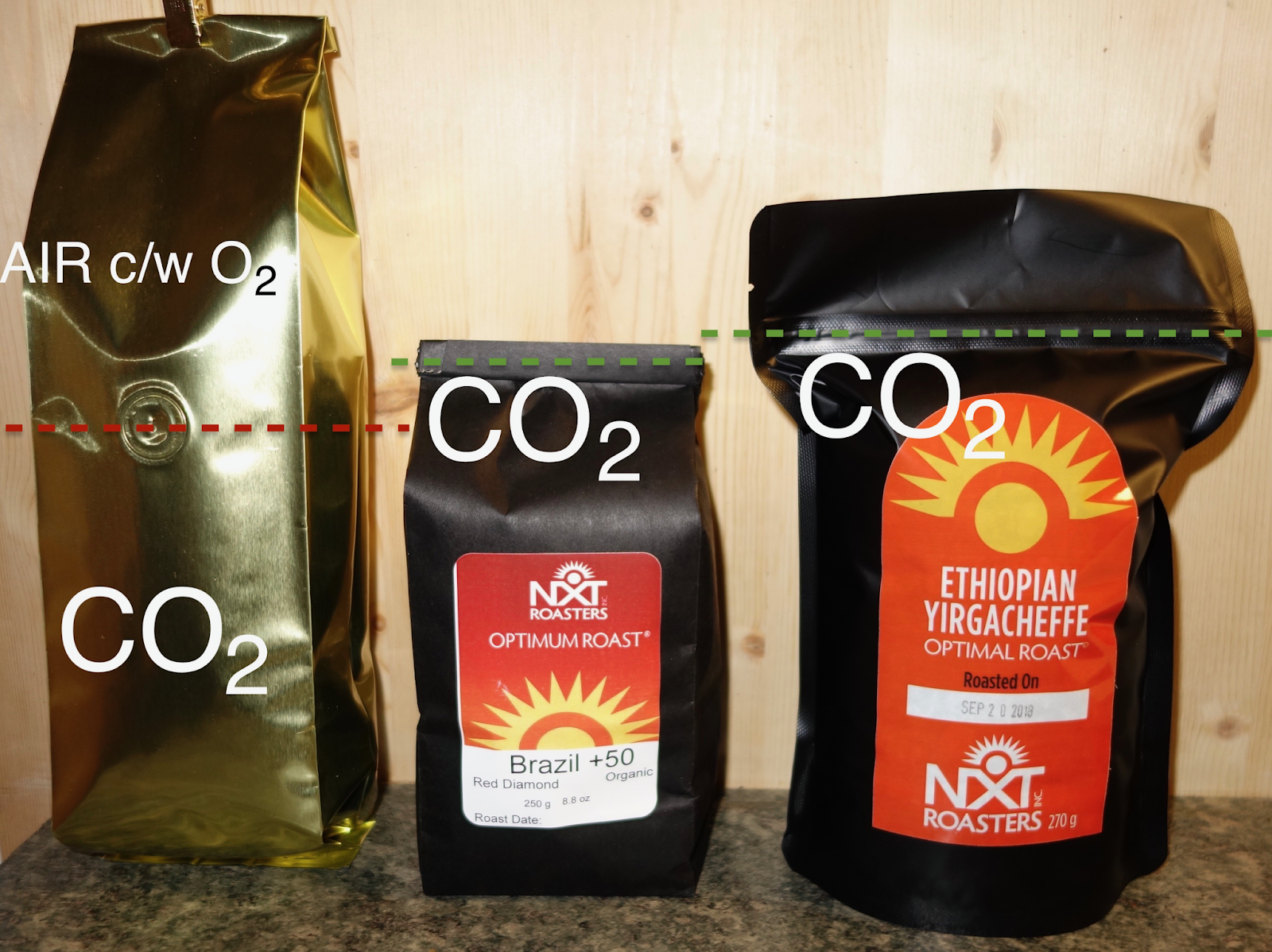
It is possible that the valve is a single solution to burst bags when with a little more thought it could have also help to extend the freshness of coffee beans.

The CO2 is roughly 50% denser than the air we breathe, which consists of about 21% Oxygen.  This means when packaged, on the first day, beans emit CO2 that gas drops to the lowest level in the container and pushes the existing air upwards.  Surrounded the Freshly Roasted Coffee Beans with CO2 retards the oxidation process, hence, slows down the staling process.  How well and for how long the freshness is preserved is much more difficult to assess and beyond the limits of a one page blog entry.  For arguments sake I say it gives an extra week.  This process exists for the beans that are continually bathed in CO2 which is not the case when there is a venting valve.  As shown in the photo the CO2 will rise up to the valve then exit rather than flush out the air above the valve.  That means that, as the photo illustrates, that only 2/3 of the beans are in CO2 providing the bag is not tilted.  If the bag was laid on it back so that the valve was at the high point of the bag then there would be a different outcome but bags are not stored, shipped, or displayed laying down.  That scenario would be improved by moving the valve upwards to minimize the amount of air in the bag.

Using a valve does allow the roaster to degas in the heat sealed bag which offers the consumers the security and assurance that the bag contents have not been tampered with.

Alternatives:

The NXT solution to this dilemma is to use a ziplock bag which presents more flexible packaging options.  First, all the oxygenated air is pushed out of the bag when the bag is kept upright.  We recommend that people scoop out the beans for immediate consumption rather than pour them out which would drain much of the CO2.  Leaving CO2 to protect the beans extends the freshness.  Our bags are in a supervised area and they are not opened after closing but for added security, where bags are placed in a public area and a heat seal is required a simple pin prick between the ziplock and the heat seal which will prevent bursting the bag and allow a flushing of the oxygenated air.

NXT advocates degassing in the bag to take advantage of the emitted CO2 to extend the freshness of the coffee beans.

We have a Carbon Dioxide high pressure tank and a regulator to test the effect of giving a shot of CO2 to a bag of beans that are more than a day old when outgassing has mostly ceased.

It might mean some beans will be destroyed with water to determine the volume of the interstitial spaces which will indicate how much CO2 has to be injected to bathe all the beans in a protective gas.

To Do:

Test to determine how CO2 will enhance the life of ground coffee.

Sunday, 15 April 2018

NXT Freshly Roasted Coffee vs Marketing Spin

There are a lot of excuses that are generated by the untimely delivery of coffee.  It appears that more effort is made to make up a fanciful story than to deliver freshly roasted coffee.

It is easier to examine process where companies will pronounce certain rules as if they were laws rather than an opinion or marketing ploy.  Grocery stores have convinced the government agencies that coffee is not a perishable or that its shelf life is greater than 18 months.  Why?  I would say that it fits in with their warehousing distribution model rather than their concern for delivering a fresh product.  The economy brand coffee purveyors notably dance around their weakness which is usually centered on freshness.  Most often there is a clash of goals between their purchasing based on price and their desire to sell at a high end price.  Obviously that is not the message they wish to convey so this is where the marketing dance is conjured.
The question "Is your coffee freshly roasted"?  The typical answers:
- we grind it just before brewing
- we brew on the hour
- we serve our coffee when it is at its prime
- our coffee is ground to a different level
- we have a special relationship with our roaster even if it is 500 miles away
- our roaster uses the best beans
In all cases the question is not answered because it is important to circumvent that limitation by presenting a subjective answer (usually missing the point of the question).  It is a chink in their armour that appears to only be visible to those who are passionate about coffee, inquisitive about the claims, and discriminating purchasers.

On that note, a client must judge if coffee beans must degas for one to 5 days.  The beans will degas regardless because the pressure is sufficient to burst a tightly sealed plastic bag.  I prefer to package ASAP after roasting, letting the beans degas in the bag.  To that end we keep the bags closed, but not sealed, and upright so that the carbon dioxide* (which is more dense and heavier than air) will displace the air by pushing it our the top of the bag.  The client is able to decide when to drink the freshly roasted coffee. We have not found a need for valves.  If the valve is kept as the highest point of the bag the interstitial spaces will also be occupied by carbon dioxide instead of oxygen rich air.

Unfortunately most valves are located around the mid-line which means only half of the bag is purged of oxygen.  To purge the air from the valve equipped bag the bag has to be laid down so that the valve is the highest point in the bag.  Emptying the bag requires the same consideration to preserve the CO2 level, while keeping the bag upright scoop out the beans rather than pouring out the beans along with the CO2.  Pouring the entire bag into the grinder will pour in the CO2 as well but I suspect that the CO2 will drain out the bottom of the hopper, through the burrs, and out of the grinder.  That illustrates a grinder limitation which should be examined in another post.

*  Carbon dioxide is a colorless gas with a density about 60% higher than that of dry air. Carbon dioxide consists of a carbon atom double bonded to two oxygen atoms.  Dry ice is the solid version of CO2.  The wafted vapour that we see above the dry ice exposed to room air is actually moisture from the air that has condensed due to the low temperature near the dry ice.

Wednesday, 31 July 2013

NXT Roasters has the Aeropress brewer

There are several brewing options available to the consumer but only a few have a "freshly roasted" priority mostly because they cannot deliver their coffee in a timely manner.

We searched  the Internet and wrote many emails to source the brewer that would give the best value to our customers.  The Aeropress is a well designed and built device which does not require an expensive electric brewer.

There are countless videos that address brewing with the Aeropress but most of them are not worth a mention because they exhort what I consider a faux pas i.e.
- advocating coffee is ok up to 40 days after roasting
- coffee should be used within 10 days of grinding
- a presenter attempts to explain how they defy the laws of physics by building unbelievable pressure
- another has concluded that the pressure pushing out the coffee is a vacuum
- for some reason some equate hot water with bitterness rather than improper roasting and staleness
Critical thinking is required on the Internet.  Yes, even now!

The Aeropress is versatile and has well designed accessories.  It can be used in two ways which are best explained by way of videos followed by pictures and explanations.

The KPCC Radio video demonstrates the Filter Down Method (photo to the left).  The temperature is important, it affects the extraction and should be above 90°C  (194°F).  The low temperature advocates probably make or sell machines that are unable to serve hot water.  The simplicity of the electric kettle is not to be scoffed at.  In an anecdotal observation a few tablespoons of coffee are placed on the bottom of your sink (especially appropriate experiment for those that have weeks old coffee but want to move to freshly roasted delights).  Allow some warm water to flow gently against the mini mound (gently - don't power wash it away) then increase the temperature.  You will find that the hot water dissolves while warm water agglomerates.

The Atomic Way video demonstrates the Inverted Method (photo below) which eliminates the dripping into the cup while mixing.


THE GRIND.  We often drink a modified Turkish style coffee where all the ingredients are mixed in the cup.  The finely ground coffee is only produced by a burr style grinder.  A finely ground coffee has a large surface area proportional to its volume which means a rapid extraction and that the grains soak up the water and decant quickly.  A fine grind like this creates a mini disaster in the gravity drained brewers because the water is poured onto the grind faster than the permeability allows it to go through, resulting in the dreaded overflow.  The plunger pressure in the Aeropress appears to circumvent that problem and yields a better extraction.

The end user has to determine the grind by experimentation.   A coarse grind will under extract and the water will be pushed through too quickly.


The Aeropress is then flipped over and placed
on a cup and the process continues as in the
conventional method.


FRESHNESS IS #1  The staling process starts after
roasting and begins to be detected at the end of one week.  Grinding the coffee accelerates the staling process.  The high surface area proportional to the content of a coffee ground means that it is more rapidly affected by oxygen and moisture.  Grind at the last minute.

More will follow shortly when the pictures of the various Aeropress components are taken or downloaded.

Tuesday, 28 May 2013

When Price is #1 Criteria ! (Who really pays ?)

A Purchaser is able to impose a price importance by choosing what is purchased based uniquely on the monetary cost.  Sellers quickly realize when a low selling price is required to make the sales.  Typically, "quality" is sacrificed to reduce the sellers cost while meeting a few important criteria such as appearance to a non critical eye.

Coffee beans do not visually change when way past their prime apart from having a little more surface oil.   That creates an opportunity for marketing spin that is analogous to a magic act.  The Purchaser may decide the price but the Seller decides everything else including the message that is crafted to give the Purchaser assurance that they received a premium product even when it is not.  In a magic show the spectator's attention is skillfully guided to the advantage of the magician so that the impossible is viewed as real.   The spectator does not suspend disbelief because they know that it is a performance.  Most spectators try to figure out how the magic was carried out.  For some reason low price marketing is not often subjected to the same analysis.

Economies of scale, low quality, and a magic presentation are fundamental to selling many products at low prices.  Foods with low or no nutritional value outsell fresh organic vegetables and are designed for the supply chain rather than the consumer.  The buying criteria are satisfied while other possible benefits are only implied.

Economy of scale can only be achieved with a wide network that can store and distribute a uniform product.  The supply chain optimized product, usually produced in one highly automated factory, to specifications that favour longevity or visual aspects .  The processing or transformation technology is optimized to fulfill the goals of the seller based on the buying criteria of the clients.  A great deal of research is undertaken to understand the buying decision and what common "markers" are used in reaching that decision.

The volume of imported roasted coffee is staggering.  This "Warehouse Coffee" does not reach the client while fresh but it does reach the end user while it is cheap.

My mantra is "Buy from a small batch roaster".   I prefer the freshest coffee over the exotic varietal that was roasted two or more weeks ago.

Sunday, 24 March 2013

Maturing Espresso


The Espresso Transformation

Few people see the Espresso when it is all Crema.  You could be tricked into believing that it is an "air head".        Perhaps the roasting method deserves consideration but for now let's say that Freshly Roasted Coffee is the key which of course has to be supported by a well adjusted Espresso Machine.  This topic was also mentioned in a previous post.   The evolution is followed more closely this time. 
The first picture was taken 26 seconds into the extraction which continued for another two seconds.  The coffee is Cocamu (COCAMU is a coffee growers cooperative located in the district of Kirehe in the eastern province of Rwanda) roasted three days earlier.  The picture to the left was taken at the 4 second mark (after extraction).
 The Crema transforms into the liquid elixir.  The glorious description often depends on how badly the observer requires that first coffee.  The third photo, taken at the 11 second mark, is an indicator of the Crema to liquid conversion.  Unfortunately the graduated glass has rather coarse markings but they can be overcome by overlaying a grid on a printed picture.


Photo #4 is from the 20 second mark.  This is about when the client first sees the "magic potion".  Some may opine that a blend with a healthy Sumatran representation would be more appropriate.  That may be but it is outside the scope of this post.
 Photo #5, taken at the 34 second mark, is reasonably close to the typical serving time unless you yanked it out of the hands of the Barista which would only gain you three seconds and a frown
When are you served your Espresso?

Sunday, 1 July 2012

After Burners and Greener Roasting !

The car market illustrates a large selection of solutions to what at first appears to be a transportation problem.  Such a wide scope of solutions implies that much more is in play than moving passengers from A to B.  Some features are at the expense of others such as high performance usually eliminates the possibility of incredible fuel savings.   Maximizing nearly all characteristics usually implies a large financial outlay whether it is comfort, performance, or low fuel consumption.

Some people wish to believe that their "prized possession" is simply the best.  That is usually more than a subjective analysis or wishful dreaming where the shortcomings are deemed unimportant.  The Internet provides, sometimes humourous, pictures of people "stretching" the capability of their vehicle such as cars that are  given the role of heavy transporters which is a usage not foreseen by the designers.  Of course the danger, failure, and wear rate is abnormally high.

The same occurs in industrial machinery which is usually characterized by a design that has been optimized to solve a well defined problem.  Better equipment has many of these features; consistent, reliable, efficient, clean, predictable, safe, repairable, and of course they tend to be more expensive.  The expense of a heavy duty design sometimes requires the marketers of lesser units to "upgrade" the features and to declare that shortcomings are really features that were not understood.

Clean technology should mean more than "not visible to the naked eye". A 400,000 BTU Afterburner does virtually eliminate the coffee roasting odours and visible smoke but it can hardly be considered green technology.  The 400,000 BTU/hr  signifies 400,000 BTU/(114,000 BTU per US Gallon of gasoline) or 3.5 US gallons per hour of operation.  Consumed in a car traveling at 55 mph that represents 15.5 miles per gallon, not really in the Prius performance standard.

Some natural gas roasters have countered with the claim that they recycle 100% of their air.  That must be a statement originating in the marketing department because engineering has not figured out how to sustain a flame with air depleted of its oxygen.

Design involves more than covering up the problem, it is turning a problem into part of the solution.  Good design is using the energy within the problem process to eliminate it and if possible to use the excess energy of that destruction to reduce the roasting energy cost.

Monday, 21 May 2012

Vented Bags Revisited

The original blog of  Do Coffee Bags "Lock in the Flavour" ?   and Packaging Optimism gathered the most visits.  Does this mean that those people believe or want to believe that there is a magical way to preserve roasted coffee.  Well, apparently there is but it involves a -273°C or -459°F refrigerator.  That is no ordinary ice box.  Even then the degrading chemical reaction is only slowed down not stopped.


This little valve is, in my view, good engineering. The object can be mass produced cheaply and there is much more to the design than the average coffee drinker pays attention to. Notice the fiber filter which is backed by a plastic frame to give it strength. I assume that the purpose is to keep coffee particles away from the sealing lip but then it may also keep small life forms out of the bag.
Interestingly, the valve is required to preserve the bag rather than the coffee.  In the days after roasting the coffee beans will produce enough CO2 to burst the bag ( it depends on the bag material but I found that 250 to 350 grams was the limit for un-vented vacuum packed bags).  I suspect that the "longevity improving" aspect was more an invention of the marketing department than an engineering criteria. 

A marginal improvement in longevity might be possible with vacuum packed vented bags.  If the bags are packed within the hour after roasting they will need the valve even if they are vacuum packed.  The porosity of the bean is relatively low and it takes time for the CO2  to migrate from the bean.  Without a vent even vacuum packed packages look like overstuffed pillows.  Obviously that would not allow efficient boxing of the bags.  

Rather than believe that the bag was not kept in a warehouse for months and or spending days in truck trailers I prefer to buy from a local roastery or from Fresh Cup because they expedite the order on the day it is roasted.  Oh well, that offer is only for Canada which means that more than Alaska and Hawaii are hit by the shipping restriction.

Saturday, 10 December 2011

Packaging - Optimism


Packaging attempts to circumvent or overcome the stalling of coffee.   It does not keep old coffee fresh though it is claimed that it slows down the staling for an unbelievably long time.  Most of the advantages are perceived by the consumer based on sizeable advertising programs.  Though it appears that a valve, at least under ideal conditions, lets little air into the bag.  Well, less than the bag would have had when it was sealed.  Vacuum sealing reduces the air and moisture in the bags but that requires more equipment and time.  The valve does let out the CO2 but it also lets the aroma escape.  The vented bag will have a lower internal pressure, than say a metal container.  The lower pressure exacerbates the loss of volatile compounds which are the reason for that olfactory experience.  To circumvent that loss some companies replace the vent by Oxygen and/or CO2 scavengers.

"Espresso Coffee" by Illy & Viani states that the spoilage rate increases by 7 fold with every 10°C increase in temperature.  Unfortunately there is no mention if that calculation starts at absolute zero. It is an unmeasured and uncontrolled variable that very much affects the coffee experience.


A lot of money was invested into the marketing of various types of packages because the business model of central roasters depends on convincing customers that coffee that is more than a year old still has the freshness of yesterday's roast.

I view the valve as a packaging solution which does not contribute much to maintaining the roasted bean's fresh taste.  My only acceptable solution is to buy the freshest coffee from a local roaster.  An exception, in Canada, is Freshcup.ca which ships, via expedited post, the day the coffee is roasted.  On several occasions I have sent some much appreciated coffee gifts.  It could be perceived that I am biased because they use our roaster though I maintain that the long relationship has allowed me to observe closely the organization and witness their commitment to delivering the freshest great tasting organic coffee to their customers.

Wednesday, 7 December 2011

Do Coffee Bags "Lock in the Flavour" ?

The test will be posted in a few phases, perhaps more if there are leakage problems around the valve, such as the testing apparatus, results, and implications of the findings.
To the left is the inside part of a Check Valve that is incorporated on many coffee bags.  It permits the coffee roaster to bag the coffee very soon after roasting.

For those who may not be aware, freshly roasted coffee releases CO2 (Carbon Dioxide) in the days that follow the roasting session.  The pressure is sufficient to burst bags.  Initially the coffee was packaged in various media such as paper and consequently not hermetically sealed.  Some roasters "aged" the coffee and packaged it several days later when the CO2 had been dissipated.  The Check Valve is a more recent development which allows the CO2 to escape without splitting the bag.  There could be an advantage to this method if the valve is placed such that when the filled bag is stored the valve is the highest point of the bag.  CO2 is heavier than air therefore it will gravitate to the bottom of the bag forcing out the lighter air first.  Technically it is possible that all the oxygen could be forced out in this way.

The purpose of this test is to verify the premise that the Check Valves are more important to the marketing campaigns than to preserve coffee or "locking in the flavour".  Does a valve costing about a penny do the work of precision devices?  If the bag is not hermetically sealed the constantly changing atmospheric pressure will make the bag "breathe" which will introduce oxygen to the contents. 

The apparatus is quite simple and will involve measuring a Control to be certain that the test equipment is leak proof.  The upper left barbed fitting will be connected to a vacuum pump then the valve will be closed.  The Needle Valve is rated at 6,000 psi therefore it should not be harmed by this test.  The vacuum will be measured by water movement in a U tube.  The picture shows two devices that can be sealed to the bag.  The preferred socket is the one to the right which is machined with steps that will fit just over the valve so that it is not distorted or twisted.  This is better than in reality where the valve is pushed by the beans.  Several different sealing materials may be required before a good seal is established between the socket and the plastic check valve.

Plotting the height of the water column should be a good indicator of the leakage rate, if present.

Marketing departments are notorious for making unsubstantiated claims.  Rather than admit error the trend is to spend more money to embellish their fabrication.  Let's check the foundation to the claims.

Freshly roasted coffee does its own marketing.

                                           -------------------------------------------------


The first phase is Testing the bag's Venting Valve in Ideal Conditions.  


The venting valve was cut from a new bag (unfortunately that is a sacrificial test) but a lots of material was left on either side of the valve.  The valve was then mounted to the socket and sealed with a thin layer of silicone adhesive on the periphery.  The adhesive cured overnight. 
A slight vacuum ( 33.5" H2O or 851 mm of H2O) was drawn against the valve.  That is P1-P2 = 67" H2O (1.702 m) in the U tube manometer.

After an hour the water column was 1" (25.4 mm) lower which represents 1.81 cc of water.

After an 2:45 hours the water column was 1.5" (38 mm) lower which represents .165 in3  (2.7 cc) of water.

After an 6:00 hours the water column was 3" (76.2 mm) lower which represents .33 in3  (5.43 cc) of water.

After an 47:00 hours the water column was 9.25" (235 mm) lower which represents 1.022 in3  (16.74 cc) of water.

After an 70:00 hours the water column was 9.88" (251 mm) lower which represents 1.091 in3  (17.89 cc) of water.

Granted the Control Run has not been done.  Under ideal conditions it is little leakage but then it is over a short period.  The pressure, however, is considerably higher than the barometric fluctuations.  So far it can be established that it is not a hermetic seal.  To reflect the packaging role the pressure may have to be reduced, the time period increased, and the valve will have to be pushed against beans rather than held flat in a socket.

                                                 --------------------------
More on a newer blogs Vented Bags Revisited  and Packaging - Optimism