Pages

Showing posts with label recycling air. Show all posts

Sunday, 8 July 2018

NXT Coffee Roaster Design not "off the shelf"

To Google Maps
Most coffee roasters are heated by  a natural gas flame.  Natural gas is a cheaper form of energy than electricity but it comes with inherent limitations.  Since the flame requires a continual supply of oxygen it requires a lot of air which must be raised from ambient to combustion temperature, this  is not the end of the energy waste.  The coffee roasting is usually done in the exhaust gasses of the flame which, are not hot enough after passing through the Roasting Chamber, to break down the roasting smoke.  That smell is similar to burnt toast, in the later stages, - imagine several kilo grams of burnt toast.  Hence, an Afterburner is required to raise the temperature to over a 1000°F to break down the smoke.  The large amount of air required by the flame means that a large amount of air must be raised from ambient temperature to over 1000°F.  Consequently, the Afterburner burns, depending on the model,  three times as much energy as the roaster (the equivalence of 6 home furnaces) just so that the neighbourhood will not see nor smell the roaster emissions.  Of course the emissions from such burners are always present but the operators hope that they become sufficiently diluted by the outside air that they will not trigger calls to the environmental agency.  Pollution awareness is upon us and some areas already require permits for coffee roasters with 5 kg or more capacity.

Are there alternatives?
There is, if the fabricator begins with a clean design slate rather than use off the shelf technologies.  First, the amount of air needs to be reduced to greatly reduce the waste of energy.  It is true that often the electricity is generated by the combustion of natural gas but the electrical companies have specialized equipment to remove and neutralize gas volatiles that individual roasters do not use.  Nevertheless, the electrical Roastaire™'s biggest advantage is virtually eliminating the continual feeding of air to the roasting process.  It is possible to recirculate the air with electrical heating because you do not need to feed a flame.  The advantage, is that less energy is required to heat the returning air than to heat room temperature air (ambient) to roasting temperatures.  There is less air to treat when neutralizing the emissions therefore it can be done on a continual basis. A minor advantage is that the oily smoke, as part of the re-circulation process, is burnt which helps to heat the roaster.

Does the design work?
 Below is a photo of the tubing that guides the re-circulated air to the Roasting Chamber.  The roaster was in service for 5 years before this photo was taken.  It had roasted about 30 tonnes of coffee.  It does illustrate why Fresh Cup Roastery Café (Saanichton & Vancouver) clients refer to it as  "Clean Air Roasting"

5 yrs of roasting = clean air duct


 Now compare the above photo with one taken of a drum roaster after one year of service.


There wasn't a copyright on the photo but I am not attributing the photo because there is little benefit to kicking a hornet's nest.

In 2010, it is reported that there were 1800 chimney fires, in the USA, that were attributed to coffee roasters.  What heating method do you think was responsible for this incredible statistic?


                                                ------------------------------------------
In the Roastaire the exhaust is passed through a second SmokEater© before it is discharged.  It roasted hundreds of batches inside the Toronto and Vancouver convention centres without the use of a vent or chimney.

What is exhausted?
 Only the air cooling the roasted coffee is exhausted after scrubbing it twice.  More details about the design reasoning will be forthcoming when the topic of Bean Cooling is approached.  In the interim here is some more information on an earlier NXT    blogspot page.


Sunday, 15 April 2018

NXT Freshly Roasted Coffee vs Marketing Spin

There are a lot of excuses that are generated by the untimely delivery of coffee.  It appears that more effort is made to make up a fanciful story than to deliver freshly roasted coffee.

It is easier to examine process where companies will pronounce certain rules as if they were laws rather than an opinion or marketing ploy.  Grocery stores have convinced the government agencies that coffee is not a perishable or that its shelf life is greater than 18 months.  Why?  I would say that it fits in with their warehousing distribution model rather than their concern for delivering a fresh product.  The economy brand coffee purveyors notably dance around their weakness which is usually centered on freshness.  Most often there is a clash of goals between their purchasing based on price and their desire to sell at a high end price.  Obviously that is not the message they wish to convey so this is where the marketing dance is conjured.
The question "Is your coffee freshly roasted"?  The typical answers:
- we grind it just before brewing
- we brew on the hour
- we serve our coffee when it is at its prime
- our coffee is ground to a different level
- we have a special relationship with our roaster even if it is 500 miles away
- our roaster uses the best beans
In all cases the question is not answered because it is important to circumvent that limitation by presenting a subjective answer (usually missing the point of the question).  It is a chink in their armour that appears to only be visible to those who are passionate about coffee, inquisitive about the claims, and discriminating purchasers.

On that note, a client must judge if coffee beans must degas for one to 5 days.  The beans will degas regardless because the pressure is sufficient to burst a tightly sealed plastic bag.  I prefer to package ASAP after roasting, letting the beans degas in the bag.  To that end we keep the bags closed, but not sealed, and upright so that the carbon dioxide* (which is more dense and heavier than air) will displace the air by pushing it our the top of the bag.  The client is able to decide when to drink the freshly roasted coffee. We have not found a need for valves.  If the valve is kept as the highest point of the bag the interstitial spaces will also be occupied by carbon dioxide instead of oxygen rich air.

Unfortunately most valves are located around the mid-line which means only half of the bag is purged of oxygen.  To purge the air from the valve equipped bag the bag has to be laid down so that the valve is the highest point in the bag.  Emptying the bag requires the same consideration to preserve the CO2 level, while keeping the bag upright scoop out the beans rather than pouring out the beans along with the CO2.  Pouring the entire bag into the grinder will pour in the CO2 as well but I suspect that the CO2 will drain out the bottom of the hopper, through the burrs, and out of the grinder.  That illustrates a grinder limitation which should be examined in another post.

*  Carbon dioxide is a colorless gas with a density about 60% higher than that of dry air. Carbon dioxide consists of a carbon atom double bonded to two oxygen atoms.  Dry ice is the solid version of CO2.  The wafted vapour that we see above the dry ice exposed to room air is actually moisture from the air that has condensed due to the low temperature near the dry ice.

Sunday, 15 November 2015

High Temperature Blower II

                                                High Temp. & High Pressure Blower II


Further to the 2012 post "High Temperature Blower at Work"and 2011 post "High Pressure & High Temperature Industrial Blower"; NXT Roasters has been working on an air bearing package that will deliver the same pressure and volume but at higher temperatures.

High temperatures create a hostile environment especially to an object that must turn at high speeds.  Materials must be carefully chosen so that they will maintain their strength and hardness at the elevated temperatures.  Thermal expansion creates problems as well because not only do different materials expand at different rates but various components operate at different temperatures.  That "constant" X 10-6 per °C can really bite you.

Common bearings can handle high temperatures and high speeds but rarely can they do both in the same application.  The high speeds (above 10,000 rpm) mean that the components have to be dynamically balanced plus tight tolerances have to be maintained.

The initial goal was to place the Blower in the coffee roasters where it should easily cope with the 250°C recirculated air.  Curiosity drove the project to higher and higher temperatures.  The current temperature ceiling will remain until a stainless steel housing is fabricated.


Earlier this week a blog reader  requested information on a blower capable of moving flue gases.  Unfortunately the 800°C flue gasses are 300° higher than we have been running the Blower, that temperature is beyond the capacity of the 6061 Blower Housing.  

There are some obvious applications for the Blower but it would be interesting to find out if it is able to solve or enhance some industrial processes.  Email your suggestions and requests to main@nxtroasters.com  .  Perhaps our development plans will coincide.

In the meantime we will continue to accumulate operating hours.


Monday, 21 October 2013

Improving Roasting Technology

The picture links were removed because Photobucket decided to change the terms of usage in mid stream, so to say,  It is inconvenient for viewers but it is better to rid yourself of such people as soon as possible.  It is the attitude as much as the action.   We will try to repair that mess at NXTroasters.com

 The conventional approach appears to be - buy a roaster and endure its limitations.  Most conventional roaster owners spend more time developing marketing spin than improving their coffee roaster.   The deficiencies i.e. emissions are already the focus of some legislative bodies which require permits for roasters in their jurisdictions.   Oil burning engines, showing that blue smoke, are rarely seen on the road today yet many owners are complacent about roasting without pollution controls.

The roaster owners who are concerned that large plumes of smoke coming from their chimney are bad for their community image have purchased large gas fired after-burners that burn approximately three times more gas than the roaster itself.  Imagine if automobile pollution controls involved using three times more gasoline than the engine.

Rather than maintain the polluting status quo which may or may not have visible smoke, NXT Roasters Inc., have developed an alternative (branded the Roastaire in Canada) approach that uses the smoke generated as a source of roasting heat rather than expend large amounts of additional energy to thermally neutralize the smoke.   Both 15 Kg/hour concepts thermally treat the pollutants but one system uses a 400,000 to 700,000 BTU after-burner  to accomplish the task.

The first picture is of the main air passageway of a Roastaire after five years of full time roasting.  This revealing photo demonstrates the reason for their motto of "Clean Air Roasting".  This illustrates how efficient and effective the air is scrubbed clean as it is re-circulated during the roasting process.   This closed loop roasting process means that the air only has to be heated 20° to 40°C to return it to the roasting temperature.  Compare that to a single pass air supply that is continually heated from ambient temperature then sent to the chimney.   In "Espresso Coffee" R. Eggers writes the typical gas temperature of a drum roaster is 400° - 550°C.   What a wasteful process.


In comparison,
one drum roasters Maintenance Manual draws attention to the chimney,  "Even if residue build-ups do not exceed 1/8 inch (.3 cm) per year, clean system annually ".    The quotation is not properly cited nor acknowledged but I will do so if the manufacturer requests it.

They also have this picture of a drum roaster fan as a warning about the residue that coats some of their components.  Roast Magazine had the following quotation "It's not IF you're going to have a roaster fire, but WHEN."  Which roaster do you think requires the most maintenance?  Which type of roaster do you think was responsible for nearly 1,800 chimney fires in the USA in 2010?


Which roaster do you think roasted hundreds of pounds of green beans inside the exhibition hall of the last four annual 
Canadian Coffee & Tea Shows?

Thursday, 13 December 2012

Coffee Roasting & Heat Transfer

One of the challenges in attempting a discussion that compares roasting environments is that too many "just know that they are right" without doing any tests or measurements.

An untested concept is, more often than not, nonsense.  Transformation processes require laboratory equipment and technical training to understand.  Some technologies have been around for a long time and have been saddled with claims that just do not stand up to scrutiny.  Drum roasting has many devotees that have been critical of other drum roaster users and other roasting methods. There have been several comments of disbelief about the R. Eggers quotation  from  "Espresso Coffee"  in which he claims that "the typical gas temperature of a drum roaster is 400° - 550°C".  The people contesting this did not measure the air temperature in a drum roaster but "felt" that it was way too high.   Now, I have not measured it either but then, I don't have a drum roaster nor do I advocate for their use.  Some drum roasters use heat exchangers which can be fed with variable volumes of air which consequently alters the air temperature sent to the roasting drum.  Perhaps someone will grace us with the range in temperatures achievable and the slope at which changes can be made.   What they don't have is an efficient way of transferring the energy in the air to the beans.   Without a high pressure blower forcing the hot air through the beans it is only possible to transfer significant heat to the outside layer.  In this situation more energy goes up the chimney than into the beans.

Efficient use of energy can only be attained through recirculation of the roasting air which has to be continually scrubbed of smoke to prevent redepositing on the beans.  Untreated air sent to the chimneys is responsible for many chimney fires.

Wednesday, 17 October 2012

High Temperature Blower at Work


Highly reflective insulation is not an ideal material to photograph but it is easier to blow clean, reflective surfaces do reflect heat, and it effectively contains the ceramic insulation.

The testing has showed that the highest gains in efficiency were made with recirculation of the heated air.  Of course that does create some challenges especially if high pressures are required.  High pressures require positive displacement or high speeds.   Design solutions involve benefit tradeoffs.  A really good design makes use of the component's strengths without being penalized for its shortcomings.

Improving the insulation involves preserving the heated area, facilitating the application of the insulation, and reusing the heat that does escape i.e. air that is used to cool the high speed belt.   To effectively utilize that cooling air there has to be a sufficient temperature differential between it and the item to be heated.  It does work well in preheating a batch because the 70°C flowing air can impart energy to ambient temperature batches.

The air is used to preheat diverse products in order to reduce the load on the main system.  The temperature is too low to create a moisture problem therefore condensation requirements are reserved to the main circuit.  Another efficiency gain would be to use the processed batch to raise the temperature of incoming batch.  Direct contact risks contaminating both batches but heat exchangers have become very efficient providing the throughput is sufficiently high.

Apart from the coffee roasting application we are involved in fluidized bed drying.  A high pressure and high temperature convection oven that can also distribute super heated steam is only in the testing stage.

NOTE: Regarding the comments that this is an old Blower; the Blower is new but the Belt Cover has been repurposed.  The original cover was made from sheet metal only, while this one, had some vibration dampening bars inside.  Further testing showed that noise dampening material was lighter and more effective.  We just kept the old cover for testing prototypes.  Time for a coffee.

Friday, 30 December 2011

Roaster Carbon Calculations

The good people at Fresh Cup used the U.S. EPA Carbon Calculator to compare the Roastaire Carbon Footprint with that of a gas roaster.   


A 100 lbs.  of roasted coffee = 1 car off the road for 16 days  


This is how our roasting method impacts the environment. The energy ratio is  2 light bulbs versus the drum roasters 48 light bulbs.  Gas is a cheaper form of energy therefore in dollar terms the approximate heating cost of a gas fired roaster with afterburner is 16¢ per pound vs. the 2.5¢ for the recirculating Roastaire.


Evidently the Roastaire is way more environmentally friendly and cheaper to operate.  


The 100 lbs. of roasted beans represents about 3 hours of roasting, depending on the degree of roast.  Think of the savings to the environment and to the owner.  


It's time for a cup of freshly roasted coffee and a read about selling carbon credits.


Thursday, 15 December 2011

High Pressure & High Temperature Industrial Blower

The suggested applications required either high temperature or high pressure but not both.  Googling the terms "high pressure" "high temperature" Blower brings up every type of air mover imaginable.  The designations are quite "loosey goosey" and often stretched so that it will accommodate the particular product being offered for sale.


I expected that this blower rated at 250°C would be at the bottom end of high temperature blowers but no - some units were given the same designation yet could only operate at temperatures that were 100°C lower.  


Some units had operational ceilings that were twice as high as what this one was tested at but their "high pressure" turned out to be .3 psi or 2,070 pascals which implies that it turns relatively slowly.  Low speeds are attainable with off the shelf bearings.  Therefore, it is not a niche that is of interest.


The version pictured is currently on the test bench where it is subjected to high temperature moist air.  Previous tests of off the shelf blowers demonstrated bearing corrosion in less than 100 hours.  It is possible that had it been a continuous test the bearings would have survived longer but running tests that lasted a few hours compromised the bearings too soon.


We are currently using the blower to fluidize and roast beans (coffee and others).  The pressure output of over 1 psi ( 6,894 pascals ) at 250°C  could certainly fluidize denser materials at a lesser depth.  At these temperatures the blower could be the heart of a monstrous pop corn pumper.  With continual introduction of kernels the output will compete with Vesuvius.  Such a machine would have to be brought to corn country Taber for testing.  


A recycled hot air requirement is fundamental to this niche, otherwise it is more efficient to heat the air after the blower i.e. an air knife.  Now, if a high temperature air knife was in a closed system nearly every blower in the marketplace would be inappropriate.


Hot air accelerated drying in an industrial setting would require a moisture extraction process but if it is a recirculated hot air application this is a custom application.  


Have a freshly roasted coffee and think of another application for the unit.

Thursday, 1 December 2011

High Temperature Industrial Blower

"Delivering the air with sufficient pressure at 240°C is a challenge that will be addressed in a later post.  Sufficient to say that no off the shelf hot air blowers were found, resulting in another product development." from the earlier post Heating Coffee Beans to Roasting Temperature.


Note:  A fan generally turns slower than a blower and therefore cannot reach the same pressure differential (inlet / outlet).  Fluidizing a batch of coffee requires more pressure than a fan delivers.


The easy, but wasteful, way to circulate hot air is to heat it after it passes through the blower.  This means that all the air has to be heated from ambient temperature to final temperature before it is vented while, if the air is recirculated, only the lost heat needs to be replaced.  The higher the temperature the more efficient the recirculation process becomes.  The advantage is not a few percentage points but rather tens of percentage points.


Our prime interest is roasting coffee which becomes much more efficient when the heated air is recirculated.  No off the shelf unit could be purchased.  Initially we tried then modified an existing name brand blower.  The MTBF (mean time before failures) improved from the initial few hours to over 1,500 hours but the maintenance and problems required a new solution.  The concept was simple but mastering the quirks was not always a linear process.


The designed temperature ceiling for the current model is 300°C but it has only been operated up to 270°C.  Since we did not find this to be an optimum roasting temperature the importance of establishing a higher operating threshold lost its urgency.  There is reason to believe that the upper temperature limit can be raised significantly.


Apart from surviving the high temperature the priority is to develop sufficient pressure to create a fluidized bed so that the coffee beans are evenly heated and continually mixed.  The pressure, while roasting, is just under 1 psi (approximately 6 kPa).  This is the flowing pressure not dead head pressure.  


The current blower configuration is driven by a 3 Hp electrical motor connected to a three phase contactor based motor controller.  The Belt Guard Cover was removed for the photo.


Have a freshly roasted coffee and think of another application for the unit.

Wednesday, 12 October 2011

"Green" Roaster


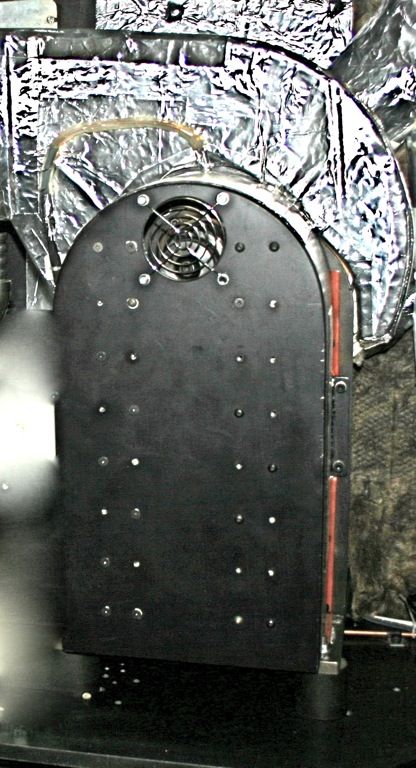
Pollution controls is a timely topic but it was not at all planned for right now, another example of serendipity.  We are currently upgrading Mel's ( freshcup.ca ) third generation Roastaire™.  It is only five years old but enough new parts were developed in the interim that it was a good idea to modify or install parts to satisfy his working requirements.  The first occasion for an "Ah Hah!" moment was the inside view of the exhaust just before it enters the chimney.   It was a good feeling to have the proof that the "SmokEater™" was working so well.

The second element in this synchronicity is the chimney fire warning contained in two advertisements in the September - October  "roast Magazine":
- If you're a roaster, you know the quote: "It's not IF you're going to have a roaster fire, but WHEN."
- "According to the U.S. Government, there were over 1,800 roaster fires last year." an advert by Iron Dragon Tools

They were advocating regular exhaust and chimney cleaning to prevent chimney fires yet the Roastaire™s roasted for over a decade without cleaning an exhaust nor having a problem.  Furthermore, only days before we had witnessed a five year old Roastaire™, which roasted 5 days a week,  that had an exhaust which was as clean as the day it was installed.

Further reading of "roast Magazine" showed the significance of the problem where their featured interviews asked each interviewee about their experience with fires.  Youtube has some videos of the chimney coating problems faced by other roasting companies.  Mel was deprived of this experience but he does not mind.

Originally our pollution test was only a visual inspection or rather the lack of visual evidence at the chimney when the Roastaire began the Cool Mode.  The test is more stringent now but we did not have to make any changes to the roaster.  Obviously a clear exhaust cannot be deemed to be a definitive pollution test after all we know that the common solution to neutralizing the smoke is to subject it to the high heat of a natural gas flame.  Small independent roasters do not have the required scrubbers to clean the combustion residues but they do eliminate the roasting smoke.  You still have to ask "Is the 400,000 btu to 1 million btu flame in the Afterburner the best way to eliminate smoke?".  It seems to be very wasteful to me not to mention the pollution by that flame itself.  In addition to its costly fuel charges the gas Afterburner takes up valuable floor space.  We decided to make the SmokEater™ a standard component of the roaster to optimize its operation and to minimize the footprint.  It does create a more expensive basic unit but we don't foster midnight roasting unless it is the third shift.  Of course not having to pay the gas heating for those high input Afterburners means that savings accrue very quickly.


Another fundamental difference with Drum Coffee Roasters is that they are continually flowing air through the flame, through the beans, and then up the chimney.  The Roastaire™ is a closed loop system for the entire Roast Mode.  During that time the air is recirculated which has the added benefit of significantly increasing the heating efficiency.  The air cleaning process wasn't an easy problem to solve.  Leaving too much smoke in the circulating air can affect the taste of the coffee by coating the beans with a tar like substance plus coating the inside of the roaster with the same substance.  Below is a photo of the air duct just before it enters the Roasting Chamber.  After 5 years of roasting there is only a light staining of the interior of the duct.


A design choice was to stop the roasting process within the roaster to improve the roasting repeatability.  Our earlier generations used a cooling tray, which is easier to accomplish, that delays cooling until the transfer is done and evenly distributed over the bottom.  Cooling within the Roasting Chamber permits the constant monitoring of the air quenching of the beans which stops the exothermic roasting reaction within a few seconds.   It also assures that the air entering the roaster during the Cool Mode will be "double cleaned" before it is evacuated to the vent or chimney.

California is the bellwether on emission standards but it is still a work in progress.  The traditional method has been complaint based forcing many roasters to occupy commercial areas or midnight roasting.  The people at Roastaire™ promote the "theatre of roasting" which takes place at the café.  It is the most convincing way of communicating to clients that the coffee is "freshly roasted".  To this end they roasted, without a chimney, on the floor of the Canadian Coffee & Tea Shows in Vancouver and last year in Toronto.  

In closing here is a quotation that appears in the October 26, 2011 edition of the Edmonton Journal Food Section which describes one side effect of the technologies we supersede.
“When we moved from our old location to this new location, the first couple of months we roasted coffee, I saw the fire department four times because people driving by would see all the smoke from the roaster coming out of the roof, and they thought the building was on fire,” says Filpula, laughing. “The firemen would come in; I’d give a tour of the roaster.”

Saturday, 8 October 2011

Sustainable Roasting


During the last decade we have been quite busy "doing" rather than writing about our goals.  Vancouver was the second Coffee & Tea Show in which the Roastaire™ was the only coffee roaster that was making magic in the hall.  In time, we should blog some of the fundamentals that drive the project i.e. efficiency, pollution controls, sustainability, "greeness", freshness, design, roasting, etc.
For more detail click photo and choose original size

 Function determined style for the roaster and the business model.  FRESHNESS is our dominant theme.  It, along with SUSTAINABILITY  has determined the roaster design and the business model.

No one involved had the desire to operate a roasted coffee warehouse.  For those who may not have given it much thought the green beans have a relatively long life span, just as other living seeds.  Given proper storage conditions they last more than a year. 

Roasted coffee has a short life span.  This is incongruous with the designation of non perishable food.  It has been written that lobbying by food purveyors resulted in a legislation that roasted coffee has a lifespan of greater than 18 months hence it was deemed non perishable.  The coffee continues to stale along its own time line but the vendors do not have to indicate when it was roasted.   Many gimmicks are used to give the impression that freshness is maintained or is not important.  Valves do not "lock in freshness" they prevent the carbon dioxide, given off by the recently roasted beans, from bursting the bags.  Cold storage does reduce chemical reactions but studies promoting this used temperatures that were much colder than the inside of a household deep freeze.  Furthermore, bar the bath tub, the refrigerator is the most humid place in a house.  It is not a good bean storage environment.  Moving beans between the cold storage and the coffee preparation counter only exacerbates the problem.  Grinding the beans at the time of purchase is most likely the worst practice.  Store ground beans are probably better than going without but you deserve so much more. 

The aim of getting the coffee to the consumer within 3 - 5 days has determined the size of the roaster and the business model.  People have found that the optimum flavour is produced 24 to 48 hours after roasting.  With this in mind   www,FreshCup.ca   opened an Online Store which ships coffee on roasting day via Expedited Parcel.  There is no compromise possible on shipping - it has to be as fast as possible.  To make the Expedited Parcel costs acceptable they are free within Canada for two lbs. of coffee, or more.  To present the consumer with a top notch product all elements of the preparation have to attain the same high level.  Giving someone the choice of saving a dollar with a snail like delivery was thought to be counter-productive.

It is getting quite obvious why this opinion was not a tweet.

The Roastaire™ has a 3 kg green bean capacity which yields nearly 6 lbs of roasted coffee depending on the degree of roast.  The darker the roast the greater the weight losses.  This roaster is able to do about 5 batches per hour, again depending on the degree of roast.  This implies that a café only needs to roast what is required in the immediate future.  The concept is "store green beans" and "move roasted coffee".   Regarding the café owners; they will pay for a coffee roaster regardless, either it will be their own or that of a supplier.

Even though we have reason to believe that our roaster produces excellent coffee I think that you can be well served by a local roaster if your coffee is freshly roasted On-Site.

Friday, 7 October 2011

Canadian Coffee & Tea Show


We just returned from the Canadian Coffee & Tea Show, in Vancouver, where the Roastaire™ roasted coffee on the show floor.  The big deal was that it was the only coffee roaster that took on the challenge of roasting inside without a chimney.  A lot of design work has gone into improving the roaster efficiency and pollution controls but that is what made it possible to accomplish task.

The air, cooling the newly roasted beans, was vented into the room so there was a coffee aroma near the booth but the roasting smoke was neutralized within the machine which is why this machine is friendly to neighbours.
 Mel, the Roast Master, roasted approximately forty 3 kg batches of coffee while he explained  the Roastaire™ features and the significance of monitoring the roasting process in real time with the computer.  The Bean Sampler was only pulled to show the visitors that there was a Bean Sampler but that the process was not optimal especially for someone with less than a year's roasting experience.

Mel's coffee is available at FreshCup.ca   There are no transportation costs within Canada for two or more pounds of coffee.  Unfortunately this morning's order from Santiago, Chile could not be filled in a timely manner.  FRESHNESS is their mantra.

We also received the Twitter Lawrence Tanner who has a better photo of the Roastaire™ on yfrog:  (link is     ) as shown below


 It is quite a challenge to photograph stainless steel cylinders in front of a black wall.  There is certainly something to be learned in that process as well.
Roastaire™ and Coffee Roasting