Pages

Showing posts with label staling. Show all posts

Friday, 21 September 2018

Extending Freshly Roasted Coffee Lifespan

The main enemies of Freshly Roasted Coffee are Time, Oxygen, and Moisture.

A solution has been presented to the public that is more beneficial to the manufacturers than to the end user.

Background info:

Immediately after roasting the coffee beans begin to emit carbon dioxide in sufficient volume and pressure to burst a hermetically sealed bag.  Some roasters opted to degas the beans for one to three days to alleviate this problem while manufacturers came up with a new product, the valve.
http://nxt-roasters.blogspot.com/2011/12/do-coffee-bag-valves-leak-1.html
http://nxt-roasters.blogspot.com/2012/05/revisited.html

Valve Limitation - as currently used:
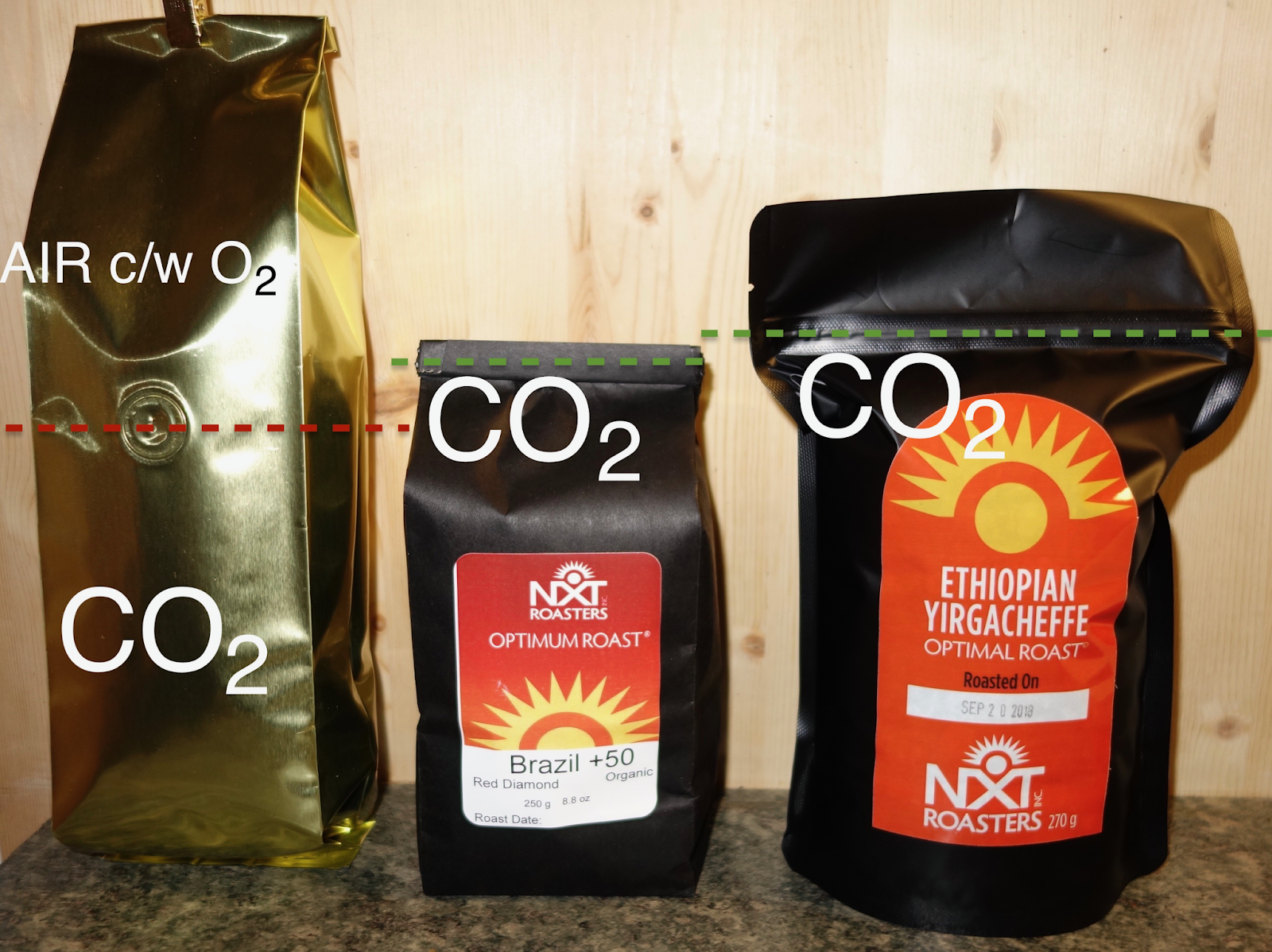
It is possible that the valve is a single solution to burst bags when with a little more thought it could have also help to extend the freshness of coffee beans.

The CO2 is roughly 50% denser than the air we breathe, which consists of about 21% Oxygen.  This means when packaged, on the first day, beans emit CO2 that gas drops to the lowest level in the container and pushes the existing air upwards.  Surrounded the Freshly Roasted Coffee Beans with CO2 retards the oxidation process, hence, slows down the staling process.  How well and for how long the freshness is preserved is much more difficult to assess and beyond the limits of a one page blog entry.  For arguments sake I say it gives an extra week.  This process exists for the beans that are continually bathed in CO2 which is not the case when there is a venting valve.  As shown in the photo the CO2 will rise up to the valve then exit rather than flush out the air above the valve.  That means that, as the photo illustrates, that only 2/3 of the beans are in CO2 providing the bag is not tilted.  If the bag was laid on it back so that the valve was at the high point of the bag then there would be a different outcome but bags are not stored, shipped, or displayed laying down.  That scenario would be improved by moving the valve upwards to minimize the amount of air in the bag.

Using a valve does allow the roaster to degas in the heat sealed bag which offers the consumers the security and assurance that the bag contents have not been tampered with.

Alternatives:

The NXT solution to this dilemma is to use a ziplock bag which presents more flexible packaging options.  First, all the oxygenated air is pushed out of the bag when the bag is kept upright.  We recommend that people scoop out the beans for immediate consumption rather than pour them out which would drain much of the CO2.  Leaving CO2 to protect the beans extends the freshness.  Our bags are in a supervised area and they are not opened after closing but for added security, where bags are placed in a public area and a heat seal is required a simple pin prick between the ziplock and the heat seal which will prevent bursting the bag and allow a flushing of the oxygenated air.

NXT advocates degassing in the bag to take advantage of the emitted CO2 to extend the freshness of the coffee beans.

We have a Carbon Dioxide high pressure tank and a regulator to test the effect of giving a shot of CO2 to a bag of beans that are more than a day old when outgassing has mostly ceased.

It might mean some beans will be destroyed with water to determine the volume of the interstitial spaces which will indicate how much CO2 has to be injected to bathe all the beans in a protective gas.

To Do:

Test to determine how CO2 will enhance the life of ground coffee.

Wednesday, 31 July 2013

NXT Roasters has the Aeropress brewer

There are several brewing options available to the consumer but only a few have a "freshly roasted" priority mostly because they cannot deliver their coffee in a timely manner.

We searched  the Internet and wrote many emails to source the brewer that would give the best value to our customers.  The Aeropress is a well designed and built device which does not require an expensive electric brewer.

There are countless videos that address brewing with the Aeropress but most of them are not worth a mention because they exhort what I consider a faux pas i.e.
- advocating coffee is ok up to 40 days after roasting
- coffee should be used within 10 days of grinding
- a presenter attempts to explain how they defy the laws of physics by building unbelievable pressure
- another has concluded that the pressure pushing out the coffee is a vacuum
- for some reason some equate hot water with bitterness rather than improper roasting and staleness
Critical thinking is required on the Internet.  Yes, even now!

The Aeropress is versatile and has well designed accessories.  It can be used in two ways which are best explained by way of videos followed by pictures and explanations.

The KPCC Radio video demonstrates the Filter Down Method (photo to the left).  The temperature is important, it affects the extraction and should be above 90°C  (194°F).  The low temperature advocates probably make or sell machines that are unable to serve hot water.  The simplicity of the electric kettle is not to be scoffed at.  In an anecdotal observation a few tablespoons of coffee are placed on the bottom of your sink (especially appropriate experiment for those that have weeks old coffee but want to move to freshly roasted delights).  Allow some warm water to flow gently against the mini mound (gently - don't power wash it away) then increase the temperature.  You will find that the hot water dissolves while warm water agglomerates.

The Atomic Way video demonstrates the Inverted Method (photo below) which eliminates the dripping into the cup while mixing.


THE GRIND.  We often drink a modified Turkish style coffee where all the ingredients are mixed in the cup.  The finely ground coffee is only produced by a burr style grinder.  A finely ground coffee has a large surface area proportional to its volume which means a rapid extraction and that the grains soak up the water and decant quickly.  A fine grind like this creates a mini disaster in the gravity drained brewers because the water is poured onto the grind faster than the permeability allows it to go through, resulting in the dreaded overflow.  The plunger pressure in the Aeropress appears to circumvent that problem and yields a better extraction.

The end user has to determine the grind by experimentation.   A coarse grind will under extract and the water will be pushed through too quickly.


The Aeropress is then flipped over and placed
on a cup and the process continues as in the
conventional method.


FRESHNESS IS #1  The staling process starts after
roasting and begins to be detected at the end of one week.  Grinding the coffee accelerates the staling process.  The high surface area proportional to the content of a coffee ground means that it is more rapidly affected by oxygen and moisture.  Grind at the last minute.

More will follow shortly when the pictures of the various Aeropress components are taken or downloaded.

Saturday, 16 March 2013

This is Crema !

Crema !!
There are few "honest" ways to get great Crema.  The first one is Freshly Roasted Coffee in a tuned Espresso Machine.  Of course that is also how you maximize the sweetness of high quality Arabica beans.

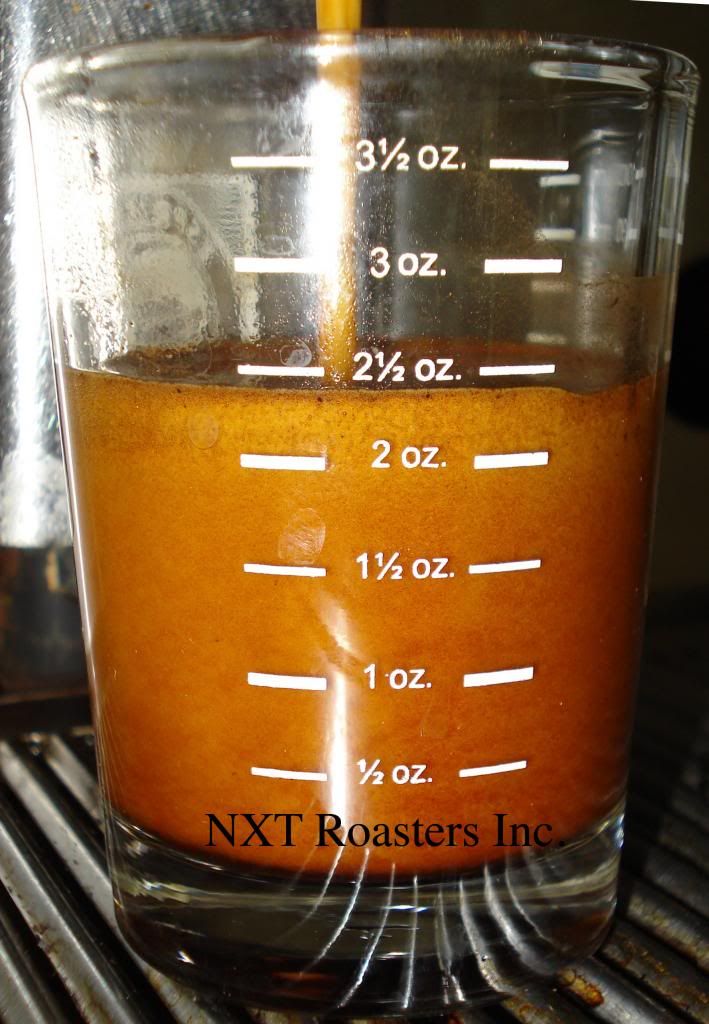
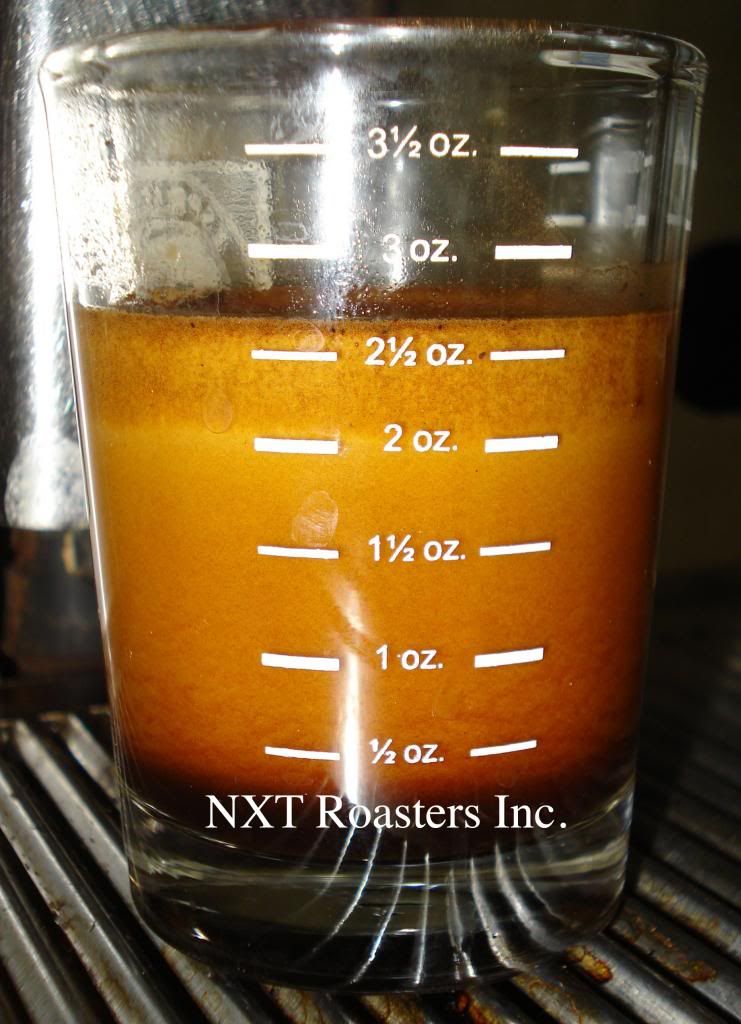
The quantity of Crema rapidly decreases as the roasted coffee ages.  The taste is also greatly affected by the staling that begins to make itself noticeable within one week after roasting.

In the first two pictures the Arabica beans were roasted four days previously.

The crema to liquid coffee conversion starts towards the end of the brewing process it is not so fast that the client would be deprived of a significant amount of Crema.


Crema has been viewed by many as an indicator of freshness.  Unfortunately some people think that it is clever to deliver Crema without the freshness.  Common techniques are to add chemical foamers or to add Robusta beans to a blend of Arabica beans because the Robusta beans yield a greater amount of Crema even when it is stale.  At one time the Robusta beans were considerably cheaper but the price increased when too many people started to add Robusta to the Arabica beans.   Adding bitterness for the sake of looks is not a good trade - for the client.  

Though it is possible for anyone to add Robusta beans it is less likely when a roaster is serving freshly roasted coffee, because their brew will naturally have the great indicator of freshness.  After all, a local roaster does not have a long supply chain which requires months to complete the distribution process.

Do yourself a great "flavour" by sourcing beans from a local roaster or someone who can deliver them within 2-3 days from the roasting date.

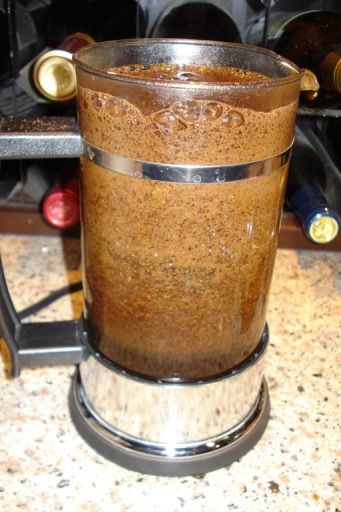
The brew in this French Press was prepared two days after Roasting.  It is also significant that the beans were ground with a blade type grinder which yields a coarser ground that yields  impressive results but is inconvenient because water will have to be added and the particles take longer to decant.  If the Plunger is pushed too quickly the Screen will plug and a hydraulic lock will occur.                                                        
A burr style grinder yields finer and more consistent results.  The finer grounds will infuse more quickly and will decant reasonably quickly.  The screen is then pushed down to prevent the grounds from being poured into the cup.  The solids do not add to the pleasant experience.                                   

Develop a personal coffee ceremony to consistently get great results.  If the results are not the best then try one thing differently and note if it is better or worse.

Hopefully there will be many improvements because well prepared freshly roasted coffee is so sublime.


Monday, 21 May 2012

Vented Bags Revisited

The original blog of  Do Coffee Bags "Lock in the Flavour" ?   and Packaging Optimism gathered the most visits.  Does this mean that those people believe or want to believe that there is a magical way to preserve roasted coffee.  Well, apparently there is but it involves a -273°C or -459°F refrigerator.  That is no ordinary ice box.  Even then the degrading chemical reaction is only slowed down not stopped.


This little valve is, in my view, good engineering. The object can be mass produced cheaply and there is much more to the design than the average coffee drinker pays attention to. Notice the fiber filter which is backed by a plastic frame to give it strength. I assume that the purpose is to keep coffee particles away from the sealing lip but then it may also keep small life forms out of the bag.
Interestingly, the valve is required to preserve the bag rather than the coffee.  In the days after roasting the coffee beans will produce enough CO2 to burst the bag ( it depends on the bag material but I found that 250 to 350 grams was the limit for un-vented vacuum packed bags).  I suspect that the "longevity improving" aspect was more an invention of the marketing department than an engineering criteria. 

A marginal improvement in longevity might be possible with vacuum packed vented bags.  If the bags are packed within the hour after roasting they will need the valve even if they are vacuum packed.  The porosity of the bean is relatively low and it takes time for the CO2  to migrate from the bean.  Without a vent even vacuum packed packages look like overstuffed pillows.  Obviously that would not allow efficient boxing of the bags.  

Rather than believe that the bag was not kept in a warehouse for months and or spending days in truck trailers I prefer to buy from a local roastery or from Fresh Cup because they expedite the order on the day it is roasted.  Oh well, that offer is only for Canada which means that more than Alaska and Hawaii are hit by the shipping restriction.

Saturday, 10 December 2011

Packaging - Optimism


Packaging attempts to circumvent or overcome the stalling of coffee.   It does not keep old coffee fresh though it is claimed that it slows down the staling for an unbelievably long time.  Most of the advantages are perceived by the consumer based on sizeable advertising programs.  Though it appears that a valve, at least under ideal conditions, lets little air into the bag.  Well, less than the bag would have had when it was sealed.  Vacuum sealing reduces the air and moisture in the bags but that requires more equipment and time.  The valve does let out the CO2 but it also lets the aroma escape.  The vented bag will have a lower internal pressure, than say a metal container.  The lower pressure exacerbates the loss of volatile compounds which are the reason for that olfactory experience.  To circumvent that loss some companies replace the vent by Oxygen and/or CO2 scavengers.

"Espresso Coffee" by Illy & Viani states that the spoilage rate increases by 7 fold with every 10°C increase in temperature.  Unfortunately there is no mention if that calculation starts at absolute zero. It is an unmeasured and uncontrolled variable that very much affects the coffee experience.


A lot of money was invested into the marketing of various types of packages because the business model of central roasters depends on convincing customers that coffee that is more than a year old still has the freshness of yesterday's roast.

I view the valve as a packaging solution which does not contribute much to maintaining the roasted bean's fresh taste.  My only acceptable solution is to buy the freshest coffee from a local roaster.  An exception, in Canada, is Freshcup.ca which ships, via expedited post, the day the coffee is roasted.  On several occasions I have sent some much appreciated coffee gifts.  It could be perceived that I am biased because they use our roaster though I maintain that the long relationship has allowed me to observe closely the organization and witness their commitment to delivering the freshest great tasting organic coffee to their customers.

Sunday, 27 November 2011

Food Processing vs. Nutrition ?

AKA - Does Processing make it a Lesser Food ?

The distilled opinion is "the more you process the less the consumer receives".

For various reasons the most common vehicle for food delivery has been perverted.  In response to "manufactured food", fresh food advocates are informing the public about  real food and real food costs.  

Living on the 100-Mile Diet , Revisiting Carrying Capacity:, Natural Foods, Organic Foods, etc.  It appears that greater "inputs" yield less nutrition.  Large marketing budgets promote convenience and "filling the belly" instead of feeding the body for growth and health.  Increased time spent transporting food means, as well, increased food degradation time.  Industry will typically attempt to address product appearance indicators that influence a consumer.  Unfortunately nutrition is sacrificed for the sake of colour and appearance.  


Before focusing on one product not usually covered in the fresh food debates I would like to add that I believe that the movement advocating quality food is gaining membership.  

My interest is the freshness of coffee.  Of course people do not live by freshness of coffee alone.  That would be silly because it mostly feeds the soul, the well being, the disposition, etc. Coffee has undergone a centralizing process which exchanged convenience for quality.  Bigger is not better if the product is lessened.  We have not developed Star Trek transporters to move food instantly to the consumer while maintaining the product integrity.  If the past is any indicator this futuristic device would further degrade the food.  Warehousing roasted coffee decreases the value to the end user.

I advocate that the coffee roaster, grinder, espresso machine, and brewer should be at the same site.  Nothing gives more credibility to the freshness of the product as when the consumer can observe the preparation.  To this end Jim Townley uses the moniker of "the Theatre of Roasting".  It encourages clients to learn about the process while it reinforces the artisanal qualities of freshness and caring preparation.  Small batch roasting, in our case 3 kg batches, allows the RoastMaster to roast the requirements of the next few days.  Most likely more than one batch of each coffee will be roasted but that is a choice based on sales.

This is a simple food preparation model even though it appears to counter the produced locally mantra of some of the above links.  We are not blessed with local coffee plantations but because the coffee bean is a seed which is designed by nature for long term storage it may be consumed at a distance from its origins with a certain proviso.  So where is the Freshness Challenge?  Roasting transforms the bean and creates havoc with the storage capability of the bean.  Roasted Coffee degrades quickly despite touted storage "solutions".   Freshly ground stale beans is an advertising distraction which offers no benefit to the consumer.  The analogy of the weak chain link is true.  Nothing will resurrect stale coffee not even a marketing campaign.  

For the best cup of coffee start with a freshly roasted high mountain grown Arabica bean that is ground just before brewing.

Wednesday, 16 November 2011

Staling of Roasted Coffee

Coffee stales much faster than it is commonly perceived.  An extreme example is noted in "Coffee Technology"by Michael Sivetz where he mentions that moisture absorption from the air or due to water quenching need only to be 1% to noticeably stale coffee within the hour.  This represents 30 cc (1 fluid ounce ) per 3 kg ( 6.6 lb ) batch which,  considering that the beans lost 12 to 20 times that much moisture when roasting, is quite significant.  Advocates of water quenching claim that all the water evaporates as it hits the bean.  I am not so certain that this is so because after roasting the bean is very porous which means that the water will quickly cool the outside layer the bean will then have difficulty conducting the heat to the surface to evaporate 100% of the moisture.  The increased porosity will help draw the moisture inside.

Each opening of the container allows more moist air to reach the roasted coffee.   Sivetz writes that the beans are "moderately stale" within a week, more stale within two weeks and stale in three weeks.  Greater surface area i.e. ground beans significantly increases the absorption of air and moisture.

Vacuum packaging does remove most of the air but if it is done within a few hours of roasting it can create problems because of the high pressure CO2 will be released from the beans and inflate the bag.  If the coffee is ground the CO2 will be mostly released within the hour.

In theory the Valve on the Bag permits a longer storage time but I am sceptical about that valve working perfectly.  The changes in air pressure are small and applied over long periods of time as the barometric pressure changes which causes the bag to breathe.  The valves are attached to a bag that is filled with coffee beans which is not a flat surface hence I am thinking that it leaks and that it's purpose is to prevent the bag from bursting from C02 pressure.  Before going further that has to be tested.  I reiterate that the only safe bet is buy Freshly Roasted coffee.