Pages

Showing posts with label NXT Roaster. Show all posts

Friday, 21 September 2018

Extending Freshly Roasted Coffee Lifespan

The main enemies of Freshly Roasted Coffee are Time, Oxygen, and Moisture.

A solution has been presented to the public that is more beneficial to the manufacturers than to the end user.

Background info:

Immediately after roasting the coffee beans begin to emit carbon dioxide in sufficient volume and pressure to burst a hermetically sealed bag.  Some roasters opted to degas the beans for one to three days to alleviate this problem while manufacturers came up with a new product, the valve.
http://nxt-roasters.blogspot.com/2011/12/do-coffee-bag-valves-leak-1.html
http://nxt-roasters.blogspot.com/2012/05/revisited.html

Valve Limitation - as currently used:
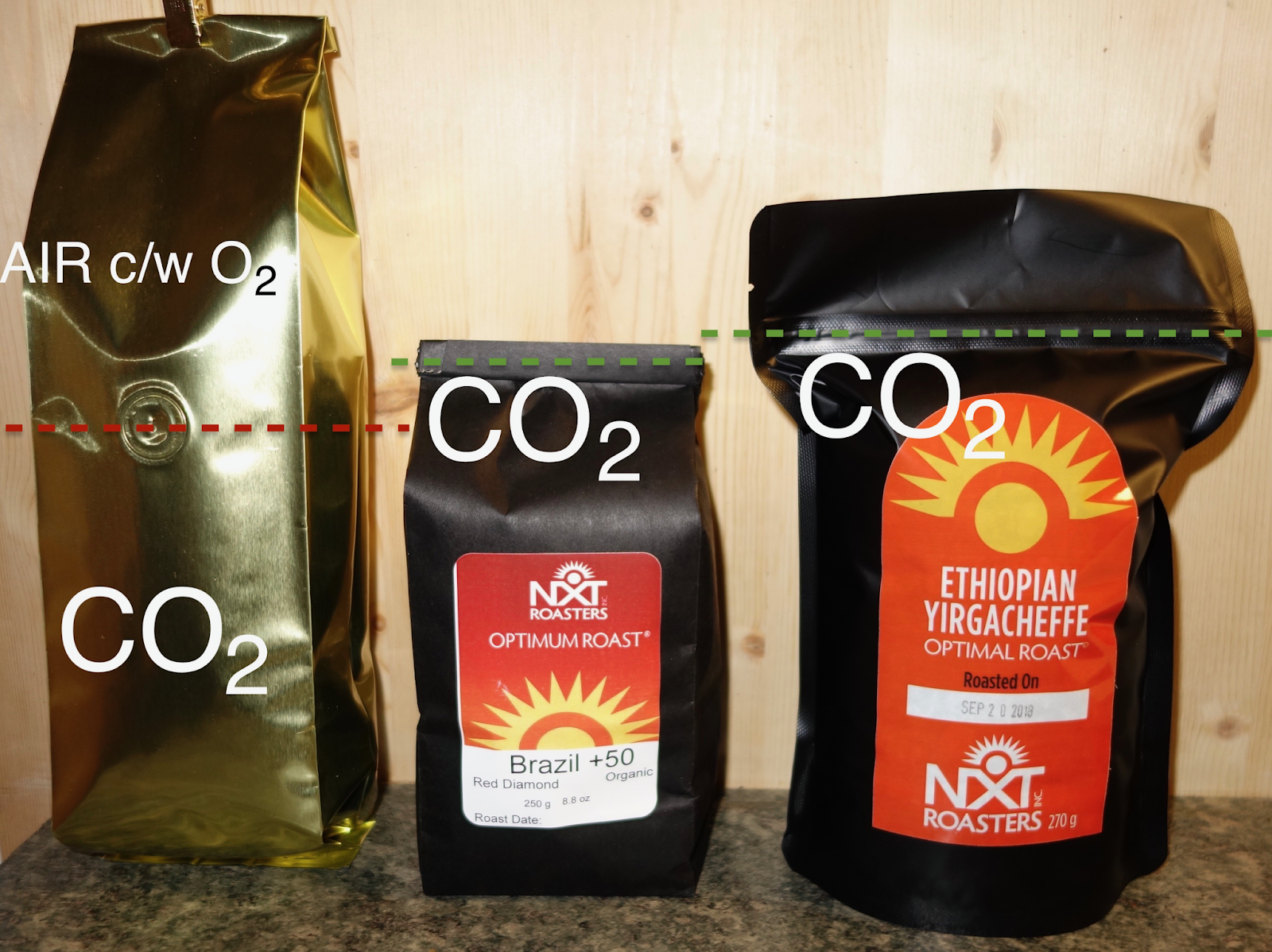
It is possible that the valve is a single solution to burst bags when with a little more thought it could have also help to extend the freshness of coffee beans.

The CO2 is roughly 50% denser than the air we breathe, which consists of about 21% Oxygen.  This means when packaged, on the first day, beans emit CO2 that gas drops to the lowest level in the container and pushes the existing air upwards.  Surrounded the Freshly Roasted Coffee Beans with CO2 retards the oxidation process, hence, slows down the staling process.  How well and for how long the freshness is preserved is much more difficult to assess and beyond the limits of a one page blog entry.  For arguments sake I say it gives an extra week.  This process exists for the beans that are continually bathed in CO2 which is not the case when there is a venting valve.  As shown in the photo the CO2 will rise up to the valve then exit rather than flush out the air above the valve.  That means that, as the photo illustrates, that only 2/3 of the beans are in CO2 providing the bag is not tilted.  If the bag was laid on it back so that the valve was at the high point of the bag then there would be a different outcome but bags are not stored, shipped, or displayed laying down.  That scenario would be improved by moving the valve upwards to minimize the amount of air in the bag.

Using a valve does allow the roaster to degas in the heat sealed bag which offers the consumers the security and assurance that the bag contents have not been tampered with.

Alternatives:

The NXT solution to this dilemma is to use a ziplock bag which presents more flexible packaging options.  First, all the oxygenated air is pushed out of the bag when the bag is kept upright.  We recommend that people scoop out the beans for immediate consumption rather than pour them out which would drain much of the CO2.  Leaving CO2 to protect the beans extends the freshness.  Our bags are in a supervised area and they are not opened after closing but for added security, where bags are placed in a public area and a heat seal is required a simple pin prick between the ziplock and the heat seal which will prevent bursting the bag and allow a flushing of the oxygenated air.

NXT advocates degassing in the bag to take advantage of the emitted CO2 to extend the freshness of the coffee beans.

We have a Carbon Dioxide high pressure tank and a regulator to test the effect of giving a shot of CO2 to a bag of beans that are more than a day old when outgassing has mostly ceased.

It might mean some beans will be destroyed with water to determine the volume of the interstitial spaces which will indicate how much CO2 has to be injected to bathe all the beans in a protective gas.

To Do:

Test to determine how CO2 will enhance the life of ground coffee.

Sunday, 8 July 2018

NXT Coffee Roaster Design not "off the shelf"

To Google Maps
Most coffee roasters are heated by  a natural gas flame.  Natural gas is a cheaper form of energy than electricity but it comes with inherent limitations.  Since the flame requires a continual supply of oxygen it requires a lot of air which must be raised from ambient to combustion temperature, this  is not the end of the energy waste.  The coffee roasting is usually done in the exhaust gasses of the flame which, are not hot enough after passing through the Roasting Chamber, to break down the roasting smoke.  That smell is similar to burnt toast, in the later stages, - imagine several kilo grams of burnt toast.  Hence, an Afterburner is required to raise the temperature to over a 1000°F to break down the smoke.  The large amount of air required by the flame means that a large amount of air must be raised from ambient temperature to over 1000°F.  Consequently, the Afterburner burns, depending on the model,  three times as much energy as the roaster (the equivalence of 6 home furnaces) just so that the neighbourhood will not see nor smell the roaster emissions.  Of course the emissions from such burners are always present but the operators hope that they become sufficiently diluted by the outside air that they will not trigger calls to the environmental agency.  Pollution awareness is upon us and some areas already require permits for coffee roasters with 5 kg or more capacity.

Are there alternatives?
There is, if the fabricator begins with a clean design slate rather than use off the shelf technologies.  First, the amount of air needs to be reduced to greatly reduce the waste of energy.  It is true that often the electricity is generated by the combustion of natural gas but the electrical companies have specialized equipment to remove and neutralize gas volatiles that individual roasters do not use.  Nevertheless, the electrical Roastaire™'s biggest advantage is virtually eliminating the continual feeding of air to the roasting process.  It is possible to recirculate the air with electrical heating because you do not need to feed a flame.  The advantage, is that less energy is required to heat the returning air than to heat room temperature air (ambient) to roasting temperatures.  There is less air to treat when neutralizing the emissions therefore it can be done on a continual basis. A minor advantage is that the oily smoke, as part of the re-circulation process, is burnt which helps to heat the roaster.

Does the design work?
 Below is a photo of the tubing that guides the re-circulated air to the Roasting Chamber.  The roaster was in service for 5 years before this photo was taken.  It had roasted about 30 tonnes of coffee.  It does illustrate why Fresh Cup Roastery Café (Saanichton & Vancouver) clients refer to it as  "Clean Air Roasting"

5 yrs of roasting = clean air duct


 Now compare the above photo with one taken of a drum roaster after one year of service.


There wasn't a copyright on the photo but I am not attributing the photo because there is little benefit to kicking a hornet's nest.

In 2010, it is reported that there were 1800 chimney fires, in the USA, that were attributed to coffee roasters.  What heating method do you think was responsible for this incredible statistic?


                                                ------------------------------------------
In the Roastaire the exhaust is passed through a second SmokEater© before it is discharged.  It roasted hundreds of batches inside the Toronto and Vancouver convention centres without the use of a vent or chimney.

What is exhausted?
 Only the air cooling the roasted coffee is exhausted after scrubbing it twice.  More details about the design reasoning will be forthcoming when the topic of Bean Cooling is approached.  In the interim here is some more information on an earlier NXT    blogspot page.


Sunday, 15 April 2018

NXT Freshly Roasted Coffee vs Marketing Spin

There are a lot of excuses that are generated by the untimely delivery of coffee.  It appears that more effort is made to make up a fanciful story than to deliver freshly roasted coffee.

It is easier to examine process where companies will pronounce certain rules as if they were laws rather than an opinion or marketing ploy.  Grocery stores have convinced the government agencies that coffee is not a perishable or that its shelf life is greater than 18 months.  Why?  I would say that it fits in with their warehousing distribution model rather than their concern for delivering a fresh product.  The economy brand coffee purveyors notably dance around their weakness which is usually centered on freshness.  Most often there is a clash of goals between their purchasing based on price and their desire to sell at a high end price.  Obviously that is not the message they wish to convey so this is where the marketing dance is conjured.
The question "Is your coffee freshly roasted"?  The typical answers:
- we grind it just before brewing
- we brew on the hour
- we serve our coffee when it is at its prime
- our coffee is ground to a different level
- we have a special relationship with our roaster even if it is 500 miles away
- our roaster uses the best beans
In all cases the question is not answered because it is important to circumvent that limitation by presenting a subjective answer (usually missing the point of the question).  It is a chink in their armour that appears to only be visible to those who are passionate about coffee, inquisitive about the claims, and discriminating purchasers.

On that note, a client must judge if coffee beans must degas for one to 5 days.  The beans will degas regardless because the pressure is sufficient to burst a tightly sealed plastic bag.  I prefer to package ASAP after roasting, letting the beans degas in the bag.  To that end we keep the bags closed, but not sealed, and upright so that the carbon dioxide* (which is more dense and heavier than air) will displace the air by pushing it our the top of the bag.  The client is able to decide when to drink the freshly roasted coffee. We have not found a need for valves.  If the valve is kept as the highest point of the bag the interstitial spaces will also be occupied by carbon dioxide instead of oxygen rich air.

Unfortunately most valves are located around the mid-line which means only half of the bag is purged of oxygen.  To purge the air from the valve equipped bag the bag has to be laid down so that the valve is the highest point in the bag.  Emptying the bag requires the same consideration to preserve the CO2 level, while keeping the bag upright scoop out the beans rather than pouring out the beans along with the CO2.  Pouring the entire bag into the grinder will pour in the CO2 as well but I suspect that the CO2 will drain out the bottom of the hopper, through the burrs, and out of the grinder.  That illustrates a grinder limitation which should be examined in another post.

*  Carbon dioxide is a colorless gas with a density about 60% higher than that of dry air. Carbon dioxide consists of a carbon atom double bonded to two oxygen atoms.  Dry ice is the solid version of CO2.  The wafted vapour that we see above the dry ice exposed to room air is actually moisture from the air that has condensed due to the low temperature near the dry ice.

Sunday, 23 February 2014

Where to Next or is it NXT ? Suggestions? Freshly Roasted?

It is time to refresh the blog but the subject matter is not "gelling".  We are working on upgrades but it would be premature to discuss a modification before it is introduced.  I am open to re-examining a blog or even attempting a new topic.  We are also considering a coffee related forum but it should be outside of the crowded topic of sensory and subjective appreciation for the brew.  Our preference is to measure rather than just opine.

Send us an email about a topic.

Tuesday, 26 November 2013

Improving the Roasting Efficiency.

There are several aspects to be considered before a process can be implemented to improve a design.   Often it is possible to identify, let's say for the sake of discussion, 10 variables that will affect the process.  What is usually impossible to predict is the rank or the level of dominance of each variable unless you are really really really a gifted analyzer or clairvoyant.  Personally I resort to testing a few variables at a time to better understand their effect.  There will undoubtedly be surprises and inconsistencies when various variables are tested together but it is simpler to test in parts than in whole.

The testing results are unlikely to produce a clear graph such are joys of solving problems with multiple unknowns.  The results will give a better idea about the trade-offs that are required before a process can be adopted.  We maintained that coffee beans should be uniformly heated so that the chemical reactions that occur within the beans progress evenly.  It was also deemed important that the beans not be thermally overloaded.  To clarify; the bean has a certain capacity to transmit heat to its interior, if the heat applied is greater than what can be evenly distributed the exterior surface becomes much hotter  and creates a risk of scorching.  It is also for this reason that we roast at a relatively lower temperatures of 240°C to 250°C instead of ...  In "Espresso Coffee" R. Eggers writes the typical gas temperature of a drum roaster is 400° - 550°C.  The high temperature cooking analogy for beans hit by the super hot air is frying eggs while using the stoves highest heat setting.  Yet this fluidized bed roaster has a cycle time of less than 12 minutes versus up to 20 minutes in a drum roaster.   That  is Better Efficiency! 

The even distribution of heat is critical to preparing the beans for the roasting process.  We force heated air between the beans so that they are all heated, not just the outside layer.  There are small domestic roasters that also use air to create a fountain of beans.  It is quite dramatic but if the air flows through a narrow passageway then the remaining beans are not being heated until they gradually make it to the fountain.  Consequently, if you are looking for a home roaster look for one that pushes the air through all the beans.  Typically, the batch will move upwards as the beans are levitated by the flowing air then the air will break through and mix the beans.  The release of air pressure allows them to drop within the chamber but are then suspended again.  The air cushion has the added advantage of keeping the beans off the hot metal which often causes tipping which appear as little pieces of the exterior wall that leave behind a shallow cavity.

It is a simple concept that is regulated by many variables which turn it into a complex process.  

There is more to the efficiency quest than even thermal transfer and the recycling of air mentioned in the previous blog which leaves something to write about later.  Now it is time for an espresso.

Monday, 21 October 2013

Improving Roasting Technology

The picture links were removed because Photobucket decided to change the terms of usage in mid stream, so to say,  It is inconvenient for viewers but it is better to rid yourself of such people as soon as possible.  It is the attitude as much as the action.   We will try to repair that mess at NXTroasters.com

 The conventional approach appears to be - buy a roaster and endure its limitations.  Most conventional roaster owners spend more time developing marketing spin than improving their coffee roaster.   The deficiencies i.e. emissions are already the focus of some legislative bodies which require permits for roasters in their jurisdictions.   Oil burning engines, showing that blue smoke, are rarely seen on the road today yet many owners are complacent about roasting without pollution controls.

The roaster owners who are concerned that large plumes of smoke coming from their chimney are bad for their community image have purchased large gas fired after-burners that burn approximately three times more gas than the roaster itself.  Imagine if automobile pollution controls involved using three times more gasoline than the engine.

Rather than maintain the polluting status quo which may or may not have visible smoke, NXT Roasters Inc., have developed an alternative (branded the Roastaire in Canada) approach that uses the smoke generated as a source of roasting heat rather than expend large amounts of additional energy to thermally neutralize the smoke.   Both 15 Kg/hour concepts thermally treat the pollutants but one system uses a 400,000 to 700,000 BTU after-burner  to accomplish the task.

The first picture is of the main air passageway of a Roastaire after five years of full time roasting.  This revealing photo demonstrates the reason for their motto of "Clean Air Roasting".  This illustrates how efficient and effective the air is scrubbed clean as it is re-circulated during the roasting process.   This closed loop roasting process means that the air only has to be heated 20° to 40°C to return it to the roasting temperature.  Compare that to a single pass air supply that is continually heated from ambient temperature then sent to the chimney.   In "Espresso Coffee" R. Eggers writes the typical gas temperature of a drum roaster is 400° - 550°C.   What a wasteful process.


In comparison,
one drum roasters Maintenance Manual draws attention to the chimney,  "Even if residue build-ups do not exceed 1/8 inch (.3 cm) per year, clean system annually ".    The quotation is not properly cited nor acknowledged but I will do so if the manufacturer requests it.

They also have this picture of a drum roaster fan as a warning about the residue that coats some of their components.  Roast Magazine had the following quotation "It's not IF you're going to have a roaster fire, but WHEN."  Which roaster do you think requires the most maintenance?  Which type of roaster do you think was responsible for nearly 1,800 chimney fires in the USA in 2010?


Which roaster do you think roasted hundreds of pounds of green beans inside the exhibition hall of the last four annual 
Canadian Coffee & Tea Shows?

Monday, 2 September 2013

French Press Grind

The picture links were removed because Photobucket decided to change the terms of usage in mid stream, so to say,  It is inconvenient for viewers but it is better to rid yourself of such people as soon as possible.  It is the attitude as much as the action.   We will try to repair that mess at NXTroasters.com

The French Press is a classical brewer that has garnered many comments.  Often it is used for comparisons when authors are promoting a new device.   Many instructions and guides have been published yet there are recurring themes i.e. the medium grind with less than boiling temperature water.


Of course these demonstrations use freshly roasted coffee, otherwise what is the point of drinking coffee.

To the left the coffee beans were ground with a blade type grinder which is unable to attain the finer grinds.  The larger particles initially contain a lot of CO2 hence the large amount of foam.  I hesitate to call this crema because it is a mixture of foam and coffee grounds.

The foam develops very quickly when the nearly boiling water (that point will be argued later) is poured into the container.  Much of that is likely due to the sudden rise in temperature which causes the CO2 and other gases to rapidly expand, in the bean, when immersed in the hot water.

In the first minutes much of the coffee grounds are buoyed by the foam therefore they do not absorb sufficient liquid to decant.


Relying on the Mesh Plunger to do the solids / liquid separation will not give satisfactory results. Either the screen will plug with grounds and/or the screen  will deflect inwards let the ground migrate to the top of the mesh.
The argument that the grind has to be sufficiently coarse that the Mesh Plunger is not plugged ignores the importance of the extraction.  I maintain that the purpose of the Mesh Plunger is to keep the decanted coffee grounds on the bottom of the container when the coffee is poured into the cups.  The aim is to drink coffee not to have coffee grounds for breakfast.

The picture to the right was taken 1.5 minutes later.  We can see that the liquid line has risen but that more water will have to be added if the vessel needs to be full.  Very likely it will have to be filled twice to prevent the foam from overflowing.

In this case the Mesh Plunger was depressed 4 minutes after pouring the water.


To the left is a coffee  ground with a  burr grinder using  a very fine setting which usually makes a variation of in the cup Turkish coffee.  The Mesh Plunger  only comes into play once the grounds have decanted.  The settling process is greatly accelerated by the fine grind which  yields grounds that have a high ratio of surface area to volume, hence a rapid and thorough extraction.

The crema, discerned from foam by the size of the gas bubbles, is similar to an espresso shot.  The brewing was well behaved therefore no water had to be added.  The brew decanted within seconds and was served sooner than the coarser grind.

The water was brought to a boil then poured over the coffee.  The comments about near boiling water scalding the beans must originate with manufacturers and distributors of machines that are unable to heat water over 85°C.  

The roasting chemical process is halted when the beans are cooled below approximately 150°C which hardly supports the claims that 90°C water scalds the beans.  On the contrary experiments show that the extraction is better developed at higher temperatures. 

Do your own experiments and note the observations.  If possible measure the temperature of the water for different extractions so that you can optimize your procedure.  In the meantime enjoy the fruits of your experiments.


Friday, 2 August 2013

Aeropress - Well Designed & Good Value

NXT Roasters has a Coffee and Aeropress bundle in limited quantities available at our Roastery.

The picture links were removed because Photobucket decided to change the terms of usage in mid stream, so to say,  It is inconvenient for viewers but it is better to rid yourself of such people as soon as possible.  It is the attitude as much as the action.

Freshly Roasted coffee enhances the Aeropress and vis versa.   This brewer does not require an electric brewer which may bring you better coffee since all decent kettles can boil water but not all electric brewers can deliver water at 90°C or higher.

The coffee is Freshly Roasted On-Site in a roaster of our design that has achieved new levels of consistency and pollution controls.  We are very proud of the taste.


 This is the Aeropress package which consists of the brewer and some handy accessories.  The previous blog links to two videos that demonstrate how to prepare coffee with this unit.

We have found that a fine grind enhances the extraction and quite likely gives you a better exercise.  It is difficult to establish if more calories are "burnt off" during the press.

There has been some controversy about paper filters versus perforated stainless steel discs in the domains of tasted and environment.  The stainless steel discs are nearly the price of the entire unit therefore we opted to make the bundle more affordable rather than a high end offer that would cause many to hesitate.

The coffee is less "strong" than an espresso but stronger than drip.  People adjust to their preference by adding water to the final brew and call it an Americano.

There is a challenge for those who appreciate the espresso because the Aeropress cannot be placed on a demi-tasse, well not yet.  Extracting a small volume into a large cup is not satisfactory so we must accept some limits.  However, before discounting the unit try what it does best which is a smaller cup of coffee.

Scoop:
The Scoop contains about 12 grams of coffee depending on how the coffee is scooped and packed.  The preparation of coffee depends more on consistency than an absolute number because other variables often compensate.  Just don't consistently use stale coffee - nothing compensates for that.


Funnel:
Might also be useful in the kitchen but in this case it helps assure that the caffeine deprived person gets most of the coffee grind inside the brewing chamber.

Stirrer:
This is used to be certain that the grind is dispersed in the hot water (remember the key word is hot).  The top has "wings" which prevent the blade from reaching the bottom and tearing the Paper Filter.  Of course this is a moot point when using the Inverted Method.


 Paper Filter:
This is placed inside the Cap to stop the sediment from reaching your cup.  The Paper Filter can be replaced by a stainless steel perforated disc for the people who feel that the paper absorbs essential oils that rightfully should be in their cup.


                          Brewing Chamber et al.:

                       Brewing Chamber                     Plunger                    Filter Cap                    Paper Filter

Inverted style brewing: This is mentioned first because everyone reads the instructions which illustrate the conventional way of using the brewer.

 Place the Plunger inside the Brewing Chamber. 

The internal volume increases approximately 60cc for every number the Plunger is pulled down. Therefore for those without a calculator:
- 60cc X 4 units X .03519 = 8.4 Canadian ounces
- 60cc X 4 units X .03381 = 8.1 US ounces

Unless you know all about compensating for the meniscus let's call it 8 ounces no matter where you live is the maximum capacity.

For a good Plunger seal keep both components vertical.  We cannot accept responsibility for spillage and "accidents" so we count on your diligence in keeping the hole towards the top.

Pour in the ground coffee without resting on the containers. Use one or two Scoops depending on the concentration your body requires.

Add the hot water without resting on the Brewing Chamber.

NOTE:  If there is unsteadiness or it is a challenge to manipulate these devices when they are full of scaldingly hot water you should resort to the conventional method.  Leave this method to the adventurous who thrive on danger.

Mix the water and coffee with the Stirrer to facilitate the extraction.

Place the Filter Paper in the Filter Cap (it will hold better if wet) and screw it to the top of the Brewing Chamber.  Hold the top of the Brewing Chamber.  Just remember the caveats - the liquid is very hot but bliss is now near.

Turn over the Aeropress and place it on a cup (please use a cup that is big enough for the contents). 

Push down on the Plunger.

It should now look something like the photo to the right.

Most people will now drink the coffee before extruding the Coffee Puck which is visible after removing the Filter Cap.

Wednesday, 31 July 2013

NXT Roasters has the Aeropress brewer

There are several brewing options available to the consumer but only a few have a "freshly roasted" priority mostly because they cannot deliver their coffee in a timely manner.

We searched  the Internet and wrote many emails to source the brewer that would give the best value to our customers.  The Aeropress is a well designed and built device which does not require an expensive electric brewer.

There are countless videos that address brewing with the Aeropress but most of them are not worth a mention because they exhort what I consider a faux pas i.e.
- advocating coffee is ok up to 40 days after roasting
- coffee should be used within 10 days of grinding
- a presenter attempts to explain how they defy the laws of physics by building unbelievable pressure
- another has concluded that the pressure pushing out the coffee is a vacuum
- for some reason some equate hot water with bitterness rather than improper roasting and staleness
Critical thinking is required on the Internet.  Yes, even now!

The Aeropress is versatile and has well designed accessories.  It can be used in two ways which are best explained by way of videos followed by pictures and explanations.

The KPCC Radio video demonstrates the Filter Down Method (photo to the left).  The temperature is important, it affects the extraction and should be above 90°C  (194°F).  The low temperature advocates probably make or sell machines that are unable to serve hot water.  The simplicity of the electric kettle is not to be scoffed at.  In an anecdotal observation a few tablespoons of coffee are placed on the bottom of your sink (especially appropriate experiment for those that have weeks old coffee but want to move to freshly roasted delights).  Allow some warm water to flow gently against the mini mound (gently - don't power wash it away) then increase the temperature.  You will find that the hot water dissolves while warm water agglomerates.

The Atomic Way video demonstrates the Inverted Method (photo below) which eliminates the dripping into the cup while mixing.


THE GRIND.  We often drink a modified Turkish style coffee where all the ingredients are mixed in the cup.  The finely ground coffee is only produced by a burr style grinder.  A finely ground coffee has a large surface area proportional to its volume which means a rapid extraction and that the grains soak up the water and decant quickly.  A fine grind like this creates a mini disaster in the gravity drained brewers because the water is poured onto the grind faster than the permeability allows it to go through, resulting in the dreaded overflow.  The plunger pressure in the Aeropress appears to circumvent that problem and yields a better extraction.

The end user has to determine the grind by experimentation.   A coarse grind will under extract and the water will be pushed through too quickly.


The Aeropress is then flipped over and placed
on a cup and the process continues as in the
conventional method.


FRESHNESS IS #1  The staling process starts after
roasting and begins to be detected at the end of one week.  Grinding the coffee accelerates the staling process.  The high surface area proportional to the content of a coffee ground means that it is more rapidly affected by oxygen and moisture.  Grind at the last minute.

More will follow shortly when the pictures of the various Aeropress components are taken or downloaded.

Sunday, 21 April 2013

Updating our Roastery


We updated our Roastery and reception area so that it would not be confused with the workshop.


It is slightly more pleasant to sit down at a Granite table for the morning Espresso than a work bench.  Well, there is the optional bar height table for the devotees of the fitness club.

The main goal is to show that our roaster does not require a lot of room.   There is a full glass door that encourages observation though a full glass wall would yield a better view of the Roasting Theatre.


The coffee roaster is the focal point and the "raison d'être".  The green beans are loaded into the counter height Bean Loader Hopper.  the design of which expresses our opinion about overhead bean loading.  After roasting the beans are pneumatically conveyed to the Packaging area which saves the Roast Master from picking up roasted coffee from the floor area.  It appears that drum roaster designers just do not think of ergonomics and Roast Master comfort. These are important considerations when the Roast Master does sessions of over 20 roasts.

The previous post has some pictures of some of our morning Espresso shots.  Not all shots are photographed since pictures are secondary to tasting.  That series of pictures were intended to illustrate the Crema obtained with Freshly Roasted coffee.

The Coffee Roaster is labelled "Roastaire" which is the distributor for NXT Roasters in Canada.  Check out their site for information about roasting, energy conversion efficiency, and roasting pollution controls.


Sunday, 24 March 2013

Maturing Espresso


The Espresso Transformation

Few people see the Espresso when it is all Crema.  You could be tricked into believing that it is an "air head".        Perhaps the roasting method deserves consideration but for now let's say that Freshly Roasted Coffee is the key which of course has to be supported by a well adjusted Espresso Machine.  This topic was also mentioned in a previous post.   The evolution is followed more closely this time. 
The first picture was taken 26 seconds into the extraction which continued for another two seconds.  The coffee is Cocamu (COCAMU is a coffee growers cooperative located in the district of Kirehe in the eastern province of Rwanda) roasted three days earlier.  The picture to the left was taken at the 4 second mark (after extraction).
 The Crema transforms into the liquid elixir.  The glorious description often depends on how badly the observer requires that first coffee.  The third photo, taken at the 11 second mark, is an indicator of the Crema to liquid conversion.  Unfortunately the graduated glass has rather coarse markings but they can be overcome by overlaying a grid on a printed picture.


Photo #4 is from the 20 second mark.  This is about when the client first sees the "magic potion".  Some may opine that a blend with a healthy Sumatran representation would be more appropriate.  That may be but it is outside the scope of this post.
 Photo #5, taken at the 34 second mark, is reasonably close to the typical serving time unless you yanked it out of the hands of the Barista which would only gain you three seconds and a frown
When are you served your Espresso?