Pages

Showing posts with label High Temperature Blower. Show all posts

Friday, 15 June 2018

Question and Challenge What you Read

Company Blogs which very often are prone to being commercials should not be taken at face value or believed without reflection and sometimes, some research.  

One blogger (Blogger B) submitted a comment to a competitor " I read with interest your article entitled “Roasting with Hot Air: Benefits of Air Roasters” in your company’s newsletter."  He then proceeds to authoritatively expound on his own lack of knowledge in the roasting process.  The complication here is that the article, by Blogger A, he refers to has some rather glaring falsehoods i.e. "During the roasting process, the green coffee beans go through two major “pops” or “cracks” The first occurs when the internal temperature of the bean reaches approximately 356 degrees fahrenheit.".  The problem here is that no matter how long you boil water the temperature remains no higher than 212°F or 100°C.  The evaporative process greatly slows the bean from continually increasing in temperature until virtually all the moisture is evaporated.

It appears that Blogger B then proceeds to confuse degrees Fahrenheit with degrees Centigrade.  Blogger A writes "This hot air reaches temperatures of between 450 and 485 degrees fahrenheit" (232°C to 251°C) which is slightly above the 195°C to 205°C where the beans undergo an exothermic reaction.  A much lower temperature would essentially bake the beans.  Despite Blogger B's assertion that the air roaster is way too hot it is 100°C to 200°C less hot than a typical gas fired drum roaster.  It is true that the air roaster has a faster roast cycle but 4 minutes is absurd while 11 minutes is quite normal because the heat is quite evenly applied to all sides of the bean as they are churned in the fluidized bead.  Drum roasters only have fans which are incapable of pushing the air through the batch of beans therefore they only heat the top layer, the beans touching the drum, and beans that are falling off the rotating blades.  Blogger B's comments "Regardless of how heat is applied to the outside of the beans, heat reaches the insides of the beans by conduction. And, when it comes to heat conduction, coffee beans are not very good at it. Therefore the development of the insides of the beans always trails the development of the outsides of the beans."  Ironically he is presenting a case that favours the lower temperature of the air roaster (for the same reason you do not fry eggs on high settings).  This, however, is not true for the entire roasting session.  The heat moves inwards in the endothermic phase until the bean enters the exothermic phase.  

Think of lighting a damp piece of paper.  There is a reason why you can boil water, on a flame, inside a paper bag.  It is because the water seeping through the material prevents the paper from reaching its combustion point.  However remove that water, the paper will dry, and will then burst into flames.

Blogger B apparently does not realize that a full roast includes the exothermic phase where the heat is generated inside the bean.  See sectioned bean photo.  At this point the roasting process has to be monitored closely to "kill the roast" at the right time.  We prefer to cool within the Roasting Chamber because it is quicker and easily repeatable.  At this stage the transformation is very rapid therefore it is challenging to guess "the kill point" half a minute to a minute in advance because it takes that long to dump the beans never mind cool them.

Blogger B also comments on the single pass air roaster even though his system not only is a single pass air supply but it is roasting with the exhaust of the flame.  Imagine cooking supper with the car exhaust (maybe a propane powered vehicle is slightly more appropriate", it will certainly contribute all kinds of flavour.  Recirculating hot air cannot be done with a gas fired roaster because it starves the flame.  We do it in an electric roaster but it took five years to develop a blower that would survive the temperature.   Re-circulation improves the efficiency and makes it possible to significantly cut emissions.  

A gas fired Afterburner burns on average 3 times more gas than the roaster.  It decreases the visible smoke but really loads the exhaust with volatile organic compounds known as pollution.

Sunday, 15 November 2015

High Temperature Blower II

                                                High Temp. & High Pressure Blower II


Further to the 2012 post "High Temperature Blower at Work"and 2011 post "High Pressure & High Temperature Industrial Blower"; NXT Roasters has been working on an air bearing package that will deliver the same pressure and volume but at higher temperatures.

High temperatures create a hostile environment especially to an object that must turn at high speeds.  Materials must be carefully chosen so that they will maintain their strength and hardness at the elevated temperatures.  Thermal expansion creates problems as well because not only do different materials expand at different rates but various components operate at different temperatures.  That "constant" X 10-6 per °C can really bite you.

Common bearings can handle high temperatures and high speeds but rarely can they do both in the same application.  The high speeds (above 10,000 rpm) mean that the components have to be dynamically balanced plus tight tolerances have to be maintained.

The initial goal was to place the Blower in the coffee roasters where it should easily cope with the 250°C recirculated air.  Curiosity drove the project to higher and higher temperatures.  The current temperature ceiling will remain until a stainless steel housing is fabricated.


Earlier this week a blog reader  requested information on a blower capable of moving flue gases.  Unfortunately the 800°C flue gasses are 300° higher than we have been running the Blower, that temperature is beyond the capacity of the 6061 Blower Housing.  

There are some obvious applications for the Blower but it would be interesting to find out if it is able to solve or enhance some industrial processes.  Email your suggestions and requests to main@nxtroasters.com  .  Perhaps our development plans will coincide.

In the meantime we will continue to accumulate operating hours.


Sunday, 1 June 2014

Improving a Working Device

The picture links were removed because Photobucket decided to change the terms of usage in mid stream, so to say,  It is inconvenient for viewers but it is better to rid yourself of such people as soon as possible.  It is the attitude as much as the action.   We will try to repair that mess at NXTroasters.com

Unlike a painting a machine can be tuned to new requirements without changing its fundamental reason of being.

An interesting book A Culture of Improvement: Technology and the Western Millennium written by Robert Friedel in 2007, reviews the invention and evolution of many technologies.  He certainly highlights that many factors determine the course of an idea and that it is not always the best idea that dominates.  In school,  history classes often gave the impression that there were technological leaps whereas this informed text demonstrates that more often than not inventors or the mechanically inclined stood on the shoulders of others, so to say.  Often people that leaped too far did not succeed for various reasons; people did not accept such a change, existing materials did not have the required properties, incompatibility  with existing technology, competitors sidetracked "message" etc.  In essence many aspects of a development have to be "done right" to assure success.

It is baffling that the author chooses to dismiss the work of Tesla while he lauds laboratory managers who were often credited with the inventions of employees.  Design of the distribution infrastructure of alternating current is only stated not credited.  Marconi's patent applications were turned down for years because of Tesla's existing patents.  His patent was only granted when well connected wealthy business people employed their power to influence.  It is not too different to where a federal government  concluded that the tomato is a vegetable that is subject to import regulations.
Meanwhile back in the present the challenge is to find an acceptable balance between the best technology and the price of implementing the solution.  To improve the efficiency and greatly reduce pollution the roasting air is recirculated after purging it of nearly all the smoke.  Sounds simple enough but the reality of working in a hostile environment is challenging.  

Fluidizing the bed of coffee beans is essential to the proper mixing and even distribution of heat.  In the upgrade shown on the right the Blower bearings have a lubrication system to improve the Mean Time Before Failure which usually happened too soon at roasting temperatures.

The continual cleaning of the recirculated air means that the roaster does not emit smoke during the hot weather roasting process.  A distinction is made regarding the weather because when it is cooler steam is vented during the bean cooling process.  Such a roaster can be used in higher density areas thanks to the built in pollution controls.

Of course the great smell of coffee is not to be wasted therefore we vent the air used to cool the coffee beans straight to the street to act as an olfactory business sign.


Sunday, 23 February 2014

Where to Next or is it NXT ? Suggestions? Freshly Roasted?

It is time to refresh the blog but the subject matter is not "gelling".  We are working on upgrades but it would be premature to discuss a modification before it is introduced.  I am open to re-examining a blog or even attempting a new topic.  We are also considering a coffee related forum but it should be outside of the crowded topic of sensory and subjective appreciation for the brew.  Our preference is to measure rather than just opine.

Send us an email about a topic.

Wednesday, 17 October 2012

High Temperature Blower at Work


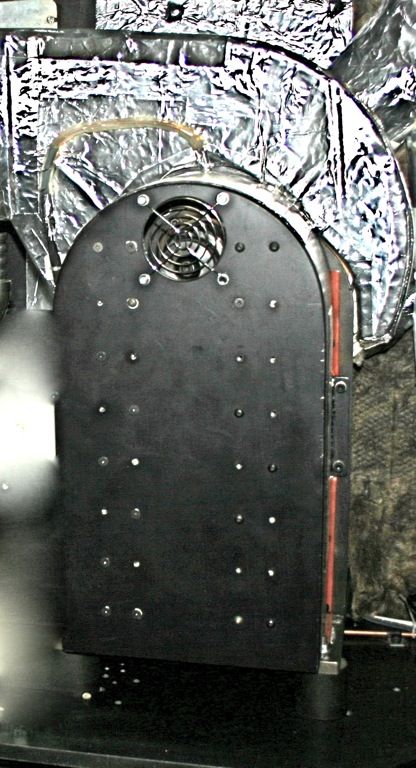
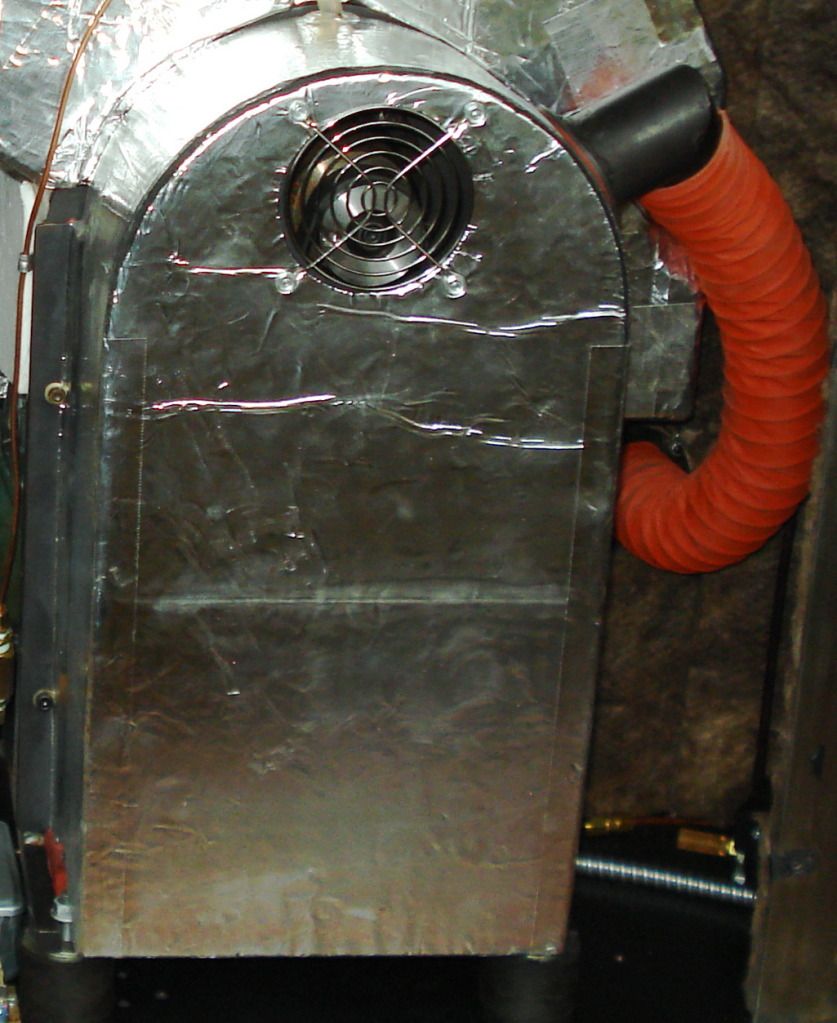
Highly reflective insulation is not an ideal material to photograph but it is easier to blow clean, reflective surfaces do reflect heat, and it effectively contains the ceramic insulation.

The testing has showed that the highest gains in efficiency were made with recirculation of the heated air.  Of course that does create some challenges especially if high pressures are required.  High pressures require positive displacement or high speeds.   Design solutions involve benefit tradeoffs.  A really good design makes use of the component's strengths without being penalized for its shortcomings.

Improving the insulation involves preserving the heated area, facilitating the application of the insulation, and reusing the heat that does escape i.e. air that is used to cool the high speed belt.   To effectively utilize that cooling air there has to be a sufficient temperature differential between it and the item to be heated.  It does work well in preheating a batch because the 70°C flowing air can impart energy to ambient temperature batches.

The air is used to preheat diverse products in order to reduce the load on the main system.  The temperature is too low to create a moisture problem therefore condensation requirements are reserved to the main circuit.  Another efficiency gain would be to use the processed batch to raise the temperature of incoming batch.  Direct contact risks contaminating both batches but heat exchangers have become very efficient providing the throughput is sufficiently high.

Apart from the coffee roasting application we are involved in fluidized bed drying.  A high pressure and high temperature convection oven that can also distribute super heated steam is only in the testing stage.

NOTE: Regarding the comments that this is an old Blower; the Blower is new but the Belt Cover has been repurposed.  The original cover was made from sheet metal only, while this one, had some vibration dampening bars inside.  Further testing showed that noise dampening material was lighter and more effective.  We just kept the old cover for testing prototypes.  Time for a coffee.

Sunday, 16 September 2012

Updated Hot Air Blower - Canadian Coffee & Tea Show

The High Pressure Hot Air Blower was updated for the Canadian Coffee & Tea Show in Toronto.  The new Insulation package improved the heat retention and made the unit even quieter.  The improved insulation is directly influenced by the desire to improve the conditions in the Roastery.  The direct participation of Roastaire supervisors meant that most of that effort would be directed to reducing both the heat and sound emissions.

Before insulating the Blower we installed improved flexible inlet and outlet connectors to decouple the rotating components from the static parts that could act as "loud speakers".  Again the moving parts were balanced to a high standard, better than G2.5, to "nip the noise source in the bud".  The new flexible connector is less transmissive and has the added advantage of having a smoother and less restrictive bore.

The deadline of the Canadian Coffee & Tea Show meant that there was no time for picture taking.  The fact that we were able to have a "normal" conversation in front of the working blower attests to the effectiveness of the sound containment.  After all, to achieve blower pressures it does have to turn at high speeds.

Containing the heat improves the efficiency of the roaster, reduces the temperature of the other components, and keeps the Roastery cooler.  The Roastaire components are insulated and mostly double walled, unlike most roasters, which greatly enhances the roasting experience.

This does bring about a philosophical design difference with bare bones roaster manufacturers that are promoting low entry prices.  Some show attendees quoted roaster prices that were much lower but the manufacturer omitted to tell the interested parties that an After-burner would be required for roasting in their city and that the After-burner would cost much more than the roaster to buy and to operate.  Neither the coffee nor the client should be "burnt".

The Impeller was also redesigned to improve efficiency and reduce noise generation.  The Impeller must redirect air that is moving axially to a radial flow as gradually and smoothly as possible.  Of course machining a steel Impeller to accomplish this requires many hours in a CNC Mill but if the noise is minimized and the output maximized at the source then the task is easier later on.  Aluminum is certainly cheaper to machine but our small pile of stretched, torn, distorted, and exploded off the shelf aluminum Impellers that could not handle our heat requirements attests to the need of using a steel Impeller at elevated temperatures.

After 1500 hrs Aluminum Rotor self destructs at 250°C


Another Aluminum Rotor tears at 250°C


The picture below was taken before the show opened. More picture are located here.  During the show there were too many interested people to get a clear shot of the roaster.  It was, after all, the only working roaster at the Canadian Coffee & Tea Show in Toronto. 


Thursday, 30 August 2012

TEST TEST TEST - Analyse

An essential element of product development is the testing which establishes the characteristics of the device.  Sometimes the required testing equipment has its own limitations or is too expensive for only limited use.  Tools such as oscilloscopes and DAQ (Digital Acquisition Boards) have many applications and are of great assistance in observing short duration or rare phenomena.  

Simultaneous DAQ boards are nice because they eliminate channel skew but they are more expensive because each channel requires its own A/D converter.  I like Labview but it is frightfully expensive which means it has not been updated for many years.  An additional problem is that the program cannot be downgraded which means if you started with a deluxe-o-matic Suite then the upgrades will approach the cost of purchasing Labview.

It is possible to be creative and resourceful when selecting sensors but often it is a quick and dirty solution that yields the equivalent data.  Non-calibrated equipment can be misleading therefore some reference measurements should be done to develop a "feel" for the measurements.  There is little that is worse than making decisions based on faulty data.

One day I'll be brave enough to look into the new mini computers such as Arduino, Rasberry Pi, etc.  These devices have daughter boards with surprising capacity.  In addition to monitoring the tested device it is possible to also actuate devices.  So far the use of the digital output has only controlled solenoid pneumatic valves and solid state relays.  Not a sign of great imagination!

One handy improvised device was a "Magic Wand" which was essentially a meter stick with a piezzo film bonded card slotted in to the end.  It saved fingers from having mishaps with moving equipment when measuring pump strokes, checking vibrating structures, or simply establishing start/stop time.  An Infrared transmitter/receiver and a 9 Volt battery makes an inexpensive tachometer.  Coils are very handy for measuring current especially when coupled with a data acquisition system.  It is handy to know the start up amperage when testing various rotors and speeds.

The Blower output can be measured in many ways i.e. anemometer, rotameter, venturi but most of them can only be used at relatively low temperatures.  Our high temperature Blower required a metallic venturi which does present some fabrication challenges since the smallest diameter is the furthest from the opening which is not ideal for cutting a smooth wall.

Darn, that was mostly about testing, the analytical part will have to be postponed.

A cup of freshly roasted coffee is a great time saver akin to measure thrice - cut once.

Tuesday, 14 August 2012

High Pressure Hot Air Blower - MTBF or Down Time?

High temperatures are not conducive to the longevity of rolling components therefore the conventional ambient blower components have the lifespan of a firefly when used at elevated temperatures.  It is almost a universal mechanical truth that items used at higher temperatures have a reduced working life.  It does not mean that durability is impossible.  It means that durability has to be a priority in the design stage and that components are selected based on their ability at surviving in a high temperature environment.

The focus has been on improving MTBF (mean time before failure) but an alternate viewpoint was raised by a "person in the know".  Essentially the comment was that MTBF is important but "down time" is also a critical factor.  Both of these constitute the inconvenience factor for the client especially if one is low and/or the other is high. 

The insulation required for high temperature equipment does not facilitate repairs therefore the selection of these materials is as important as the blower design itself in facilitating a speedy repair.  With this priority in mind there has been a move towards a faster turn around if a repair or maintenance is required.  The redesign is ongoing and alternative solutions are being tested.

Temperature is but one of the challenges.  We are currently testing blowers that are more tolerant when placed in an environment of "nasty" or corrosive gases.

It is doubtful that the maintenance or repair turn-around will approach Formula 1 tire changing experiences but it promises to be a significant improvement.  It does help to have a crew of 12 to undertake the maintenance if there is sufficient room for everyone to do their task.   It is not likely that such a crew will work unimpeded around a blower therefore it will take longer to affect the change but wages and costs will be lower.

Personally I prefer to take a little longer especially if there is a window of freshly roasted coffee reflection to organize the task.

Cheers,

Sunday, 27 May 2012

High Pressure Hot Air Blower - Sound Containment.

NXT Roasters started with off-the-shelf centrifugal blowers of which we got to know the internals too intimately.  There were no guarantees that they would handle the temperature but the salesperson thought that we should get a reasonable MTBF (Mean Time Before Failure).  At the beginning, it was only 25 hours on average!

Virtually every manufacturer claimed that their composite bearings would work at the 250°C air temperature.  They must not have realized that 18,000 rpm was on the faster side which greatly reduced the life of their product.  Regular bearing races are too soft for this temperature and speed combination.  It takes very little Brinelling which creates a looseness that, at 18K rpm, allows  the shaft to vibrate and the bearings self destruct.  Note: the faster the speed the smaller the movement of the vibration, all other things being equal.  Bearings were repacked with high temperature grease that was measured out in milligrams.  Oil bathed bearings were tried.  Many iterations of new seals had to be turned because the stock items were intended for ambient temperatures. Most modifications succeeded in improving the longevity; 25 hrs, 55 hrs, 125 hrs, 225 hrs, 320 hrs, and after a couple years it was over 1300 hrs.  Not that great, but the client could live with it while we were working on a new blower that is featured in the other blog pages.  A specialized bearing manufacturer made a bearing for us that goes like the proverbial bunny.  All we have to do is pay them a lot of money.  The switch over to our blower design started two years ago.  We do not know the MTBF because of the lack of failures (no! no! that is good).

The aim of this blog is to discuss the blower noise that was generated by that first blower compared to what we have today.

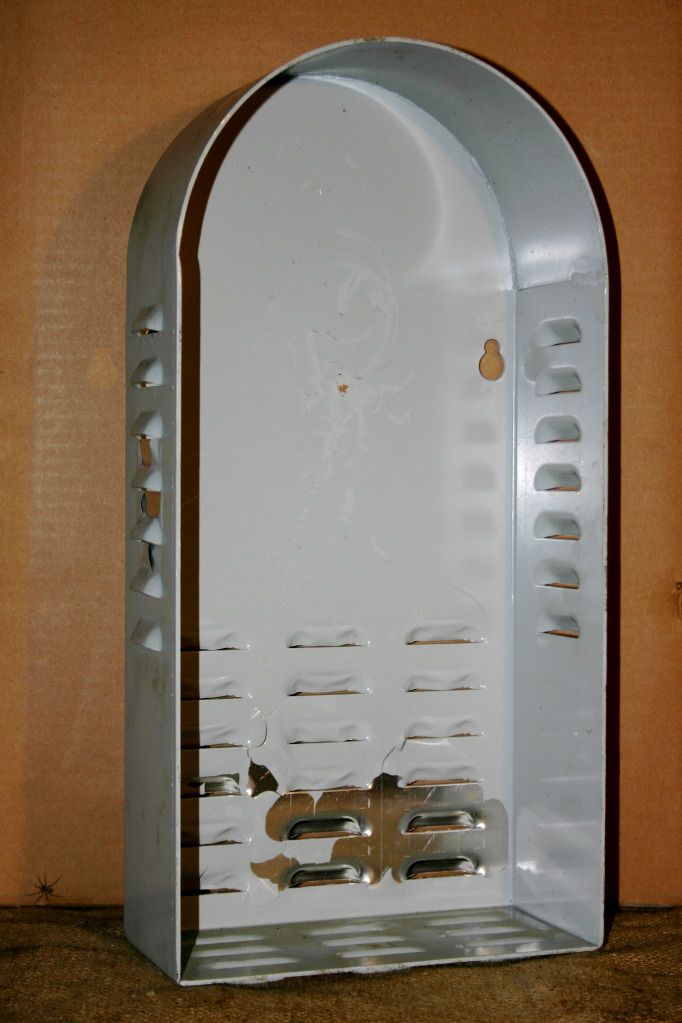
The off the shelf blower had an aluminum Belt Guard with a rubber lip that is not shown.  The guard resonated and the RoastMaster wore Ear Protectors.  Obviously the level of balance is greatly affected by the speed of the 6" Rotor.  If that manufacturer recognizes his cover they will realize that they have a problem and then see the solution.  Well, they have more problems than that which is why they do well to focus on ambient temperatures.  The paint has flaked which reflects badly on the quality of the work.

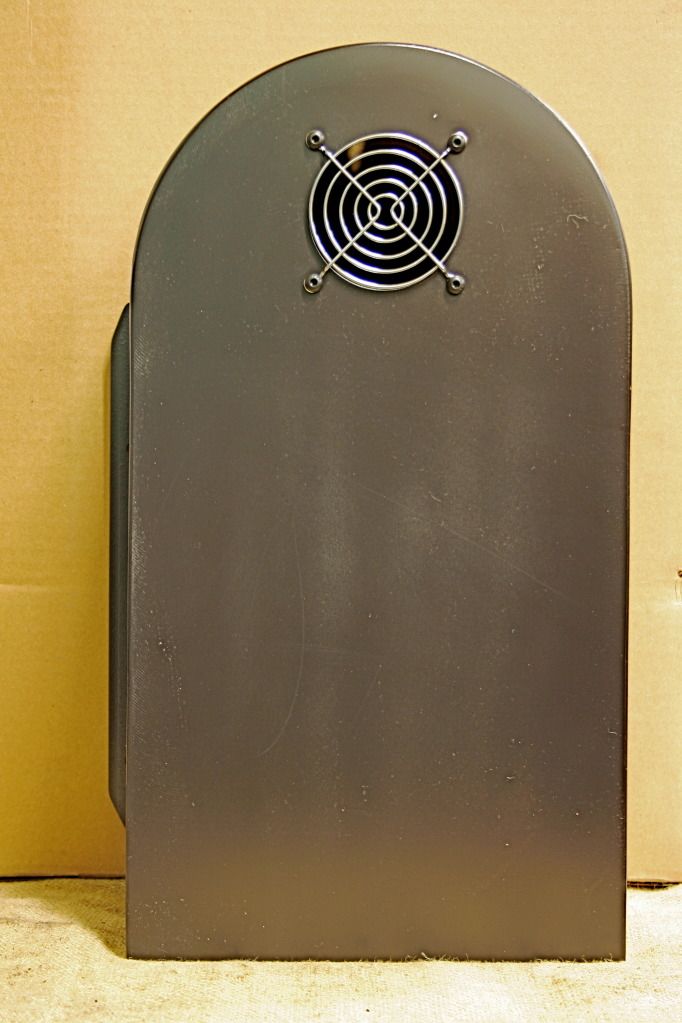
The output of our design was better than expected therefore we were able to reduce the speed.  To improve upon the case design, first, we increased the mass by making the Belt Guard from steel sheet.  It was better, or as they say, "Good, but not so good".


Heavier bar stock was screwed to the front and sides to increase the mass and reduce the amplitude of the resonance.  The roaster was delivered with that modification but the client still found the noise to be disturbing to the working environment.

In his youth the client was a hot rodder and had some experience with taming unwanted frequencies though I suspect that most of his energy went into making the engine louder.


He covered the Roastaire Belt Guard with an aluminized Butyl Rubber sheet product.  It worked so well that the covering panels got the same treatment.  The "sound treatment" was so effective that CBC Radio did part of "On the Island"  Roastery Interview in front of the working Roastaire.

At the Eptech show Ampco's Rick Gagne discussed such a product that they carry.  It is not necessary to cover much more than 25% of the surface to stop the ringing but esthetics would take a beating with less than full coverage.  The alternative was to place strips on the interior walls but if the bond fails after a while then that will certainly lead to belt failure.   Perhaps we can revisit and find a conclusion after a year - with the help of a freshly roasted coffee.

Sunday, 6 May 2012

High Temperature Pressure Gaskets

Several factors have increased the sealing challenges:
- temperature of 250ºC
- a system pressure of 1.1 psi when at roasting temperature
- Hot rolled flanges, not machined surfaces
- it must provide a barrier to very acrid smoke
- must resist suction
- must not out gas after burn in


Silicone sheet was touted to withstand the temperatures but over the years it crystallized and became brittle.  Some Teflons have a fairly high temperature ceiling but most are not nearly as capable and durable as the claims make them out to be.  We attempted to use high temperature ceramic paper but by itself it turned out to be too porous.


Out of curiosity we added a ring of packing material which would further compress the ceramic fibers but it still leaked.

It was possible to seal machined faces with High Temperature paste, some of which was "scaringly" smelly but most of the flanges are cut from hot rolled sheet material.  Better sealing capacity was required over a slightly wavy surface which is exacerbated by the weld to the tubing. 

Samples were cut from various materials that were either on the shelf or purchased.  The initial tests consisted of about four times as many gaskets as shown in the picture above.  A rather simple device was salvaged from the "steel pile" to pressurize the gaskets.  An arbitrary 1.5 atmospheres was selected as the testing pressure.  A soap mixture (sorry I forget the soap's brand-name  which pretty well ruins an endorsement contract) was used to dramatize the results for the camera.  The relative size of the bubbles is proportional to the size of the leak.

We looked for sealing ability especially after being subjected to repeated hot/cool cycles but also the material had to resist extrusion.

Many of the gaskets sealed until they were subjected to periods at 325°C a temperature that was also arbitrarily chosen to represent heat damage over an extended period.  Some people might complain that this is not a fair test.  It might not be but since their product is not named they will not know that they should complain about the procedures.

To the left is a Silicone product that is resistant to 350°C** (you have to search the fine print for the limiting conditions of only being flashed to the temperature on a Wednesday morning between 9:03 and 9:08 AM".  The extruding material created an even greater problem and it was discarded.


To the right is the outside view of the testing oven.  A PID Autonics temperature controller was added with a RTD sensor.  As mentioned above the Set Point is 325°C.  This little throw together may not win an award (it is from the same design studio as the testing jig to the left) but it keeps a stable temperature. 

Seal progress was made through the combination of various products but further work is required to determine the mixture and the method of application so that a uniform gasket is produced.
Personally - I prefer to drink freshly roasted coffee!

Friday, 4 May 2012

High Temperature Blower - Streamlined Inlet

This is another picture of the back of the High Temperature Blower which better shows the Inlet Flange.  In this version the Inlet is attached from inside of the case.   We are currently fabricating an updated version which will be fastened from the outside.

We are working on moulded ceramic insulation but those efforts are not yet worthy of a picture.  To date we have used Cerawool Blanket, ceramic hardboard, and aluminized high temperature fiberglass.  The process is tedious because of the numerous cuts (not all on the insulation) and the challenge to fitting the material to such a "curvy" object.

The unit pictured below has been working 8 hours at 250°C  nearly everyday.  The version, not using the Curved Inlet, is nearly two years old but is used more lightly, though at the same temperature.  A third unit has been used for testing purposes but will soon be used on a nearly daily basis.

A new Inlet Flex Connector has been fabricated and it will soon be tested.  The aim is keep the sound level as low as possible.  We have had a measure of success in accomplishing that.  Last week CBC Radio aired an interview that was done just in front of the working Roastaire.   Obviously more improvements will be implemented to make the work area as pleasant as possible.


Sunday, 22 April 2012

High Pressure Hot Air Blower - Add-ons

We have been reworking the Blower Inlet to improve the air flow and to make the design more compact.  The picture does not show that the Air Inlet has a circular flange but upcoming pictures will better demonstrate those features.

The Air Inlet can be rotated in 45° increments to accommodate various applications.


The Impeller is balanced to better than G.4 standard which is often referred to as gyroscopic level.  The Blower in our application is nevertheless mounted on 2" Rubber Mounts while the Inlet and Outlet are equipped with Flex Pipe to reduce the transmission of vibration from the turning components.  The Flex Pipe photo, above, is the Outlet Connector.  It is rather short due to a constrained space available. Where more space is available a longer Flex Connector can be supplied to add flexibility in the connection to off angle sources or destinations.

Previous attempts to use rolled Flexible Exhaust Pipe resulted in leakage especially at the flange connection.

The Blower output was higher than the expected requirement therefore we were able to reduce the Blower speed to approximately 12,500 rpm.  It is an approximate number due to memory rather than ability to measure accurately.  This modification significantly reduced the background noise generated within the workspace.  The vacuum pulling capacity is still fulfilling the requirements.

Friday, 30 December 2011

Roaster Carbon Calculations

The good people at Fresh Cup used the U.S. EPA Carbon Calculator to compare the Roastaire Carbon Footprint with that of a gas roaster.   


A 100 lbs.  of roasted coffee = 1 car off the road for 16 days  


This is how our roasting method impacts the environment. The energy ratio is  2 light bulbs versus the drum roasters 48 light bulbs.  Gas is a cheaper form of energy therefore in dollar terms the approximate heating cost of a gas fired roaster with afterburner is 16¢ per pound vs. the 2.5¢ for the recirculating Roastaire.


Evidently the Roastaire is way more environmentally friendly and cheaper to operate.  


The 100 lbs. of roasted beans represents about 3 hours of roasting, depending on the degree of roast.  Think of the savings to the environment and to the owner.  


It's time for a cup of freshly roasted coffee and a read about selling carbon credits.


Thursday, 15 December 2011

High Pressure & High Temperature Industrial Blower

The suggested applications required either high temperature or high pressure but not both.  Googling the terms "high pressure" "high temperature" Blower brings up every type of air mover imaginable.  The designations are quite "loosey goosey" and often stretched so that it will accommodate the particular product being offered for sale.


I expected that this blower rated at 250°C would be at the bottom end of high temperature blowers but no - some units were given the same designation yet could only operate at temperatures that were 100°C lower.  


Some units had operational ceilings that were twice as high as what this one was tested at but their "high pressure" turned out to be .3 psi or 2,070 pascals which implies that it turns relatively slowly.  Low speeds are attainable with off the shelf bearings.  Therefore, it is not a niche that is of interest.


The version pictured is currently on the test bench where it is subjected to high temperature moist air.  Previous tests of off the shelf blowers demonstrated bearing corrosion in less than 100 hours.  It is possible that had it been a continuous test the bearings would have survived longer but running tests that lasted a few hours compromised the bearings too soon.


We are currently using the blower to fluidize and roast beans (coffee and others).  The pressure output of over 1 psi ( 6,894 pascals ) at 250°C  could certainly fluidize denser materials at a lesser depth.  At these temperatures the blower could be the heart of a monstrous pop corn pumper.  With continual introduction of kernels the output will compete with Vesuvius.  Such a machine would have to be brought to corn country Taber for testing.  


A recycled hot air requirement is fundamental to this niche, otherwise it is more efficient to heat the air after the blower i.e. an air knife.  Now, if a high temperature air knife was in a closed system nearly every blower in the marketplace would be inappropriate.


Hot air accelerated drying in an industrial setting would require a moisture extraction process but if it is a recirculated hot air application this is a custom application.  


Have a freshly roasted coffee and think of another application for the unit.

Thursday, 1 December 2011

High Temperature Industrial Blower

"Delivering the air with sufficient pressure at 240°C is a challenge that will be addressed in a later post.  Sufficient to say that no off the shelf hot air blowers were found, resulting in another product development." from the earlier post Heating Coffee Beans to Roasting Temperature.


Note:  A fan generally turns slower than a blower and therefore cannot reach the same pressure differential (inlet / outlet).  Fluidizing a batch of coffee requires more pressure than a fan delivers.


The easy, but wasteful, way to circulate hot air is to heat it after it passes through the blower.  This means that all the air has to be heated from ambient temperature to final temperature before it is vented while, if the air is recirculated, only the lost heat needs to be replaced.  The higher the temperature the more efficient the recirculation process becomes.  The advantage is not a few percentage points but rather tens of percentage points.


Our prime interest is roasting coffee which becomes much more efficient when the heated air is recirculated.  No off the shelf unit could be purchased.  Initially we tried then modified an existing name brand blower.  The MTBF (mean time before failures) improved from the initial few hours to over 1,500 hours but the maintenance and problems required a new solution.  The concept was simple but mastering the quirks was not always a linear process.


The designed temperature ceiling for the current model is 300°C but it has only been operated up to 270°C.  Since we did not find this to be an optimum roasting temperature the importance of establishing a higher operating threshold lost its urgency.  There is reason to believe that the upper temperature limit can be raised significantly.


Apart from surviving the high temperature the priority is to develop sufficient pressure to create a fluidized bed so that the coffee beans are evenly heated and continually mixed.  The pressure, while roasting, is just under 1 psi (approximately 6 kPa).  This is the flowing pressure not dead head pressure.  


The current blower configuration is driven by a 3 Hp electrical motor connected to a three phase contactor based motor controller.  The Belt Guard Cover was removed for the photo.


Have a freshly roasted coffee and think of another application for the unit.