Pages

Showing posts with label Roastaire™. Show all posts

Sunday, 8 July 2018

NXT Coffee Roaster Design not "off the shelf"

To Google Maps
Most coffee roasters are heated by  a natural gas flame.  Natural gas is a cheaper form of energy than electricity but it comes with inherent limitations.  Since the flame requires a continual supply of oxygen it requires a lot of air which must be raised from ambient to combustion temperature, this  is not the end of the energy waste.  The coffee roasting is usually done in the exhaust gasses of the flame which, are not hot enough after passing through the Roasting Chamber, to break down the roasting smoke.  That smell is similar to burnt toast, in the later stages, - imagine several kilo grams of burnt toast.  Hence, an Afterburner is required to raise the temperature to over a 1000°F to break down the smoke.  The large amount of air required by the flame means that a large amount of air must be raised from ambient temperature to over 1000°F.  Consequently, the Afterburner burns, depending on the model,  three times as much energy as the roaster (the equivalence of 6 home furnaces) just so that the neighbourhood will not see nor smell the roaster emissions.  Of course the emissions from such burners are always present but the operators hope that they become sufficiently diluted by the outside air that they will not trigger calls to the environmental agency.  Pollution awareness is upon us and some areas already require permits for coffee roasters with 5 kg or more capacity.

Are there alternatives?
There is, if the fabricator begins with a clean design slate rather than use off the shelf technologies.  First, the amount of air needs to be reduced to greatly reduce the waste of energy.  It is true that often the electricity is generated by the combustion of natural gas but the electrical companies have specialized equipment to remove and neutralize gas volatiles that individual roasters do not use.  Nevertheless, the electrical Roastaire™'s biggest advantage is virtually eliminating the continual feeding of air to the roasting process.  It is possible to recirculate the air with electrical heating because you do not need to feed a flame.  The advantage, is that less energy is required to heat the returning air than to heat room temperature air (ambient) to roasting temperatures.  There is less air to treat when neutralizing the emissions therefore it can be done on a continual basis. A minor advantage is that the oily smoke, as part of the re-circulation process, is burnt which helps to heat the roaster.

Does the design work?
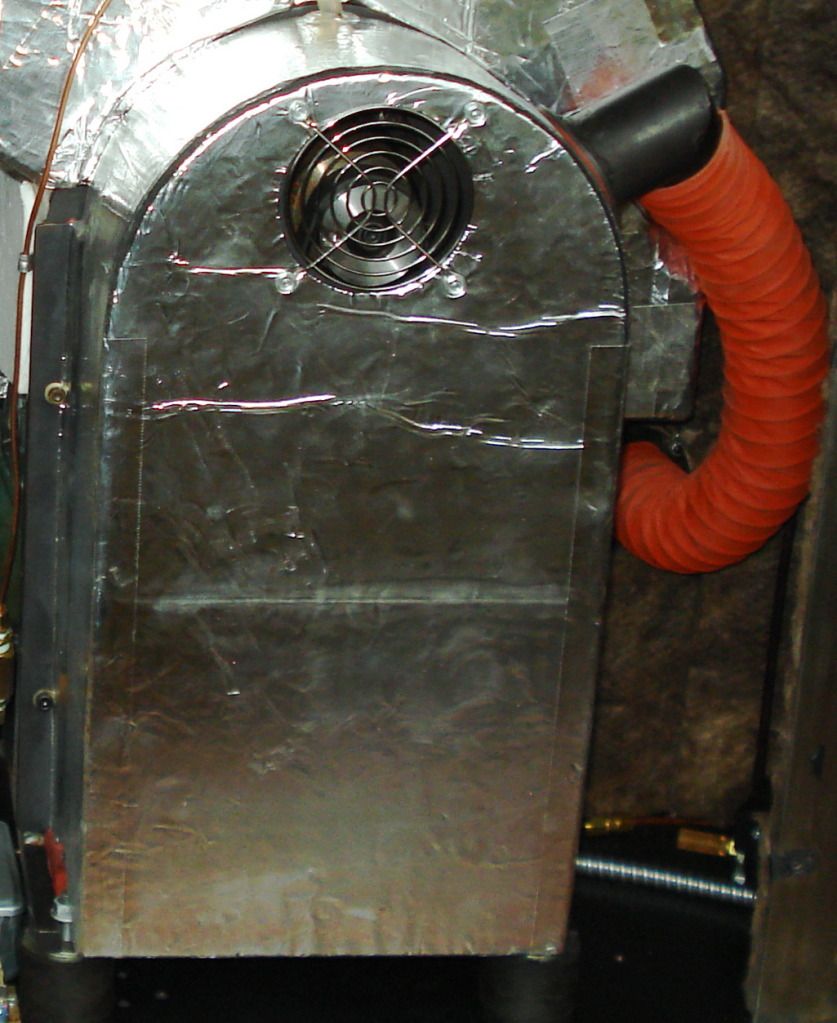
 Below is a photo of the tubing that guides the re-circulated air to the Roasting Chamber.  The roaster was in service for 5 years before this photo was taken.  It had roasted about 30 tonnes of coffee.  It does illustrate why Fresh Cup Roastery Café (Saanichton & Vancouver) clients refer to it as  "Clean Air Roasting"

5 yrs of roasting = clean air duct


 Now compare the above photo with one taken of a drum roaster after one year of service.


There wasn't a copyright on the photo but I am not attributing the photo because there is little benefit to kicking a hornet's nest.

In 2010, it is reported that there were 1800 chimney fires, in the USA, that were attributed to coffee roasters.  What heating method do you think was responsible for this incredible statistic?


                                                ------------------------------------------
In the Roastaire the exhaust is passed through a second SmokEater© before it is discharged.  It roasted hundreds of batches inside the Toronto and Vancouver convention centres without the use of a vent or chimney.

What is exhausted?
 Only the air cooling the roasted coffee is exhausted after scrubbing it twice.  More details about the design reasoning will be forthcoming when the topic of Bean Cooling is approached.  In the interim here is some more information on an earlier NXT    blogspot page.


Friday, 15 June 2018

Question and Challenge What you Read

Company Blogs which very often are prone to being commercials should not be taken at face value or believed without reflection and sometimes, some research.  

One blogger (Blogger B) submitted a comment to a competitor " I read with interest your article entitled “Roasting with Hot Air: Benefits of Air Roasters” in your company’s newsletter."  He then proceeds to authoritatively expound on his own lack of knowledge in the roasting process.  The complication here is that the article, by Blogger A, he refers to has some rather glaring falsehoods i.e. "During the roasting process, the green coffee beans go through two major “pops” or “cracks” The first occurs when the internal temperature of the bean reaches approximately 356 degrees fahrenheit.".  The problem here is that no matter how long you boil water the temperature remains no higher than 212°F or 100°C.  The evaporative process greatly slows the bean from continually increasing in temperature until virtually all the moisture is evaporated.

It appears that Blogger B then proceeds to confuse degrees Fahrenheit with degrees Centigrade.  Blogger A writes "This hot air reaches temperatures of between 450 and 485 degrees fahrenheit" (232°C to 251°C) which is slightly above the 195°C to 205°C where the beans undergo an exothermic reaction.  A much lower temperature would essentially bake the beans.  Despite Blogger B's assertion that the air roaster is way too hot it is 100°C to 200°C less hot than a typical gas fired drum roaster.  It is true that the air roaster has a faster roast cycle but 4 minutes is absurd while 11 minutes is quite normal because the heat is quite evenly applied to all sides of the bean as they are churned in the fluidized bead.  Drum roasters only have fans which are incapable of pushing the air through the batch of beans therefore they only heat the top layer, the beans touching the drum, and beans that are falling off the rotating blades.  Blogger B's comments "Regardless of how heat is applied to the outside of the beans, heat reaches the insides of the beans by conduction. And, when it comes to heat conduction, coffee beans are not very good at it. Therefore the development of the insides of the beans always trails the development of the outsides of the beans."  Ironically he is presenting a case that favours the lower temperature of the air roaster (for the same reason you do not fry eggs on high settings).  This, however, is not true for the entire roasting session.  The heat moves inwards in the endothermic phase until the bean enters the exothermic phase.  

Think of lighting a damp piece of paper.  There is a reason why you can boil water, on a flame, inside a paper bag.  It is because the water seeping through the material prevents the paper from reaching its combustion point.  However remove that water, the paper will dry, and will then burst into flames.

Blogger B apparently does not realize that a full roast includes the exothermic phase where the heat is generated inside the bean.  See sectioned bean photo.  At this point the roasting process has to be monitored closely to "kill the roast" at the right time.  We prefer to cool within the Roasting Chamber because it is quicker and easily repeatable.  At this stage the transformation is very rapid therefore it is challenging to guess "the kill point" half a minute to a minute in advance because it takes that long to dump the beans never mind cool them.

Blogger B also comments on the single pass air roaster even though his system not only is a single pass air supply but it is roasting with the exhaust of the flame.  Imagine cooking supper with the car exhaust (maybe a propane powered vehicle is slightly more appropriate", it will certainly contribute all kinds of flavour.  Recirculating hot air cannot be done with a gas fired roaster because it starves the flame.  We do it in an electric roaster but it took five years to develop a blower that would survive the temperature.   Re-circulation improves the efficiency and makes it possible to significantly cut emissions.  

A gas fired Afterburner burns on average 3 times more gas than the roaster.  It decreases the visible smoke but really loads the exhaust with volatile organic compounds known as pollution.

Tuesday, 26 November 2013

Improving the Roasting Efficiency.

There are several aspects to be considered before a process can be implemented to improve a design.   Often it is possible to identify, let's say for the sake of discussion, 10 variables that will affect the process.  What is usually impossible to predict is the rank or the level of dominance of each variable unless you are really really really a gifted analyzer or clairvoyant.  Personally I resort to testing a few variables at a time to better understand their effect.  There will undoubtedly be surprises and inconsistencies when various variables are tested together but it is simpler to test in parts than in whole.

The testing results are unlikely to produce a clear graph such are joys of solving problems with multiple unknowns.  The results will give a better idea about the trade-offs that are required before a process can be adopted.  We maintained that coffee beans should be uniformly heated so that the chemical reactions that occur within the beans progress evenly.  It was also deemed important that the beans not be thermally overloaded.  To clarify; the bean has a certain capacity to transmit heat to its interior, if the heat applied is greater than what can be evenly distributed the exterior surface becomes much hotter  and creates a risk of scorching.  It is also for this reason that we roast at a relatively lower temperatures of 240°C to 250°C instead of ...  In "Espresso Coffee" R. Eggers writes the typical gas temperature of a drum roaster is 400° - 550°C.  The high temperature cooking analogy for beans hit by the super hot air is frying eggs while using the stoves highest heat setting.  Yet this fluidized bed roaster has a cycle time of less than 12 minutes versus up to 20 minutes in a drum roaster.   That  is Better Efficiency! 

The even distribution of heat is critical to preparing the beans for the roasting process.  We force heated air between the beans so that they are all heated, not just the outside layer.  There are small domestic roasters that also use air to create a fountain of beans.  It is quite dramatic but if the air flows through a narrow passageway then the remaining beans are not being heated until they gradually make it to the fountain.  Consequently, if you are looking for a home roaster look for one that pushes the air through all the beans.  Typically, the batch will move upwards as the beans are levitated by the flowing air then the air will break through and mix the beans.  The release of air pressure allows them to drop within the chamber but are then suspended again.  The air cushion has the added advantage of keeping the beans off the hot metal which often causes tipping which appear as little pieces of the exterior wall that leave behind a shallow cavity.

It is a simple concept that is regulated by many variables which turn it into a complex process.  

There is more to the efficiency quest than even thermal transfer and the recycling of air mentioned in the previous blog which leaves something to write about later.  Now it is time for an espresso.

Monday, 21 October 2013

Improving Roasting Technology

The picture links were removed because Photobucket decided to change the terms of usage in mid stream, so to say,  It is inconvenient for viewers but it is better to rid yourself of such people as soon as possible.  It is the attitude as much as the action.   We will try to repair that mess at NXTroasters.com

 The conventional approach appears to be - buy a roaster and endure its limitations.  Most conventional roaster owners spend more time developing marketing spin than improving their coffee roaster.   The deficiencies i.e. emissions are already the focus of some legislative bodies which require permits for roasters in their jurisdictions.   Oil burning engines, showing that blue smoke, are rarely seen on the road today yet many owners are complacent about roasting without pollution controls.

The roaster owners who are concerned that large plumes of smoke coming from their chimney are bad for their community image have purchased large gas fired after-burners that burn approximately three times more gas than the roaster itself.  Imagine if automobile pollution controls involved using three times more gasoline than the engine.

Rather than maintain the polluting status quo which may or may not have visible smoke, NXT Roasters Inc., have developed an alternative (branded the Roastaire in Canada) approach that uses the smoke generated as a source of roasting heat rather than expend large amounts of additional energy to thermally neutralize the smoke.   Both 15 Kg/hour concepts thermally treat the pollutants but one system uses a 400,000 to 700,000 BTU after-burner  to accomplish the task.

The first picture is of the main air passageway of a Roastaire after five years of full time roasting.  This revealing photo demonstrates the reason for their motto of "Clean Air Roasting".  This illustrates how efficient and effective the air is scrubbed clean as it is re-circulated during the roasting process.   This closed loop roasting process means that the air only has to be heated 20° to 40°C to return it to the roasting temperature.  Compare that to a single pass air supply that is continually heated from ambient temperature then sent to the chimney.   In "Espresso Coffee" R. Eggers writes the typical gas temperature of a drum roaster is 400° - 550°C.   What a wasteful process.


In comparison,
one drum roasters Maintenance Manual draws attention to the chimney,  "Even if residue build-ups do not exceed 1/8 inch (.3 cm) per year, clean system annually ".    The quotation is not properly cited nor acknowledged but I will do so if the manufacturer requests it.

They also have this picture of a drum roaster fan as a warning about the residue that coats some of their components.  Roast Magazine had the following quotation "It's not IF you're going to have a roaster fire, but WHEN."  Which roaster do you think requires the most maintenance?  Which type of roaster do you think was responsible for nearly 1,800 chimney fires in the USA in 2010?


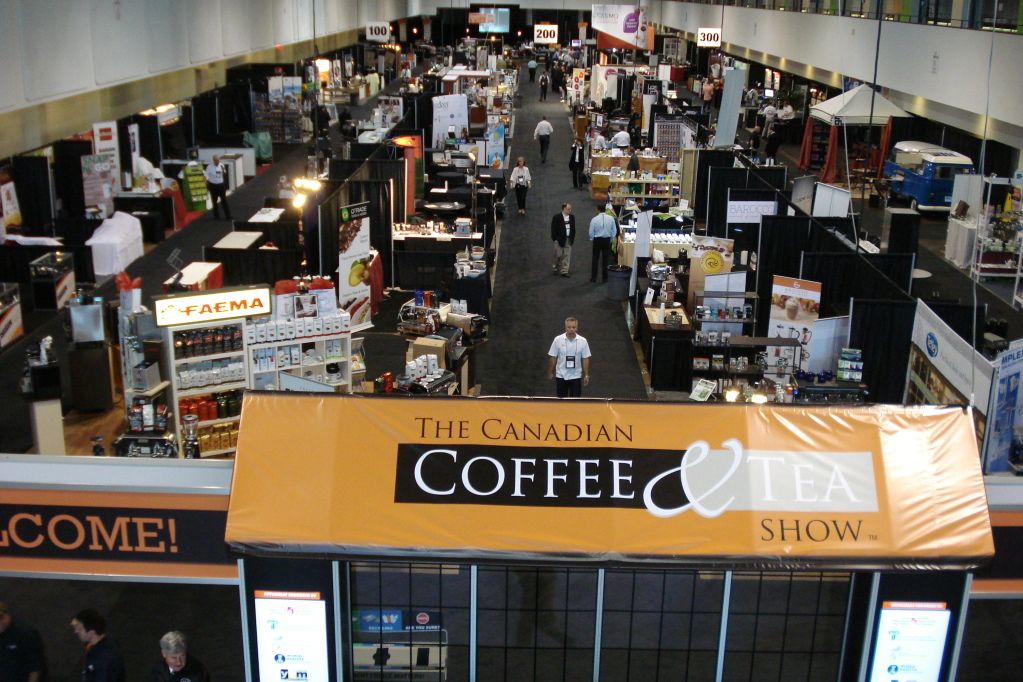
Which roaster do you think roasted hundreds of pounds of green beans inside the exhibition hall of the last four annual 
Canadian Coffee & Tea Shows?

Wednesday, 12 September 2012

The Roastaire™ visits Canadian Coffee & Tea Show

The Roastaire™ was the only functioning coffee roaster at the Canadian Coffee & Tea Show in Toronto.


The booth was near the Canadian Barista Championships but we were so busy that it was impossible to attend the skill demonstrations.

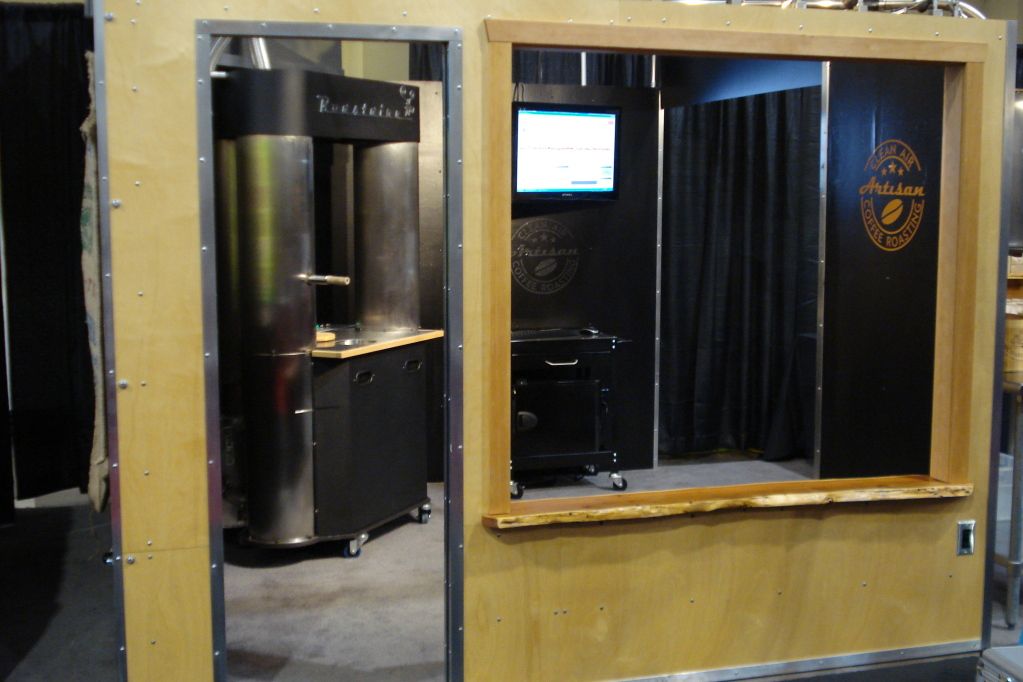
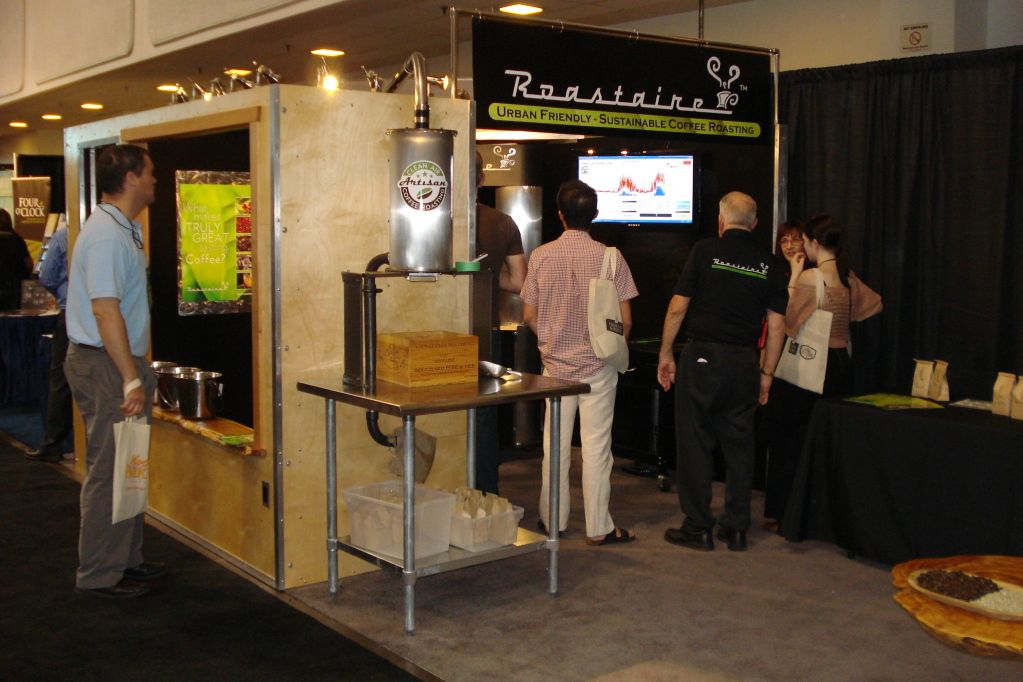
The Roastaire™ booth was designed to emulate the look of a Roastaire, coffee roaster, in a roastery café.  This layout favours the Theatre of Roasting which invites clients to observe the roasting process.  The clientele is able to pose questions to the Roastmaster without having the liability of having someone brush against hot surfaces.


The "roast is arrested" in the Roasting Chamber within seconds then is pneumatically conveyed to the Packaging Area where the beans are cooled for an additional three minutes while the Roastaire™ roasts another batch of beans.

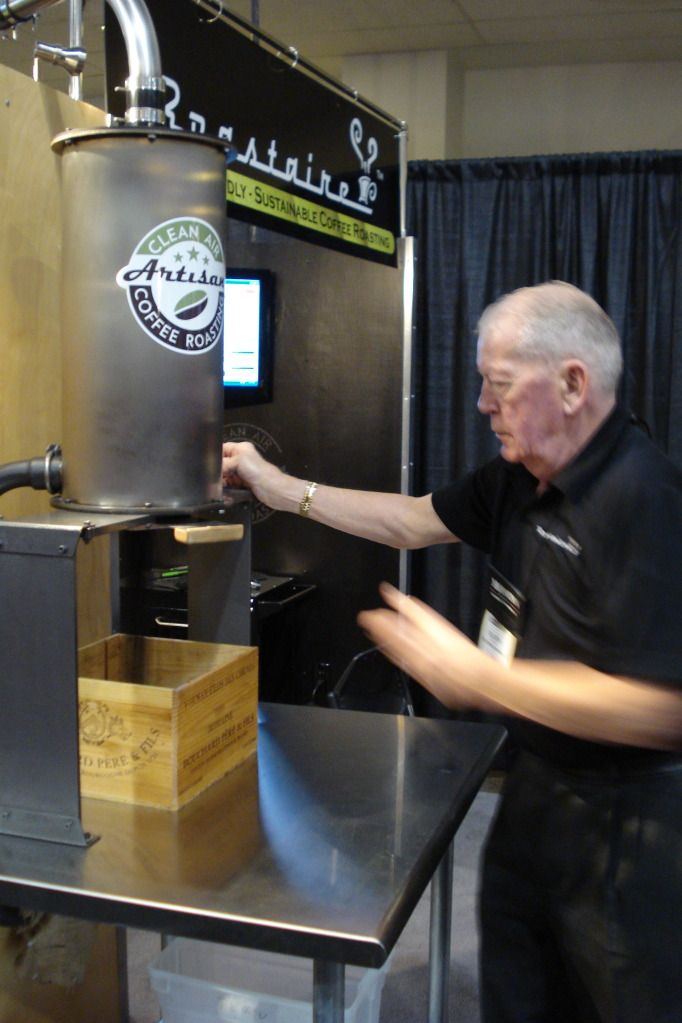
In the picture below Mel, the Roastmaster, is removing the roasted beans from the Cooling Hopper (usually located in the packaging area).  The beans are cooled while another batch is roasting.  Many people dropped in to view the only functioning Coffee Roaster at the Coffee & Tea Show.


So very close now to a Freshly Roasted cup of coffee.

 The tiff to jpg conversion is off which emulates working before enjoying a Freshly Roasted cup of coffee.


After a Freshly Roasted cup of coffee everything just works better.   Even technology is receptive!

Friday, 7 September 2012

The Canadian Coffee & Tea Show

Well we are on our way to The Canadian Coffee & Tea Show in Toronto.


The trailer was packed with the Roastaire and the booth earlier in the week.  We expect to be roasting 3 kg batches in the conference hall without a chimney.  We did this at two earlier Canadian Coffee & Tea Shows in Toronto and Vancouver therefore it is not a new experience.  No other roaster appears to have the pollution controls to attempt this.

It will be a rather hectic event with many seminars, presentations, and discussions therefore there will most likely only be a recap after the show.  Perhaps Roastaire will be updating their blog during the event .

Saturday, 16 June 2012

Does Food Processing reduce nutrition ?

The distilled opinion is "the more you process the less the consumer receives".

For various reasons the most common vehicle for food delivery has been perverted.  Perhaps "Extra VirginityThe Sublime and Scandalous World of Olive Oil by Tom Mueller shows that number cruncher executives care not a wit about their product, the well being of their customers, and sometimes the law.   People that are passionate about their product will bring the best to the customers sometimes at a great sacrifice.

Reuters had an article, a few days ago, to this effect: ...Coffee roasters quietly pulled off a financial feat last year that went unnoticed by most customers: Adding a higher proportion of cheaper, lower-grade robusta to their grounds as the price of top-notch arabica beans surged...  Not only are the beans cheaper but Robusta creates substantial crema even when it is stale therefore it gives a visual indicator of freshness even when it is not.

In response to "manufactured food", fresh food advocates are informing the public about  real food and real food costs.  
Living on the 100-Mile Diet , Revisiting Carrying Capacity:, Natural Foods, Organic Foods, etc.  It appears that greater "inputs" yield less nutrition.  Large marketing budgets promote convenience and "filling the belly" instead of feeding the body for growth and health.  Increased time spent transporting food means, as well, increased food degradation time.  Industry will typically attempt to address product appearance indicators that influence a consumer.  Unfortunately nutrition is sacrificed for the sake of colour and appearance.  

Before focusing on one product not usually covered in the fresh food debates I would like to add that I believe that the movement advocating quality food is gaining membership.  

My interest is the freshness of coffee.  Of course people do not live by freshness of coffee alone.  That would be silly because it mostly feeds the soul, the well being, the disposition, etc. Coffee has undergone a centralizing process which exchanged convenience for quality.  Bigger is not better if the product is lessened.  We have not developed Star Trek transporters to move food instantly to the consumer while maintaining the product integrity.  If the past is any indicator this futuristic device would further degrade the food.  Warehousing roasted coffee decreases the value to the end user.

I advocate that the coffee roaster, grinder, espresso machine, and brewer should be at the same site.  Nothing gives more credibility to the freshness of the product as when the consumer can observe the preparation.  To this end Jim Townley uses the moniker of "the Theatre of Roasting".  It encourages clients to learn about the process while it reinforces the artisanal qualities of freshness and caring preparation.  Small batch roasting, in our case 2 to 3 kg batches, allows the RoastMaster to roast the requirements of the next few days.  Most likely more than one batch of each coffee will be roasted but that is a choice based on sales.

This is a simple food preparation model even though it appears to counter the produced locally mantra of some of the above links.  We are not blessed with local coffee plantations but because the coffee bean is a seed which is designed by nature for long term storage it may be consumed at a distance from its origins with a certain proviso.  So where is the Freshness Challenge?  Roasting transforms the bean and creates havoc with the storage capability of the bean.  Roasted Coffee degrades quickly despite touted storage "solutions".   Freshly ground stale beans is an advertising distraction which offers no benefit to the consumer.  The analogy of the weak chain link is true.  Nothing will resurrect stale coffee, not milk, not sugar, not artificial liquids, not even a marketing campaign.  

For the best cup of coffee start with a freshly roasted high mountain grown Arabica bean that is ground just before brewing.

Sunday, 27 May 2012

High Pressure Hot Air Blower - Sound Containment.

NXT Roasters started with off-the-shelf centrifugal blowers of which we got to know the internals too intimately.  There were no guarantees that they would handle the temperature but the salesperson thought that we should get a reasonable MTBF (Mean Time Before Failure).  At the beginning, it was only 25 hours on average!

Virtually every manufacturer claimed that their composite bearings would work at the 250°C air temperature.  They must not have realized that 18,000 rpm was on the faster side which greatly reduced the life of their product.  Regular bearing races are too soft for this temperature and speed combination.  It takes very little Brinelling which creates a looseness that, at 18K rpm, allows  the shaft to vibrate and the bearings self destruct.  Note: the faster the speed the smaller the movement of the vibration, all other things being equal.  Bearings were repacked with high temperature grease that was measured out in milligrams.  Oil bathed bearings were tried.  Many iterations of new seals had to be turned because the stock items were intended for ambient temperatures. Most modifications succeeded in improving the longevity; 25 hrs, 55 hrs, 125 hrs, 225 hrs, 320 hrs, and after a couple years it was over 1300 hrs.  Not that great, but the client could live with it while we were working on a new blower that is featured in the other blog pages.  A specialized bearing manufacturer made a bearing for us that goes like the proverbial bunny.  All we have to do is pay them a lot of money.  The switch over to our blower design started two years ago.  We do not know the MTBF because of the lack of failures (no! no! that is good).

The aim of this blog is to discuss the blower noise that was generated by that first blower compared to what we have today.

The off the shelf blower had an aluminum Belt Guard with a rubber lip that is not shown.  The guard resonated and the RoastMaster wore Ear Protectors.  Obviously the level of balance is greatly affected by the speed of the 6" Rotor.  If that manufacturer recognizes his cover they will realize that they have a problem and then see the solution.  Well, they have more problems than that which is why they do well to focus on ambient temperatures.  The paint has flaked which reflects badly on the quality of the work.

The output of our design was better than expected therefore we were able to reduce the speed.  To improve upon the case design, first, we increased the mass by making the Belt Guard from steel sheet.  It was better, or as they say, "Good, but not so good".


Heavier bar stock was screwed to the front and sides to increase the mass and reduce the amplitude of the resonance.  The roaster was delivered with that modification but the client still found the noise to be disturbing to the working environment.

In his youth the client was a hot rodder and had some experience with taming unwanted frequencies though I suspect that most of his energy went into making the engine louder.


He covered the Roastaire Belt Guard with an aluminized Butyl Rubber sheet product.  It worked so well that the covering panels got the same treatment.  The "sound treatment" was so effective that CBC Radio did part of "On the Island"  Roastery Interview in front of the working Roastaire.

At the Eptech show Ampco's Rick Gagne discussed such a product that they carry.  It is not necessary to cover much more than 25% of the surface to stop the ringing but esthetics would take a beating with less than full coverage.  The alternative was to place strips on the interior walls but if the bond fails after a while then that will certainly lead to belt failure.   Perhaps we can revisit and find a conclusion after a year - with the help of a freshly roasted coffee.

Thursday, 10 May 2012

Carbon reduction or is it just "horse trading"*

There is even more to the story !
The unfortunate part about marketing claims vs. true development and technical improvements is that the marketing claims focus on changing perception rather improving the equipment.  It is the easy way out which in this case does nothing for the local air quality if someone planted trees hundreds of kilometres away.  The article cited does not mention that it took a decade to reduce the Roastaire emissions to a small fraction of conventional roasters.  In the process the energy required to roast was reduced to about 1/6 of a conventional coffee roaster.

The Roastaire™ was designed for the Café environment where people can observe the roasting process.  We refer to that as the "theatre of roasting".  The roaster is a compact unit that includes Chaff Cyclone, SmokEater™ (pollution controls), Pneumatic Bean Conveyor, and a Packaging Silo.  The roaster is approximately 6.5 feet high.  The roaster is controlled by a computer based Roast Monitor which  also configures the roaster, through the use of pneumatic valves, for the various modes in the roasting process.

More information is given in the post "Sustainable Design Follows Function"  such as the attention given to ergonomics.  An obvious example is the placement of the Loading Hopper which is placed at counter height rather than above the RoastMasters head.  The roasted beans are quickly cooled internally so that the smoke can be neutralized before it is vented.  The aim has been to improve and streamline the roasting session.  Cooling with a sustained blast of cool air within the Roasting Chamber means that the RoastMaster does not need to compensate for the roasting that takes place between the time of the decision and the moment that the beans are lowered below their combustion point.  The sum of the drum RoastMaster's reaction time, Roasting Chamber evacuation time, plus the actual time it takes to sufficiently cool the beans to stop the roasting process means that the RoastMaster must anticipate the final roast a minute or more in advance.  In drum roasting the process is analogous to "duck hunting";  if the hunter aims for the duck they will miss.  The hunter must shoot ahead of the duck by a distance that varies with variables such as height and speed of the duck.   Similarly skill and much training is required to anticipate the time required to get the correct drum roast.  The drum concept does not make it easier for the RoastMaster but that analysis will have to wait.
To help improve the efficiency of the Roastery the roasted beans are pneumatically conveyed to the packaging area where they can be weighed and placed directly in the bins. 


The Packaging Hopper can be mounted to the wall or placed on a table or counter.  It can be placed directly over the scale if the RoastMaster finds it more convenient.

Café owners that buy roasted beans see " FRESH Coffee! " post are simply paying for someone else's roaster without getting all the benefits.


* Horse trading is an idiom used to describe negotiations, especially where these are difficult and involve a lot of compromise.

Friday, 30 December 2011

Roaster Carbon Calculations

The good people at Fresh Cup used the U.S. EPA Carbon Calculator to compare the Roastaire Carbon Footprint with that of a gas roaster.   


A 100 lbs.  of roasted coffee = 1 car off the road for 16 days  


This is how our roasting method impacts the environment. The energy ratio is  2 light bulbs versus the drum roasters 48 light bulbs.  Gas is a cheaper form of energy therefore in dollar terms the approximate heating cost of a gas fired roaster with afterburner is 16¢ per pound vs. the 2.5¢ for the recirculating Roastaire.


Evidently the Roastaire is way more environmentally friendly and cheaper to operate.  


The 100 lbs. of roasted beans represents about 3 hours of roasting, depending on the degree of roast.  Think of the savings to the environment and to the owner.  


It's time for a cup of freshly roasted coffee and a read about selling carbon credits.


Thursday, 1 December 2011

Heating Coffee Beans to Roasting Temperature

In cooking the heating process is usually prescribed by the recipe.  Yet, there are reasons why certain chemical reactions are promoted by heating method and temperature.  Common sense tells us that a Blow Torch is not a good heat source for warming the body.  The high temperature differential means that the outside layer will burn before the inside is warm.  Perhaps the Blow Torch salesman would suggest that the body whirl like a Dervish near the flame to distribute the heat.


In "Espresso Coffee" R. Eggers writes the typical gas temperature of a drum roaster is 400° - 550°C.  The high temperature cooking analogy for beans hit by the super hot air is frying eggs while using the stoves highest heat setting.   To this end the Roastaire uses a fluidized bed in which 240°C (adjustable as required) air is pushed through the beans.  This significantly increases the heat transferred to the entire batch of beans.  The beans have a limited ability to absorb the heat therefore the temperature gradient is more uniform throughout the batch with the forced air stream.  The added benefit is that the air flow continually churns the beans and carries away the chaff.


Considerable research has been done to understand the dynamic and continually evolving variables in the coffee roasting process.  In the design phase, of the Roaster, the limitations of the bean and the requirements to start the chemical reaction, referred to as roasting, determine the roasting precepts.  We do not believe in using extreme 400°C plus air  temperature that mostly moves around the batch of beans.  The beans will burn on the outside before it is hot inside.  Agreed the beans are in motion and only subjected to intermittent burning temperatures.  The average may be arithmetically acceptable but then so is keeping half your body in ice while the other half is in boiling water.  Perhaps some manufacturers slavishly follow this century old trend because it is easy and obvious.   


The starting point of the exothermic reaction ( above 180°C according to R.Eggers and at 200°C according to Clarke & Macrae).  We commonly use an air temperature of 240°C delivered under pressure so that the air is forced through the batch without initially losing more than a few tens of degrees.  The heat transfer to the beans, is slightly higher at the beginning of the roast when the beans are denser and able to transmit more heat internally.  Initially the heat absorbed serves to evaporate the moisture which determines the heat slope (how quickly the beans increase in temperature).  The decrease in bean density reduces the heat absorption by the beans hence the air temperature is rather uniform for the first and last layers.  Actually when the exothermic reaction begins the heat generated in the first layers raises the temperature of the beans that are down stream.   Delivering the air with sufficient pressure at 240°C is a challenge that will be addressed in a later post.  Sufficient to say that no off the shelf hot air blowers were found, resulting in another product development.


The Blower's pressurized air heats the beans and mixes them with a "bubble action" which helps reduce the contact of beans and the hot metal sides of the Roasting Chamber.  Some home roasters tout the advantage of their fountain mixing of the beans which is not optimal for roasting.  A fountain is created when the air flow is concentrated in one area which means that the air is not flowing through the rest of the beans i.e. not heating them evenly.


Time for a freshly roasted coffee.  Agree?

Sunday, 27 November 2011

Food Processing vs. Nutrition ?

AKA - Does Processing make it a Lesser Food ?

The distilled opinion is "the more you process the less the consumer receives".

For various reasons the most common vehicle for food delivery has been perverted.  In response to "manufactured food", fresh food advocates are informing the public about  real food and real food costs.  

Living on the 100-Mile Diet , Revisiting Carrying Capacity:, Natural Foods, Organic Foods, etc.  It appears that greater "inputs" yield less nutrition.  Large marketing budgets promote convenience and "filling the belly" instead of feeding the body for growth and health.  Increased time spent transporting food means, as well, increased food degradation time.  Industry will typically attempt to address product appearance indicators that influence a consumer.  Unfortunately nutrition is sacrificed for the sake of colour and appearance.  


Before focusing on one product not usually covered in the fresh food debates I would like to add that I believe that the movement advocating quality food is gaining membership.  

My interest is the freshness of coffee.  Of course people do not live by freshness of coffee alone.  That would be silly because it mostly feeds the soul, the well being, the disposition, etc. Coffee has undergone a centralizing process which exchanged convenience for quality.  Bigger is not better if the product is lessened.  We have not developed Star Trek transporters to move food instantly to the consumer while maintaining the product integrity.  If the past is any indicator this futuristic device would further degrade the food.  Warehousing roasted coffee decreases the value to the end user.

I advocate that the coffee roaster, grinder, espresso machine, and brewer should be at the same site.  Nothing gives more credibility to the freshness of the product as when the consumer can observe the preparation.  To this end Jim Townley uses the moniker of "the Theatre of Roasting".  It encourages clients to learn about the process while it reinforces the artisanal qualities of freshness and caring preparation.  Small batch roasting, in our case 3 kg batches, allows the RoastMaster to roast the requirements of the next few days.  Most likely more than one batch of each coffee will be roasted but that is a choice based on sales.

This is a simple food preparation model even though it appears to counter the produced locally mantra of some of the above links.  We are not blessed with local coffee plantations but because the coffee bean is a seed which is designed by nature for long term storage it may be consumed at a distance from its origins with a certain proviso.  So where is the Freshness Challenge?  Roasting transforms the bean and creates havoc with the storage capability of the bean.  Roasted Coffee degrades quickly despite touted storage "solutions".   Freshly ground stale beans is an advertising distraction which offers no benefit to the consumer.  The analogy of the weak chain link is true.  Nothing will resurrect stale coffee not even a marketing campaign.  

For the best cup of coffee start with a freshly roasted high mountain grown Arabica bean that is ground just before brewing.

Wednesday, 9 November 2011

No Carbon Credits Required !


November 1st, 2011 – Victoria, B.C.
Many coffee roasting companies across Canada claim 'carbon neutral' status these days, however, consumers are encouraged to look closely at their labels to find out 'how' they achieve this. Carbon credits are being bought by a number of roasting companies whose technology is outdated and continues to pollute the environment. Many companies are folding the costs of carbon credits into their cost of goods. 'If you look closely, many coffee companies are claiming carbon neutral status, but all they're doing is buying credits to offset their emissions', states Fresh Cup President, Jim Townley. 'The truth is, the consumer is likely paying a higher price for a product without even knowing it'. No matter how you slice buying carbon credits, they are a cost to any company and many companies are buying them more for their marketing value than the purpose that they were intended for. 'Whether you plant a tree, or buy credits to off-set the carbon emissions produced in making a product, it costs money', notes Townley. That cost has to show up somewhere along the line, and if the cost to buy credits is left low like it currently is, many companies will continue to pollute and make consumers pay the price. 'What's the point of low cost credits, if the cost can be added to the product for the consumer to pay ? Where's the motivation for companies to change their business practices to minimize the impact on the environment', asks Townley. 'Our approach is simple…be sustainable in how we roast coffee by reusing the heat, while drastically minimizing the emissions, then there's no carbon credits required'.


---------------------------------------------------------------------------------------------------------------
There is even more to the story !
The unfortunate part about marketing claims vs. true development and technical improvements is that the marketing claims focus on changing perception rather improving the equipment.  It is the easy way out which in this case does nothing for the local air quality if someone planted trees hundreds of kilometres away.  The article above does not mention that it took a decade to reduce the Roastaire emissions to a small fraction of conventional roasters.  In the process the energy required to roast was reduced to about 1/6 of a conventional coffee roaster.

The Roastaire™ was designed for the Café environment where people can observe the roasting process.  We refer to that as the "theatre of roasting".  The roaster is a compact unit that includes Chaff Cyclone, SmokEater™ (pollution controls), Pneumatic Bean Conveyor, and a Packaging Silo.  The roaster is approximately 6.5 feet high.  The roaster is controlled by a computer based Roast Monitor which  also configures the roaster, through the use of pneumatic valves, for the various modes in the roasting process.

More information is given in the post "Sustainable Design Follows Function"  such as the attention given to ergonomics.  An obvious example is the placement of the Loading Hopper which is placed at counter height rather than above the RoastMasters head.  The roasted beans are quickly cooled internally so that the smoke can be neutralized before it is vented.  The aim has been to improve and streamline the roasting session.

Café owners that buy roasted beans see " FRESH Coffee! " post are simply paying for someone else's roaster without getting all the benefits.

Friday, 28 October 2011

Sustainable Design Follows Function

In the Generation 1 the Roastmaster had to lift the beans over his head to fill the Loading Hopper.  Not surprisingly it was not the popular choice but it was the simplest solution.  The Roasting Chamber was pivoted from the Loading/Roasting position to the Dump position where the roasted coffee was dropped into a Cooling Tray.   The SmokEater™ (an efficient form of the After-burner used gas heated roasters) was attached but not an integral part of the machine.   Maintaining seal integrity on the sliding Roast Chamber was difficult and was exacerbated by the strong smoke of the dark roasts.

Generation 2 went through several iterations.  It did away with the sliding Roasting Chamber and overhead Loading Hopper.  The counter top roaster, again with an outboard SmokEater™ had pneumatically controlled valves which were able to route the air so that green beans could be loaded from a counter height Loading Hopper. The re-circulated pressurized air is able to transfer more heat evenly to the beans than the high temperature (often twice the temperature)- low pressure circulated air used in drum roasters because in the fluidized bed all the air goes through the beans without having a portion of the flow simply going around the beans.  This model also introduced the second generation of the Roasting Monitor.
The function of the NXT Roaster is responsible for the form it was given.  In brief, recirculation requires the shape of an "O" which is formed by the two larger columns tied together by the base and top pipes.  The left most small rear column is the Cyclone which removes the chaff from the circulating air while the right most  rear column is the SmokEater™which does the final air cleaning or smoke neutralizing before exhausting the air during the Cool Mode.

Shown above is the third generation 3 kg Roastaire™ that roasted on the exhibition floor at both the Toronto and the Vancouver Canadian Coffee & Tea Shows.  No chimney was used for the 110 batches of green beans roasted.  It was the only roaster that Roasted On-Site and inside the hall.   This version was a "complete re-think" of the functions and the layout of the coffee roaster.  It required the development of a High Temperature Blower capable of fluidizing the green beans, a new computer based Roasting Monitor, PID Temperature Controllers, two Pneumatic Bean Conveyors, initial bean cooling within the Roasting Chamber, and a Packaging Silo to further cool the roasted coffee beans.  The SmokEater™ was incorporated into the Roaster body so that the entire unit could be moved on casters and occupy a relatively small footprint.

The goal was to make the industrial roaster compatible with an urban environment, without requiring optional add-ons, yet be as compact as possible.  To improve the efficiency well above that of a gas burning roaster the air was recirculated.  The post "Roaster Pollution Reduction" shows photographic results, after 5 years of cafe roasting, that the air was cleaned before it was re-circulated to the Roasting Chamber.   This compares very well with the caked exhausts, of other roasters, shown by KaladiCoffee on Youtube.com .  It was not an overnight success but it works well.  The High Temperature Blower required a great deal of development since off the shelf blowers do not survive such temperatures for very long even with high priced precision bearings.  The pressure and flow is required to fluidize the beans which is among the most efficient ways to evenly transfer the heat to the beans.  The wasteful solution has been to move cold air which is then passed through the Heating Element.  Air is continually heated from ambient to roasting temperature.  The wasted energy is augmented when the Pollution Controls are implemented. The NXT Roaster only exhausts air for 75 seconds of the 10 to 12 minute roasting cycle,  During this phase the air is further cleaned, as shown in another photo in the already mentioned post.

The Computer based Roasting Monitor makes it possible for the Roastmaster to monitor the pyrolytic process to consistently and repeatedly attain the required degree of roast.  There will be another post along with annotated pictures of the program's screen view in a further post or maybe posts.  The Roasting Monitor clearly shows the the pyrolytic reaction is stopped within seconds, minimizing the roasting overshoot which allows the Roastmaster to "call the roast" for its degree rather than for what it will be in 60 to 90 seconds. Which is the time some units take to dump the beans, fill the bottom of the Cooling Tray, then turn on the Cooling Fan.

The PID ( Proportional Integral Derivative ) Temperature Controllers do not click Off/On as the temperature passes through the set point but rather the algorithms analyze the rate of temperature change to anticipate, with accuracy, reaching the temperature set point.

The Loading Pneumatic Conveyor allows the Roastmaster to fill the counter height Loading Hopper with 3 kg of green beans rather than the too common overhead hopper.  The Green Bean loading takes place at the same time as the roasted coffee beans are conveyed to the Packaging Silo then cooled for several minutes.  Typically this silo is positioned in the packaging area above the counter, shown in a photo from the Canadian Coffee & Tea Show booth.


Fresh Cup Roastery Café booth   (well, half of the booth)

There is no visible exhaust to show how effectively the Pollution Control System is.  We have reached the level of requiring sniffers and gas analyzers.  The electric elements obviously do not create combustion gases which, in gas fired drum roasters, are circulated through the coffee before flowing to the chimney.  Afterburners, for gas fired drum roasters, with a comparable output to the Roastaire™ range from 400,000 btu to 1 million btu which significantly increases the energy costs of each pound roasted.  Such a waste.  Perhaps an operational cost comparison blog is in the offing. 


Wednesday, 12 October 2011

"Green" Roaster


Pollution controls is a timely topic but it was not at all planned for right now, another example of serendipity.  We are currently upgrading Mel's ( freshcup.ca ) third generation Roastaire™.  It is only five years old but enough new parts were developed in the interim that it was a good idea to modify or install parts to satisfy his working requirements.  The first occasion for an "Ah Hah!" moment was the inside view of the exhaust just before it enters the chimney.   It was a good feeling to have the proof that the "SmokEater™" was working so well.

The second element in this synchronicity is the chimney fire warning contained in two advertisements in the September - October  "roast Magazine":
- If you're a roaster, you know the quote: "It's not IF you're going to have a roaster fire, but WHEN."
- "According to the U.S. Government, there were over 1,800 roaster fires last year." an advert by Iron Dragon Tools

They were advocating regular exhaust and chimney cleaning to prevent chimney fires yet the Roastaire™s roasted for over a decade without cleaning an exhaust nor having a problem.  Furthermore, only days before we had witnessed a five year old Roastaire™, which roasted 5 days a week,  that had an exhaust which was as clean as the day it was installed.

Further reading of "roast Magazine" showed the significance of the problem where their featured interviews asked each interviewee about their experience with fires.  Youtube has some videos of the chimney coating problems faced by other roasting companies.  Mel was deprived of this experience but he does not mind.

Originally our pollution test was only a visual inspection or rather the lack of visual evidence at the chimney when the Roastaire began the Cool Mode.  The test is more stringent now but we did not have to make any changes to the roaster.  Obviously a clear exhaust cannot be deemed to be a definitive pollution test after all we know that the common solution to neutralizing the smoke is to subject it to the high heat of a natural gas flame.  Small independent roasters do not have the required scrubbers to clean the combustion residues but they do eliminate the roasting smoke.  You still have to ask "Is the 400,000 btu to 1 million btu flame in the Afterburner the best way to eliminate smoke?".  It seems to be very wasteful to me not to mention the pollution by that flame itself.  In addition to its costly fuel charges the gas Afterburner takes up valuable floor space.  We decided to make the SmokEater™ a standard component of the roaster to optimize its operation and to minimize the footprint.  It does create a more expensive basic unit but we don't foster midnight roasting unless it is the third shift.  Of course not having to pay the gas heating for those high input Afterburners means that savings accrue very quickly.


Another fundamental difference with Drum Coffee Roasters is that they are continually flowing air through the flame, through the beans, and then up the chimney.  The Roastaire™ is a closed loop system for the entire Roast Mode.  During that time the air is recirculated which has the added benefit of significantly increasing the heating efficiency.  The air cleaning process wasn't an easy problem to solve.  Leaving too much smoke in the circulating air can affect the taste of the coffee by coating the beans with a tar like substance plus coating the inside of the roaster with the same substance.  Below is a photo of the air duct just before it enters the Roasting Chamber.  After 5 years of roasting there is only a light staining of the interior of the duct.


A design choice was to stop the roasting process within the roaster to improve the roasting repeatability.  Our earlier generations used a cooling tray, which is easier to accomplish, that delays cooling until the transfer is done and evenly distributed over the bottom.  Cooling within the Roasting Chamber permits the constant monitoring of the air quenching of the beans which stops the exothermic roasting reaction within a few seconds.   It also assures that the air entering the roaster during the Cool Mode will be "double cleaned" before it is evacuated to the vent or chimney.

California is the bellwether on emission standards but it is still a work in progress.  The traditional method has been complaint based forcing many roasters to occupy commercial areas or midnight roasting.  The people at Roastaire™ promote the "theatre of roasting" which takes place at the café.  It is the most convincing way of communicating to clients that the coffee is "freshly roasted".  To this end they roasted, without a chimney, on the floor of the Canadian Coffee & Tea Shows in Vancouver and last year in Toronto.  

In closing here is a quotation that appears in the October 26, 2011 edition of the Edmonton Journal Food Section which describes one side effect of the technologies we supersede.
“When we moved from our old location to this new location, the first couple of months we roasted coffee, I saw the fire department four times because people driving by would see all the smoke from the roaster coming out of the roof, and they thought the building was on fire,” says Filpula, laughing. “The firemen would come in; I’d give a tour of the roaster.”

Saturday, 8 October 2011

Sustainable Roasting


During the last decade we have been quite busy "doing" rather than writing about our goals.  Vancouver was the second Coffee & Tea Show in which the Roastaire™ was the only coffee roaster that was making magic in the hall.  In time, we should blog some of the fundamentals that drive the project i.e. efficiency, pollution controls, sustainability, "greeness", freshness, design, roasting, etc.
For more detail click photo and choose original size

 Function determined style for the roaster and the business model.  FRESHNESS is our dominant theme.  It, along with SUSTAINABILITY  has determined the roaster design and the business model.

No one involved had the desire to operate a roasted coffee warehouse.  For those who may not have given it much thought the green beans have a relatively long life span, just as other living seeds.  Given proper storage conditions they last more than a year. 

Roasted coffee has a short life span.  This is incongruous with the designation of non perishable food.  It has been written that lobbying by food purveyors resulted in a legislation that roasted coffee has a lifespan of greater than 18 months hence it was deemed non perishable.  The coffee continues to stale along its own time line but the vendors do not have to indicate when it was roasted.   Many gimmicks are used to give the impression that freshness is maintained or is not important.  Valves do not "lock in freshness" they prevent the carbon dioxide, given off by the recently roasted beans, from bursting the bags.  Cold storage does reduce chemical reactions but studies promoting this used temperatures that were much colder than the inside of a household deep freeze.  Furthermore, bar the bath tub, the refrigerator is the most humid place in a house.  It is not a good bean storage environment.  Moving beans between the cold storage and the coffee preparation counter only exacerbates the problem.  Grinding the beans at the time of purchase is most likely the worst practice.  Store ground beans are probably better than going without but you deserve so much more. 

The aim of getting the coffee to the consumer within 3 - 5 days has determined the size of the roaster and the business model.  People have found that the optimum flavour is produced 24 to 48 hours after roasting.  With this in mind   www,FreshCup.ca   opened an Online Store which ships coffee on roasting day via Expedited Parcel.  There is no compromise possible on shipping - it has to be as fast as possible.  To make the Expedited Parcel costs acceptable they are free within Canada for two lbs. of coffee, or more.  To present the consumer with a top notch product all elements of the preparation have to attain the same high level.  Giving someone the choice of saving a dollar with a snail like delivery was thought to be counter-productive.

It is getting quite obvious why this opinion was not a tweet.

The Roastaire™ has a 3 kg green bean capacity which yields nearly 6 lbs of roasted coffee depending on the degree of roast.  The darker the roast the greater the weight losses.  This roaster is able to do about 5 batches per hour, again depending on the degree of roast.  This implies that a café only needs to roast what is required in the immediate future.  The concept is "store green beans" and "move roasted coffee".   Regarding the café owners; they will pay for a coffee roaster regardless, either it will be their own or that of a supplier.

Even though we have reason to believe that our roaster produces excellent coffee I think that you can be well served by a local roaster if your coffee is freshly roasted On-Site.

Friday, 7 October 2011

Canadian Coffee & Tea Show


We just returned from the Canadian Coffee & Tea Show, in Vancouver, where the Roastaire™ roasted coffee on the show floor.  The big deal was that it was the only coffee roaster that took on the challenge of roasting inside without a chimney.  A lot of design work has gone into improving the roaster efficiency and pollution controls but that is what made it possible to accomplish task.

The air, cooling the newly roasted beans, was vented into the room so there was a coffee aroma near the booth but the roasting smoke was neutralized within the machine which is why this machine is friendly to neighbours.
 Mel, the Roast Master, roasted approximately forty 3 kg batches of coffee while he explained  the Roastaire™ features and the significance of monitoring the roasting process in real time with the computer.  The Bean Sampler was only pulled to show the visitors that there was a Bean Sampler but that the process was not optimal especially for someone with less than a year's roasting experience.

Mel's coffee is available at FreshCup.ca   There are no transportation costs within Canada for two or more pounds of coffee.  Unfortunately this morning's order from Santiago, Chile could not be filled in a timely manner.  FRESHNESS is their mantra.

We also received the Twitter Lawrence Tanner who has a better photo of the Roastaire™ on yfrog:  (link is     ) as shown below


 It is quite a challenge to photograph stainless steel cylinders in front of a black wall.  There is certainly something to be learned in that process as well.
Roastaire™ and Coffee Roasting