Pages

Showing posts with label coffee roaster. Show all posts

Sunday, 8 July 2018

NXT Coffee Roaster Design not "off the shelf"

To Google Maps
Most coffee roasters are heated by  a natural gas flame.  Natural gas is a cheaper form of energy than electricity but it comes with inherent limitations.  Since the flame requires a continual supply of oxygen it requires a lot of air which must be raised from ambient to combustion temperature, this  is not the end of the energy waste.  The coffee roasting is usually done in the exhaust gasses of the flame which, are not hot enough after passing through the Roasting Chamber, to break down the roasting smoke.  That smell is similar to burnt toast, in the later stages, - imagine several kilo grams of burnt toast.  Hence, an Afterburner is required to raise the temperature to over a 1000°F to break down the smoke.  The large amount of air required by the flame means that a large amount of air must be raised from ambient temperature to over 1000°F.  Consequently, the Afterburner burns, depending on the model,  three times as much energy as the roaster (the equivalence of 6 home furnaces) just so that the neighbourhood will not see nor smell the roaster emissions.  Of course the emissions from such burners are always present but the operators hope that they become sufficiently diluted by the outside air that they will not trigger calls to the environmental agency.  Pollution awareness is upon us and some areas already require permits for coffee roasters with 5 kg or more capacity.

Are there alternatives?
There is, if the fabricator begins with a clean design slate rather than use off the shelf technologies.  First, the amount of air needs to be reduced to greatly reduce the waste of energy.  It is true that often the electricity is generated by the combustion of natural gas but the electrical companies have specialized equipment to remove and neutralize gas volatiles that individual roasters do not use.  Nevertheless, the electrical Roastaire™'s biggest advantage is virtually eliminating the continual feeding of air to the roasting process.  It is possible to recirculate the air with electrical heating because you do not need to feed a flame.  The advantage, is that less energy is required to heat the returning air than to heat room temperature air (ambient) to roasting temperatures.  There is less air to treat when neutralizing the emissions therefore it can be done on a continual basis. A minor advantage is that the oily smoke, as part of the re-circulation process, is burnt which helps to heat the roaster.

Does the design work?
 Below is a photo of the tubing that guides the re-circulated air to the Roasting Chamber.  The roaster was in service for 5 years before this photo was taken.  It had roasted about 30 tonnes of coffee.  It does illustrate why Fresh Cup Roastery Café (Saanichton & Vancouver) clients refer to it as  "Clean Air Roasting"

5 yrs of roasting = clean air duct


 Now compare the above photo with one taken of a drum roaster after one year of service.


There wasn't a copyright on the photo but I am not attributing the photo because there is little benefit to kicking a hornet's nest.

In 2010, it is reported that there were 1800 chimney fires, in the USA, that were attributed to coffee roasters.  What heating method do you think was responsible for this incredible statistic?


                                                ------------------------------------------
In the Roastaire the exhaust is passed through a second SmokEater© before it is discharged.  It roasted hundreds of batches inside the Toronto and Vancouver convention centres without the use of a vent or chimney.

What is exhausted?
 Only the air cooling the roasted coffee is exhausted after scrubbing it twice.  More details about the design reasoning will be forthcoming when the topic of Bean Cooling is approached.  In the interim here is some more information on an earlier NXT    blogspot page.


Monday, 31 October 2016

NXT Fluidized Bed Roaster


AT NXT ROASTERS INC. WE USE THE WORD “INNOVATIVE” AS DISTINCT FROM “IMITATIVE” TO DESCRIBE OUR APPROACH TO DESIGN.


The NXT Roaster Design

We selected the fluidized bed technology for our roasting process because it provides even heat distribution, which results in product uniformity. The bean chaff is continually removed from the roasting chamber, eliminating the fire potential. 

To increase roaster efficiency we re-circulate hot air, reducing power consumption by about 75 percent.  To prevent tar deposits on roasted beans (from circulated air), we incorporate a primary afterburner, which burns away the smoke every time the air is reheated.  This arrangement increases the temperature of circulating air, which further reduces overall power consumption.

By circulating hot air in the roaster, we are open to the atmosphere only thirty seconds at the end of the roasting cycle when hot coffee beans are quenched by a blast of cool air, which is vented through our “SmokEater”.  (As an option, we deliver a roasting system that can vent to a room/space.) Loading green beans and unloading of roasted beans is done pneumatically.

The Roasting Process

Roasting requires considerable control of the process to continually achieve a given degree of roast.  In any chemical engineering, operation controls address heat requirements, actual heat balances in roasting, and various heat transfer factors to determine the time required for roasting.   Many of the variables are beyond the control, of the Roast Master but it is possible to tame the process and reliably produce consistent roasts.

The NXT Roaster and its Roasting Process Controls include features that optimize process parameters such that the quality of roasted coffee delivered remains on target and is unaffected by factors beyond one’s control.


Roaster Description

The NXT Fluidized Bed 3 kg Roaster, is now in it's third generation.  The complete system comprises of: process controls, a primary after-burner, a SmokEater, Heating and Roasting Chambers, a chaff removal Cyclone and a pneumatic control system to operate the valves, which automatically load green beans, and transport roasted beans to the Packaging Silo at the end of the roasting process.

 Sequence of Operation

The Roasting Chamber is a cylindrical vessel that has at the chamber’s bottom a Butterfly Valve with Perforated Gate. Air enters the roasting chamber and simultaneously fluidizes and heats, or cools the coffee beans.  When roasting is finished, a blast of ambient air stops the pyrolysis by cooling the beans to below 150º C (320º F). When this temperature is reached, the Butterfly Valve opens and discharges roasted beans through the Poppet Valve and beans are then pneumatically transported to a Packaging Silo.

After-Burner System

The roaster is equipped with a primary after-burner and a secondary “SmokEater”.  The primary after-burner scrubs the hot air of volatiles and tar before these enter the Roasting Chamber.

The “SmokEater” is used at the end of the roasting process to scrub the smoke-laden cooling air from the roasted beans before it is vented to the atmosphere.

Comparing NXT Roaster roasteries with  and Drum Roasters 


          NXT    Roaster
   
                 Drum               Roaster
Batch capacity
kg
3

5
Hourly output
kg
18

14.7
Average time per batch
min
10

20
Power consumption with afterburners
kW/hour
6

64.5
Air required for roasting  process
CFM
80

300
Exhaust gas vented per batch
Cubic Feet
40

6000
Exhaust gas vented per hour
Cubic Feet
240

18000


Annual output


Roasting days per year
300
16200

13230
Roasting hours per day
3


Power consumption
kWh
5400

58050
Exhaust gas vented to atmosphere Annually
Cubic Feet
216,000

        16,200,000


Sunday, 1 June 2014

Improving a Working Device

The picture links were removed because Photobucket decided to change the terms of usage in mid stream, so to say,  It is inconvenient for viewers but it is better to rid yourself of such people as soon as possible.  It is the attitude as much as the action.   We will try to repair that mess at NXTroasters.com

Unlike a painting a machine can be tuned to new requirements without changing its fundamental reason of being.

An interesting book A Culture of Improvement: Technology and the Western Millennium written by Robert Friedel in 2007, reviews the invention and evolution of many technologies.  He certainly highlights that many factors determine the course of an idea and that it is not always the best idea that dominates.  In school,  history classes often gave the impression that there were technological leaps whereas this informed text demonstrates that more often than not inventors or the mechanically inclined stood on the shoulders of others, so to say.  Often people that leaped too far did not succeed for various reasons; people did not accept such a change, existing materials did not have the required properties, incompatibility  with existing technology, competitors sidetracked "message" etc.  In essence many aspects of a development have to be "done right" to assure success.

It is baffling that the author chooses to dismiss the work of Tesla while he lauds laboratory managers who were often credited with the inventions of employees.  Design of the distribution infrastructure of alternating current is only stated not credited.  Marconi's patent applications were turned down for years because of Tesla's existing patents.  His patent was only granted when well connected wealthy business people employed their power to influence.  It is not too different to where a federal government  concluded that the tomato is a vegetable that is subject to import regulations.
Meanwhile back in the present the challenge is to find an acceptable balance between the best technology and the price of implementing the solution.  To improve the efficiency and greatly reduce pollution the roasting air is recirculated after purging it of nearly all the smoke.  Sounds simple enough but the reality of working in a hostile environment is challenging.  

Fluidizing the bed of coffee beans is essential to the proper mixing and even distribution of heat.  In the upgrade shown on the right the Blower bearings have a lubrication system to improve the Mean Time Before Failure which usually happened too soon at roasting temperatures.

The continual cleaning of the recirculated air means that the roaster does not emit smoke during the hot weather roasting process.  A distinction is made regarding the weather because when it is cooler steam is vented during the bean cooling process.  Such a roaster can be used in higher density areas thanks to the built in pollution controls.

Of course the great smell of coffee is not to be wasted therefore we vent the air used to cool the coffee beans straight to the street to act as an olfactory business sign.


Tuesday, 26 November 2013

Improving the Roasting Efficiency.

There are several aspects to be considered before a process can be implemented to improve a design.   Often it is possible to identify, let's say for the sake of discussion, 10 variables that will affect the process.  What is usually impossible to predict is the rank or the level of dominance of each variable unless you are really really really a gifted analyzer or clairvoyant.  Personally I resort to testing a few variables at a time to better understand their effect.  There will undoubtedly be surprises and inconsistencies when various variables are tested together but it is simpler to test in parts than in whole.

The testing results are unlikely to produce a clear graph such are joys of solving problems with multiple unknowns.  The results will give a better idea about the trade-offs that are required before a process can be adopted.  We maintained that coffee beans should be uniformly heated so that the chemical reactions that occur within the beans progress evenly.  It was also deemed important that the beans not be thermally overloaded.  To clarify; the bean has a certain capacity to transmit heat to its interior, if the heat applied is greater than what can be evenly distributed the exterior surface becomes much hotter  and creates a risk of scorching.  It is also for this reason that we roast at a relatively lower temperatures of 240°C to 250°C instead of ...  In "Espresso Coffee" R. Eggers writes the typical gas temperature of a drum roaster is 400° - 550°C.  The high temperature cooking analogy for beans hit by the super hot air is frying eggs while using the stoves highest heat setting.  Yet this fluidized bed roaster has a cycle time of less than 12 minutes versus up to 20 minutes in a drum roaster.   That  is Better Efficiency! 

The even distribution of heat is critical to preparing the beans for the roasting process.  We force heated air between the beans so that they are all heated, not just the outside layer.  There are small domestic roasters that also use air to create a fountain of beans.  It is quite dramatic but if the air flows through a narrow passageway then the remaining beans are not being heated until they gradually make it to the fountain.  Consequently, if you are looking for a home roaster look for one that pushes the air through all the beans.  Typically, the batch will move upwards as the beans are levitated by the flowing air then the air will break through and mix the beans.  The release of air pressure allows them to drop within the chamber but are then suspended again.  The air cushion has the added advantage of keeping the beans off the hot metal which often causes tipping which appear as little pieces of the exterior wall that leave behind a shallow cavity.

It is a simple concept that is regulated by many variables which turn it into a complex process.  

There is more to the efficiency quest than even thermal transfer and the recycling of air mentioned in the previous blog which leaves something to write about later.  Now it is time for an espresso.

Monday, 21 October 2013

Improving Roasting Technology

The picture links were removed because Photobucket decided to change the terms of usage in mid stream, so to say,  It is inconvenient for viewers but it is better to rid yourself of such people as soon as possible.  It is the attitude as much as the action.   We will try to repair that mess at NXTroasters.com

 The conventional approach appears to be - buy a roaster and endure its limitations.  Most conventional roaster owners spend more time developing marketing spin than improving their coffee roaster.   The deficiencies i.e. emissions are already the focus of some legislative bodies which require permits for roasters in their jurisdictions.   Oil burning engines, showing that blue smoke, are rarely seen on the road today yet many owners are complacent about roasting without pollution controls.

The roaster owners who are concerned that large plumes of smoke coming from their chimney are bad for their community image have purchased large gas fired after-burners that burn approximately three times more gas than the roaster itself.  Imagine if automobile pollution controls involved using three times more gasoline than the engine.

Rather than maintain the polluting status quo which may or may not have visible smoke, NXT Roasters Inc., have developed an alternative (branded the Roastaire in Canada) approach that uses the smoke generated as a source of roasting heat rather than expend large amounts of additional energy to thermally neutralize the smoke.   Both 15 Kg/hour concepts thermally treat the pollutants but one system uses a 400,000 to 700,000 BTU after-burner  to accomplish the task.

The first picture is of the main air passageway of a Roastaire after five years of full time roasting.  This revealing photo demonstrates the reason for their motto of "Clean Air Roasting".  This illustrates how efficient and effective the air is scrubbed clean as it is re-circulated during the roasting process.   This closed loop roasting process means that the air only has to be heated 20° to 40°C to return it to the roasting temperature.  Compare that to a single pass air supply that is continually heated from ambient temperature then sent to the chimney.   In "Espresso Coffee" R. Eggers writes the typical gas temperature of a drum roaster is 400° - 550°C.   What a wasteful process.


In comparison,
one drum roasters Maintenance Manual draws attention to the chimney,  "Even if residue build-ups do not exceed 1/8 inch (.3 cm) per year, clean system annually ".    The quotation is not properly cited nor acknowledged but I will do so if the manufacturer requests it.

They also have this picture of a drum roaster fan as a warning about the residue that coats some of their components.  Roast Magazine had the following quotation "It's not IF you're going to have a roaster fire, but WHEN."  Which roaster do you think requires the most maintenance?  Which type of roaster do you think was responsible for nearly 1,800 chimney fires in the USA in 2010?


Which roaster do you think roasted hundreds of pounds of green beans inside the exhibition hall of the last four annual 
Canadian Coffee & Tea Shows?

Friday, 2 August 2013

Aeropress - Well Designed & Good Value

NXT Roasters has a Coffee and Aeropress bundle in limited quantities available at our Roastery.

The picture links were removed because Photobucket decided to change the terms of usage in mid stream, so to say,  It is inconvenient for viewers but it is better to rid yourself of such people as soon as possible.  It is the attitude as much as the action.

Freshly Roasted coffee enhances the Aeropress and vis versa.   This brewer does not require an electric brewer which may bring you better coffee since all decent kettles can boil water but not all electric brewers can deliver water at 90°C or higher.

The coffee is Freshly Roasted On-Site in a roaster of our design that has achieved new levels of consistency and pollution controls.  We are very proud of the taste.


 This is the Aeropress package which consists of the brewer and some handy accessories.  The previous blog links to two videos that demonstrate how to prepare coffee with this unit.

We have found that a fine grind enhances the extraction and quite likely gives you a better exercise.  It is difficult to establish if more calories are "burnt off" during the press.

There has been some controversy about paper filters versus perforated stainless steel discs in the domains of tasted and environment.  The stainless steel discs are nearly the price of the entire unit therefore we opted to make the bundle more affordable rather than a high end offer that would cause many to hesitate.

The coffee is less "strong" than an espresso but stronger than drip.  People adjust to their preference by adding water to the final brew and call it an Americano.

There is a challenge for those who appreciate the espresso because the Aeropress cannot be placed on a demi-tasse, well not yet.  Extracting a small volume into a large cup is not satisfactory so we must accept some limits.  However, before discounting the unit try what it does best which is a smaller cup of coffee.

Scoop:
The Scoop contains about 12 grams of coffee depending on how the coffee is scooped and packed.  The preparation of coffee depends more on consistency than an absolute number because other variables often compensate.  Just don't consistently use stale coffee - nothing compensates for that.


Funnel:
Might also be useful in the kitchen but in this case it helps assure that the caffeine deprived person gets most of the coffee grind inside the brewing chamber.

Stirrer:
This is used to be certain that the grind is dispersed in the hot water (remember the key word is hot).  The top has "wings" which prevent the blade from reaching the bottom and tearing the Paper Filter.  Of course this is a moot point when using the Inverted Method.


 Paper Filter:
This is placed inside the Cap to stop the sediment from reaching your cup.  The Paper Filter can be replaced by a stainless steel perforated disc for the people who feel that the paper absorbs essential oils that rightfully should be in their cup.


                          Brewing Chamber et al.:

                       Brewing Chamber                     Plunger                    Filter Cap                    Paper Filter

Inverted style brewing: This is mentioned first because everyone reads the instructions which illustrate the conventional way of using the brewer.

 Place the Plunger inside the Brewing Chamber. 

The internal volume increases approximately 60cc for every number the Plunger is pulled down. Therefore for those without a calculator:
- 60cc X 4 units X .03519 = 8.4 Canadian ounces
- 60cc X 4 units X .03381 = 8.1 US ounces

Unless you know all about compensating for the meniscus let's call it 8 ounces no matter where you live is the maximum capacity.

For a good Plunger seal keep both components vertical.  We cannot accept responsibility for spillage and "accidents" so we count on your diligence in keeping the hole towards the top.

Pour in the ground coffee without resting on the containers. Use one or two Scoops depending on the concentration your body requires.

Add the hot water without resting on the Brewing Chamber.

NOTE:  If there is unsteadiness or it is a challenge to manipulate these devices when they are full of scaldingly hot water you should resort to the conventional method.  Leave this method to the adventurous who thrive on danger.

Mix the water and coffee with the Stirrer to facilitate the extraction.

Place the Filter Paper in the Filter Cap (it will hold better if wet) and screw it to the top of the Brewing Chamber.  Hold the top of the Brewing Chamber.  Just remember the caveats - the liquid is very hot but bliss is now near.

Turn over the Aeropress and place it on a cup (please use a cup that is big enough for the contents). 

Push down on the Plunger.

It should now look something like the photo to the right.

Most people will now drink the coffee before extruding the Coffee Puck which is visible after removing the Filter Cap.

Wednesday, 12 September 2012

The Roastaire™ visits Canadian Coffee & Tea Show

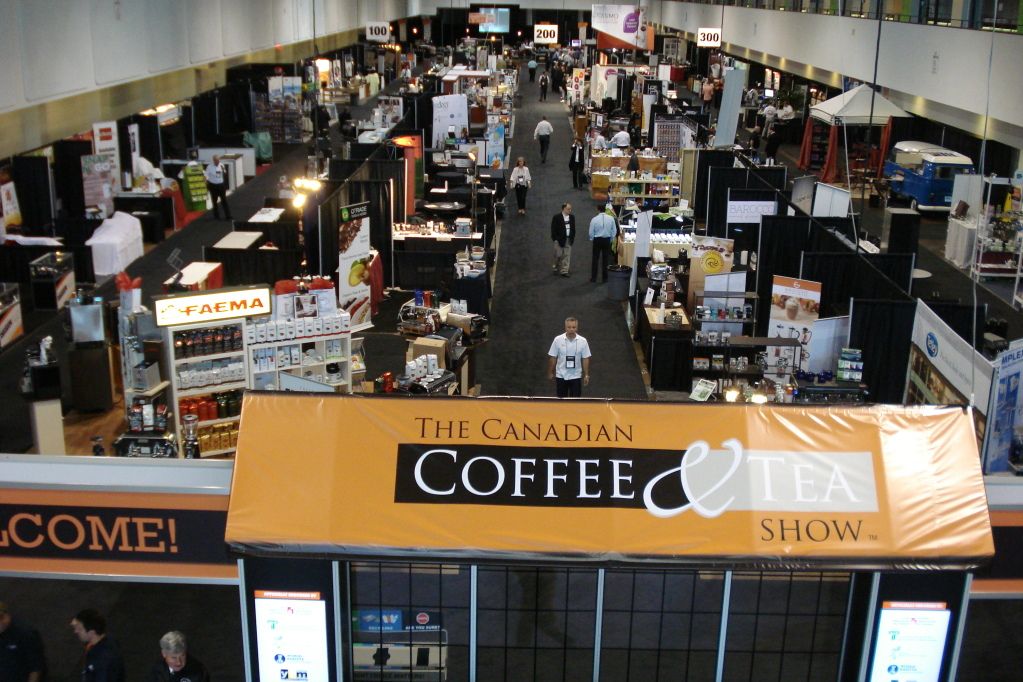
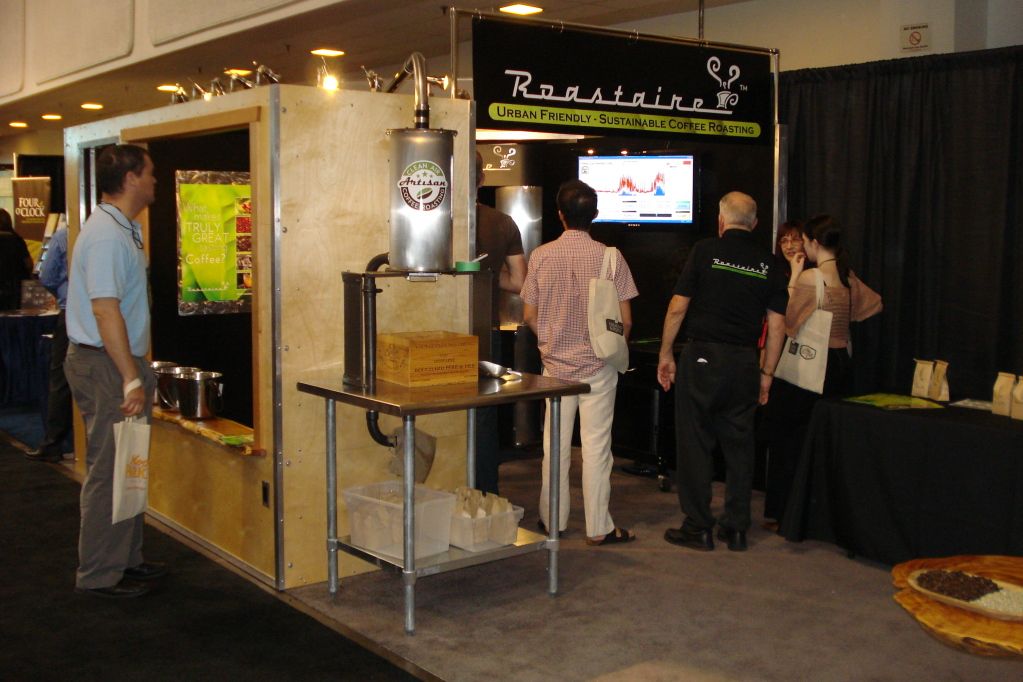
The Roastaire™ was the only functioning coffee roaster at the Canadian Coffee & Tea Show in Toronto.


The booth was near the Canadian Barista Championships but we were so busy that it was impossible to attend the skill demonstrations.

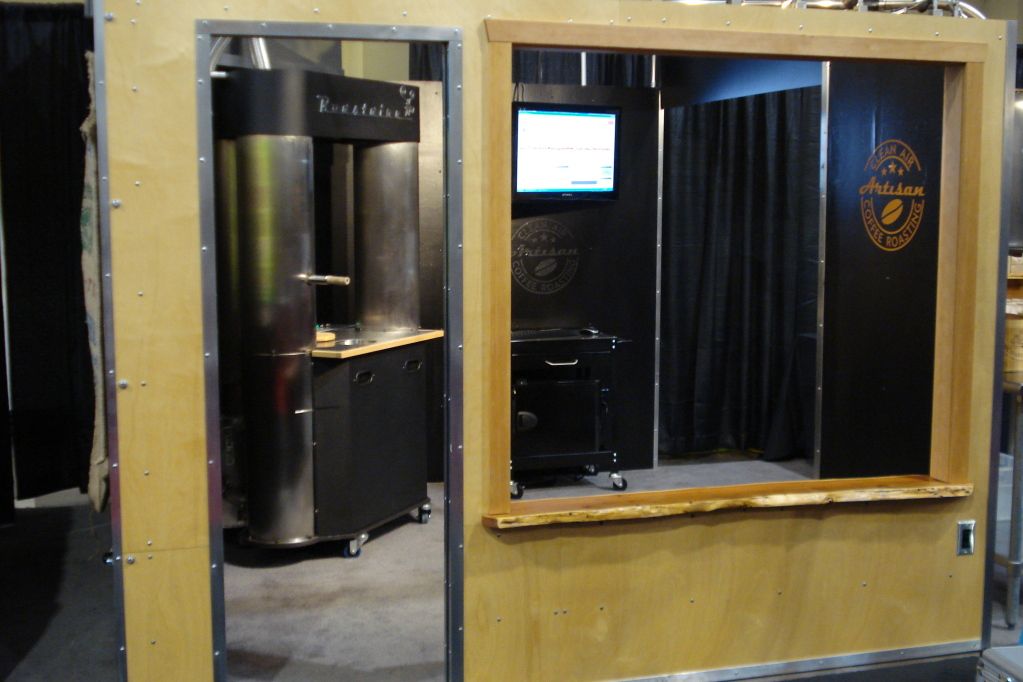
The Roastaire™ booth was designed to emulate the look of a Roastaire, coffee roaster, in a roastery café.  This layout favours the Theatre of Roasting which invites clients to observe the roasting process.  The clientele is able to pose questions to the Roastmaster without having the liability of having someone brush against hot surfaces.


The "roast is arrested" in the Roasting Chamber within seconds then is pneumatically conveyed to the Packaging Area where the beans are cooled for an additional three minutes while the Roastaire™ roasts another batch of beans.

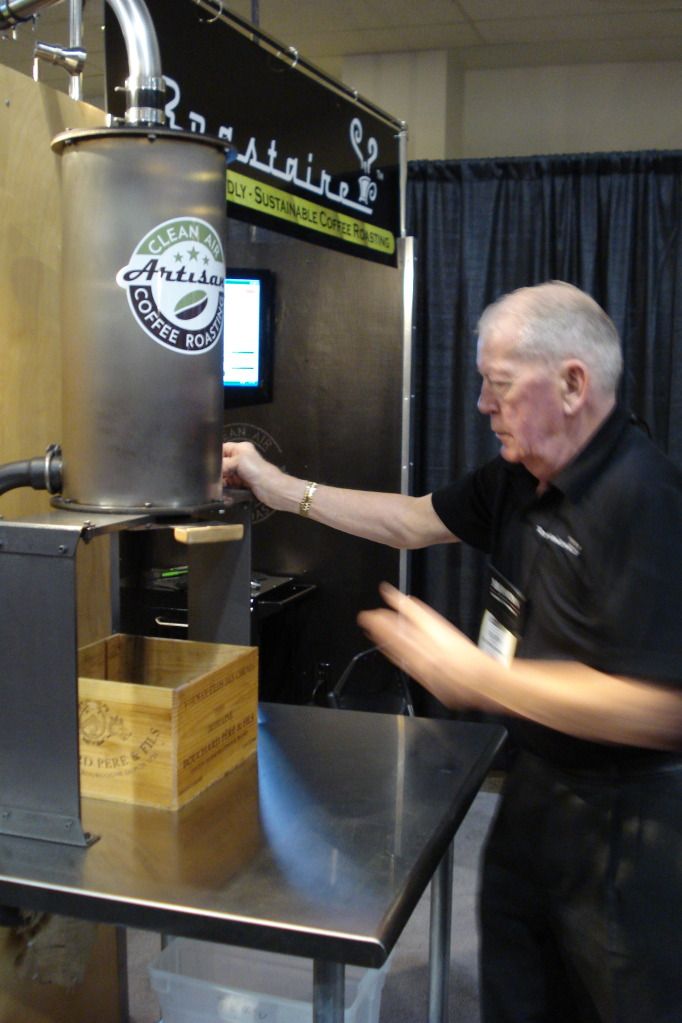
In the picture below Mel, the Roastmaster, is removing the roasted beans from the Cooling Hopper (usually located in the packaging area).  The beans are cooled while another batch is roasting.  Many people dropped in to view the only functioning Coffee Roaster at the Coffee & Tea Show.


So very close now to a Freshly Roasted cup of coffee.

 The tiff to jpg conversion is off which emulates working before enjoying a Freshly Roasted cup of coffee.


After a Freshly Roasted cup of coffee everything just works better.   Even technology is receptive!

Sunday, 1 July 2012

After Burners and Greener Roasting !

The car market illustrates a large selection of solutions to what at first appears to be a transportation problem.  Such a wide scope of solutions implies that much more is in play than moving passengers from A to B.  Some features are at the expense of others such as high performance usually eliminates the possibility of incredible fuel savings.   Maximizing nearly all characteristics usually implies a large financial outlay whether it is comfort, performance, or low fuel consumption.

Some people wish to believe that their "prized possession" is simply the best.  That is usually more than a subjective analysis or wishful dreaming where the shortcomings are deemed unimportant.  The Internet provides, sometimes humourous, pictures of people "stretching" the capability of their vehicle such as cars that are  given the role of heavy transporters which is a usage not foreseen by the designers.  Of course the danger, failure, and wear rate is abnormally high.

The same occurs in industrial machinery which is usually characterized by a design that has been optimized to solve a well defined problem.  Better equipment has many of these features; consistent, reliable, efficient, clean, predictable, safe, repairable, and of course they tend to be more expensive.  The expense of a heavy duty design sometimes requires the marketers of lesser units to "upgrade" the features and to declare that shortcomings are really features that were not understood.

Clean technology should mean more than "not visible to the naked eye". A 400,000 BTU Afterburner does virtually eliminate the coffee roasting odours and visible smoke but it can hardly be considered green technology.  The 400,000 BTU/hr  signifies 400,000 BTU/(114,000 BTU per US Gallon of gasoline) or 3.5 US gallons per hour of operation.  Consumed in a car traveling at 55 mph that represents 15.5 miles per gallon, not really in the Prius performance standard.

Some natural gas roasters have countered with the claim that they recycle 100% of their air.  That must be a statement originating in the marketing department because engineering has not figured out how to sustain a flame with air depleted of its oxygen.

Design involves more than covering up the problem, it is turning a problem into part of the solution.  Good design is using the energy within the problem process to eliminate it and if possible to use the excess energy of that destruction to reduce the roasting energy cost.

Wednesday, 16 May 2012

The Importance of Timely Bean Cooling

Coffee is roasted by way of an exothermic reaction.  Without cooling, the beans would invariably burn because they reach the combustion point.   Roasting consistency can only be achieved through the timely introduction of the cooling air, which halts the roasting, to all the beans.

Drum roasting requires well developed skills because there is an extended lag between the moment the RoastMaster views the beans in the Bean Sampler and the termination of the exothermic reaction.  Several factors affect the degree of roast in a drum roaster; the air temperature is considerably higher than what is required for roasting  ("Espresso Coffee" R. Eggers writes the typical gas temperature of a drum roaster is 400° - 550°C. ), using a Bean Sampler is a relatively slow procedure, and the Cooling fans are relatively inefficient at moving air through several layers of beans.  Sucking the air downwards through the beans is also bad design because it packs beans together which greatly hinders air flow.  Many drum roasters spray water on the beans to cool them more quickly.  This is not good nor is it a measured cooling method.

The high temperature cooking analogy for beans hit by the super hot air is cooking Scrambled Eggs while using the stoves highest heat setting.   Even if they are continually mixed the heat is much higher than the egg can transmit to the interior.  The higher heat of the drum roaster still yields a relatively slow roast which highlights the inefficient transfer of energy.         For more details see "" and "Heating Coffee Beans to Roasting Temperature"

It is said that every second counts when "calling the roast" yet it takes many seconds to determine the degree of roast using a Bean Sampler especially if multiple readings have to be taken to follow the progression.

Many roasters are  stressed  by "calling the roast" even after they have been roasting for nine months.  The beans continue to roast during the dumping process and at the beginning of the air cooling cycle.  It is a common drum roasting technique that water is sprayed unto the beans to soak up heat.  It is impossible to accurately meter water coming from a garden hose.  Moisture is the #1 enemy of roasted coffee.  That lingering roast period means the drum RoastMaster must anticipate the roast quite a bit in advance of the required roast level.  An appropriate analogy is shooting ducks; the expert hunter aims for the position where the duck will be when the buckshot arrives.  The hunter must compensate for altitude, shell powder load, temperature, duck speed, and probably many other things that only a good hunter would know. For various reasons a lot of people have a problem with duck hunting (no ducks were harmed for this analogy).  The drum RoastMaster does not deal with less variables.

 To this end the NXT aka Roastaire uses a fluidized bed in which 240°C (adjustable as required) air is pushed, under pressure, through the beans.  This significantly increases the heat transferred to the entire batch of beans.  The beans have a limited ability to absorb the heat therefore the temperature gradient is more uniform throughout the batch with the forced air stream.  The added benefit is that the air flow continually churns the beans and carries away the chaff.

 The beans are cooled within the Roasting Chamber therefore "calling the roast" is done in real time.  The blast of cooling air also churns the beans so that there is even and rapid cooling.  The Roast Monitor communicates to the RoastMaster the roasting progress so that the Cooling Cycle is started at the proper moment.  It only takes a few seconds to cool the beans ( below 180°C according to R.Eggers and below 200°C according to Clarke & Macrae) to stop the roasting process.  After this 30 second Cool Mode the beans are transported to the Packaging Hopper while the NXT aka Roastaire loads nother batch freeing the RoastMaster to appreciate a freshly roasted coffee.

Thursday, 10 May 2012

Carbon reduction or is it just "horse trading"*

There is even more to the story !
The unfortunate part about marketing claims vs. true development and technical improvements is that the marketing claims focus on changing perception rather improving the equipment.  It is the easy way out which in this case does nothing for the local air quality if someone planted trees hundreds of kilometres away.  The article cited does not mention that it took a decade to reduce the Roastaire™ emissions to a small fraction of conventional roasters.  In the process the energy required to roast was reduced to about 1/6 of a conventional coffee roaster.

The Roastaire™ was designed for the Café environment where people can observe the roasting process.  We refer to that as the "theatre of roasting".  The roaster is a compact unit that includes Chaff Cyclone, SmokEater™ (pollution controls), Pneumatic Bean Conveyor, and a Packaging Silo.  The roaster is approximately 6.5 feet high.  The roaster is controlled by a computer based Roast Monitor which  also configures the roaster, through the use of pneumatic valves, for the various modes in the roasting process.

More information is given in the post "Sustainable Design Follows Function"  such as the attention given to ergonomics.  An obvious example is the placement of the Loading Hopper which is placed at counter height rather than above the RoastMasters head.  The roasted beans are quickly cooled internally so that the smoke can be neutralized before it is vented.  The aim has been to improve and streamline the roasting session.  Cooling with a sustained blast of cool air within the Roasting Chamber means that the RoastMaster does not need to compensate for the roasting that takes place between the time of the decision and the moment that the beans are lowered below their combustion point.  The sum of the drum RoastMaster's reaction time, Roasting Chamber evacuation time, plus the actual time it takes to sufficiently cool the beans to stop the roasting process means that the RoastMaster must anticipate the final roast a minute or more in advance.  In drum roasting the process is analogous to "duck hunting";  if the hunter aims for the duck they will miss.  The hunter must shoot ahead of the duck by a distance that varies with variables such as height and speed of the duck.   Similarly skill and much training is required to anticipate the time required to get the correct drum roast.  The drum concept does not make it easier for the RoastMaster but that analysis will have to wait.
To help improve the efficiency of the Roastery the roasted beans are pneumatically conveyed to the packaging area where they can be weighed and placed directly in the bins. 


The Packaging Hopper can be mounted to the wall or placed on a table or counter.  It can be placed directly over the scale if the RoastMaster finds it more convenient.

Café owners that buy roasted beans see " FRESH Coffee! " post are simply paying for someone else's roaster without getting all the benefits.


* Horse trading is an idiom used to describe negotiations, especially where these are difficult and involve a lot of compromise.

Thursday, 1 December 2011

Heating Coffee Beans to Roasting Temperature

In cooking the heating process is usually prescribed by the recipe.  Yet, there are reasons why certain chemical reactions are promoted by heating method and temperature.  Common sense tells us that a Blow Torch is not a good heat source for warming the body.  The high temperature differential means that the outside layer will burn before the inside is warm.  Perhaps the Blow Torch salesman would suggest that the body whirl like a Dervish near the flame to distribute the heat.


In "Espresso Coffee" R. Eggers writes the typical gas temperature of a drum roaster is 400° - 550°C.  The high temperature cooking analogy for beans hit by the super hot air is frying eggs while using the stoves highest heat setting.   To this end the Roastaire uses a fluidized bed in which 240°C (adjustable as required) air is pushed through the beans.  This significantly increases the heat transferred to the entire batch of beans.  The beans have a limited ability to absorb the heat therefore the temperature gradient is more uniform throughout the batch with the forced air stream.  The added benefit is that the air flow continually churns the beans and carries away the chaff.


Considerable research has been done to understand the dynamic and continually evolving variables in the coffee roasting process.  In the design phase, of the Roaster, the limitations of the bean and the requirements to start the chemical reaction, referred to as roasting, determine the roasting precepts.  We do not believe in using extreme 400°C plus air  temperature that mostly moves around the batch of beans.  The beans will burn on the outside before it is hot inside.  Agreed the beans are in motion and only subjected to intermittent burning temperatures.  The average may be arithmetically acceptable but then so is keeping half your body in ice while the other half is in boiling water.  Perhaps some manufacturers slavishly follow this century old trend because it is easy and obvious.   


The starting point of the exothermic reaction ( above 180°C according to R.Eggers and at 200°C according to Clarke & Macrae).  We commonly use an air temperature of 240°C delivered under pressure so that the air is forced through the batch without initially losing more than a few tens of degrees.  The heat transfer to the beans, is slightly higher at the beginning of the roast when the beans are denser and able to transmit more heat internally.  Initially the heat absorbed serves to evaporate the moisture which determines the heat slope (how quickly the beans increase in temperature).  The decrease in bean density reduces the heat absorption by the beans hence the air temperature is rather uniform for the first and last layers.  Actually when the exothermic reaction begins the heat generated in the first layers raises the temperature of the beans that are down stream.   Delivering the air with sufficient pressure at 240°C is a challenge that will be addressed in a later post.  Sufficient to say that no off the shelf hot air blowers were found, resulting in another product development.


The Blower's pressurized air heats the beans and mixes them with a "bubble action" which helps reduce the contact of beans and the hot metal sides of the Roasting Chamber.  Some home roasters tout the advantage of their fountain mixing of the beans which is not optimal for roasting.  A fountain is created when the air flow is concentrated in one area which means that the air is not flowing through the rest of the beans i.e. not heating them evenly.


Time for a freshly roasted coffee.  Agree?

Sunday, 27 November 2011

Food Processing vs. Nutrition ?

AKA - Does Processing make it a Lesser Food ?

The distilled opinion is "the more you process the less the consumer receives".

For various reasons the most common vehicle for food delivery has been perverted.  In response to "manufactured food", fresh food advocates are informing the public about  real food and real food costs.  

Living on the 100-Mile Diet , Revisiting Carrying Capacity:, Natural Foods, Organic Foods, etc.  It appears that greater "inputs" yield less nutrition.  Large marketing budgets promote convenience and "filling the belly" instead of feeding the body for growth and health.  Increased time spent transporting food means, as well, increased food degradation time.  Industry will typically attempt to address product appearance indicators that influence a consumer.  Unfortunately nutrition is sacrificed for the sake of colour and appearance.  


Before focusing on one product not usually covered in the fresh food debates I would like to add that I believe that the movement advocating quality food is gaining membership.  

My interest is the freshness of coffee.  Of course people do not live by freshness of coffee alone.  That would be silly because it mostly feeds the soul, the well being, the disposition, etc. Coffee has undergone a centralizing process which exchanged convenience for quality.  Bigger is not better if the product is lessened.  We have not developed Star Trek transporters to move food instantly to the consumer while maintaining the product integrity.  If the past is any indicator this futuristic device would further degrade the food.  Warehousing roasted coffee decreases the value to the end user.

I advocate that the coffee roaster, grinder, espresso machine, and brewer should be at the same site.  Nothing gives more credibility to the freshness of the product as when the consumer can observe the preparation.  To this end Jim Townley uses the moniker of "the Theatre of Roasting".  It encourages clients to learn about the process while it reinforces the artisanal qualities of freshness and caring preparation.  Small batch roasting, in our case 3 kg batches, allows the RoastMaster to roast the requirements of the next few days.  Most likely more than one batch of each coffee will be roasted but that is a choice based on sales.

This is a simple food preparation model even though it appears to counter the produced locally mantra of some of the above links.  We are not blessed with local coffee plantations but because the coffee bean is a seed which is designed by nature for long term storage it may be consumed at a distance from its origins with a certain proviso.  So where is the Freshness Challenge?  Roasting transforms the bean and creates havoc with the storage capability of the bean.  Roasted Coffee degrades quickly despite touted storage "solutions".   Freshly ground stale beans is an advertising distraction which offers no benefit to the consumer.  The analogy of the weak chain link is true.  Nothing will resurrect stale coffee not even a marketing campaign.  

For the best cup of coffee start with a freshly roasted high mountain grown Arabica bean that is ground just before brewing.

Wednesday, 16 November 2011

Staling of Roasted Coffee

Coffee stales much faster than it is commonly perceived.  An extreme example is noted in "Coffee Technology"by Michael Sivetz where he mentions that moisture absorption from the air or due to water quenching need only to be 1% to noticeably stale coffee within the hour.  This represents 30 cc (1 fluid ounce ) per 3 kg ( 6.6 lb ) batch which,  considering that the beans lost 12 to 20 times that much moisture when roasting, is quite significant.  Advocates of water quenching claim that all the water evaporates as it hits the bean.  I am not so certain that this is so because after roasting the bean is very porous which means that the water will quickly cool the outside layer the bean will then have difficulty conducting the heat to the surface to evaporate 100% of the moisture.  The increased porosity will help draw the moisture inside.

Each opening of the container allows more moist air to reach the roasted coffee.   Sivetz writes that the beans are "moderately stale" within a week, more stale within two weeks and stale in three weeks.  Greater surface area i.e. ground beans significantly increases the absorption of air and moisture.

Vacuum packaging does remove most of the air but if it is done within a few hours of roasting it can create problems because of the high pressure CO2 will be released from the beans and inflate the bag.  If the coffee is ground the CO2 will be mostly released within the hour.

In theory the Valve on the Bag permits a longer storage time but I am sceptical about that valve working perfectly.  The changes in air pressure are small and applied over long periods of time as the barometric pressure changes which causes the bag to breathe.  The valves are attached to a bag that is filled with coffee beans which is not a flat surface hence I am thinking that it leaks and that it's purpose is to prevent the bag from bursting from C02 pressure.  Before going further that has to be tested.  I reiterate that the only safe bet is buy Freshly Roasted coffee.

Wednesday, 9 November 2011

No Carbon Credits Required !


November 1st, 2011 – Victoria, B.C.
Many coffee roasting companies across Canada claim 'carbon neutral' status these days, however, consumers are encouraged to look closely at their labels to find out 'how' they achieve this. Carbon credits are being bought by a number of roasting companies whose technology is outdated and continues to pollute the environment. Many companies are folding the costs of carbon credits into their cost of goods. 'If you look closely, many coffee companies are claiming carbon neutral status, but all they're doing is buying credits to offset their emissions', states Fresh Cup President, Jim Townley. 'The truth is, the consumer is likely paying a higher price for a product without even knowing it'. No matter how you slice buying carbon credits, they are a cost to any company and many companies are buying them more for their marketing value than the purpose that they were intended for. 'Whether you plant a tree, or buy credits to off-set the carbon emissions produced in making a product, it costs money', notes Townley. That cost has to show up somewhere along the line, and if the cost to buy credits is left low like it currently is, many companies will continue to pollute and make consumers pay the price. 'What's the point of low cost credits, if the cost can be added to the product for the consumer to pay ? Where's the motivation for companies to change their business practices to minimize the impact on the environment', asks Townley. 'Our approach is simple…be sustainable in how we roast coffee by reusing the heat, while drastically minimizing the emissions, then there's no carbon credits required'.


---------------------------------------------------------------------------------------------------------------
There is even more to the story !
The unfortunate part about marketing claims vs. true development and technical improvements is that the marketing claims focus on changing perception rather improving the equipment.  It is the easy way out which in this case does nothing for the local air quality if someone planted trees hundreds of kilometres away.  The article above does not mention that it took a decade to reduce the Roastaire™ emissions to a small fraction of conventional roasters.  In the process the energy required to roast was reduced to about 1/6 of a conventional coffee roaster.

The Roastaire™ was designed for the Café environment where people can observe the roasting process.  We refer to that as the "theatre of roasting".  The roaster is a compact unit that includes Chaff Cyclone, SmokEater™ (pollution controls), Pneumatic Bean Conveyor, and a Packaging Silo.  The roaster is approximately 6.5 feet high.  The roaster is controlled by a computer based Roast Monitor which  also configures the roaster, through the use of pneumatic valves, for the various modes in the roasting process.

More information is given in the post "Sustainable Design Follows Function"  such as the attention given to ergonomics.  An obvious example is the placement of the Loading Hopper which is placed at counter height rather than above the RoastMasters head.  The roasted beans are quickly cooled internally so that the smoke can be neutralized before it is vented.  The aim has been to improve and streamline the roasting session.

Café owners that buy roasted beans see " FRESH Coffee! " post are simply paying for someone else's roaster without getting all the benefits.