Pages

Wednesday, 31 July 2013

NXT Roasters has the Aeropress brewer

There are several brewing options available to the consumer but only a few have a "freshly roasted" priority mostly because they cannot deliver their coffee in a timely manner.

We searched  the Internet and wrote many emails to source the brewer that would give the best value to our customers.  The Aeropress is a well designed and built device which does not require an expensive electric brewer.

There are countless videos that address brewing with the Aeropress but most of them are not worth a mention because they exhort what I consider a faux pas i.e.
- advocating coffee is ok up to 40 days after roasting
- coffee should be used within 10 days of grinding
- a presenter attempts to explain how they defy the laws of physics by building unbelievable pressure
- another has concluded that the pressure pushing out the coffee is a vacuum
- for some reason some equate hot water with bitterness rather than improper roasting and staleness
Critical thinking is required on the Internet.  Yes, even now!

The Aeropress is versatile and has well designed accessories.  It can be used in two ways which are best explained by way of videos followed by pictures and explanations.

The KPCC Radio video demonstrates the Filter Down Method (photo to the left).  The temperature is important, it affects the extraction and should be above 90°C  (194°F).  The low temperature advocates probably make or sell machines that are unable to serve hot water.  The simplicity of the electric kettle is not to be scoffed at.  In an anecdotal observation a few tablespoons of coffee are placed on the bottom of your sink (especially appropriate experiment for those that have weeks old coffee but want to move to freshly roasted delights).  Allow some warm water to flow gently against the mini mound (gently - don't power wash it away) then increase the temperature.  You will find that the hot water dissolves while warm water agglomerates.

The Atomic Way video demonstrates the Inverted Method (photo below) which eliminates the dripping into the cup while mixing.


THE GRIND.  We often drink a modified Turkish style coffee where all the ingredients are mixed in the cup.  The finely ground coffee is only produced by a burr style grinder.  A finely ground coffee has a large surface area proportional to its volume which means a rapid extraction and that the grains soak up the water and decant quickly.  A fine grind like this creates a mini disaster in the gravity drained brewers because the water is poured onto the grind faster than the permeability allows it to go through, resulting in the dreaded overflow.  The plunger pressure in the Aeropress appears to circumvent that problem and yields a better extraction.

The end user has to determine the grind by experimentation.   A coarse grind will under extract and the water will be pushed through too quickly.


The Aeropress is then flipped over and placed
on a cup and the process continues as in the
conventional method.


FRESHNESS IS #1  The staling process starts after
roasting and begins to be detected at the end of one week.  Grinding the coffee accelerates the staling process.  The high surface area proportional to the content of a coffee ground means that it is more rapidly affected by oxygen and moisture.  Grind at the last minute.

More will follow shortly when the pictures of the various Aeropress components are taken or downloaded.

Tuesday, 28 May 2013

When Price is #1 Criteria ! (Who really pays ?)

A Purchaser is able to impose a price importance by choosing what is purchased based uniquely on the monetary cost.  Sellers quickly realize when a low selling price is required to make the sales.  Typically, "quality" is sacrificed to reduce the sellers cost while meeting a few important criteria such as appearance to a non critical eye.

Coffee beans do not visually change when way past their prime apart from having a little more surface oil.   That creates an opportunity for marketing spin that is analogous to a magic act.  The Purchaser may decide the price but the Seller decides everything else including the message that is crafted to give the Purchaser assurance that they received a premium product even when it is not.  In a magic show the spectator's attention is skillfully guided to the advantage of the magician so that the impossible is viewed as real.   The spectator does not suspend disbelief because they know that it is a performance.  Most spectators try to figure out how the magic was carried out.  For some reason low price marketing is not often subjected to the same analysis.

Economies of scale, low quality, and a magic presentation are fundamental to selling many products at low prices.  Foods with low or no nutritional value outsell fresh organic vegetables and are designed for the supply chain rather than the consumer.  The buying criteria are satisfied while other possible benefits are only implied.

Economy of scale can only be achieved with a wide network that can store and distribute a uniform product.  The supply chain optimized product, usually produced in one highly automated factory, to specifications that favour longevity or visual aspects .  The processing or transformation technology is optimized to fulfill the goals of the seller based on the buying criteria of the clients.  A great deal of research is undertaken to understand the buying decision and what common "markers" are used in reaching that decision.

The volume of imported roasted coffee is staggering.  This "Warehouse Coffee" does not reach the client while fresh but it does reach the end user while it is cheap.

My mantra is "Buy from a small batch roaster".   I prefer the freshest coffee over the exotic varietal that was roasted two or more weeks ago.

Sunday, 21 April 2013

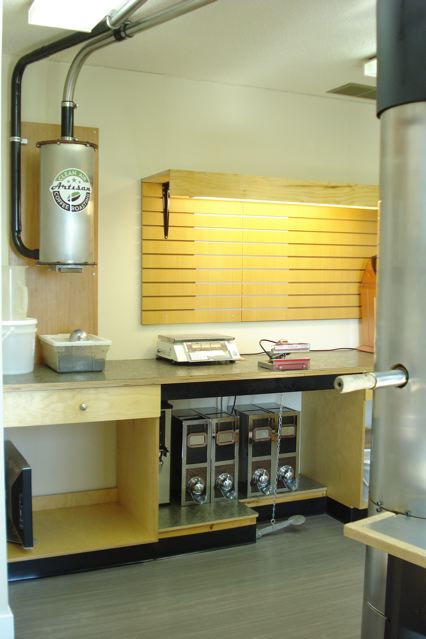
Updating our Roastery


We updated our Roastery and reception area so that it would not be confused with the workshop.


It is slightly more pleasant to sit down at a Granite table for the morning Espresso than a work bench.  Well, there is the optional bar height table for the devotees of the fitness club.

The main goal is to show that our roaster does not require a lot of room.   There is a full glass door that encourages observation though a full glass wall would yield a better view of the Roasting Theatre.


The coffee roaster is the focal point and the "raison d'être".  The green beans are loaded into the counter height Bean Loader Hopper.  the design of which expresses our opinion about overhead bean loading.  After roasting the beans are pneumatically conveyed to the Packaging area which saves the Roast Master from picking up roasted coffee from the floor area.  It appears that drum roaster designers just do not think of ergonomics and Roast Master comfort. These are important considerations when the Roast Master does sessions of over 20 roasts.

The previous post has some pictures of some of our morning Espresso shots.  Not all shots are photographed since pictures are secondary to tasting.  That series of pictures were intended to illustrate the Crema obtained with Freshly Roasted coffee.

The Coffee Roaster is labelled "Roastaire" which is the distributor for NXT Roasters in Canada.  Check out their site for information about roasting, energy conversion efficiency, and roasting pollution controls.


Sunday, 24 March 2013

Maturing Espresso


The Espresso Transformation

Few people see the Espresso when it is all Crema.  You could be tricked into believing that it is an "air head".        Perhaps the roasting method deserves consideration but for now let's say that Freshly Roasted Coffee is the key which of course has to be supported by a well adjusted Espresso Machine.  This topic was also mentioned in a previous post.   The evolution is followed more closely this time. 
The first picture was taken 26 seconds into the extraction which continued for another two seconds.  The coffee is Cocamu (COCAMU is a coffee growers cooperative located in the district of Kirehe in the eastern province of Rwanda) roasted three days earlier.  The picture to the left was taken at the 4 second mark (after extraction).
 The Crema transforms into the liquid elixir.  The glorious description often depends on how badly the observer requires that first coffee.  The third photo, taken at the 11 second mark, is an indicator of the Crema to liquid conversion.  Unfortunately the graduated glass has rather coarse markings but they can be overcome by overlaying a grid on a printed picture.


Photo #4 is from the 20 second mark.  This is about when the client first sees the "magic potion".  Some may opine that a blend with a healthy Sumatran representation would be more appropriate.  That may be but it is outside the scope of this post.
 Photo #5, taken at the 34 second mark, is reasonably close to the typical serving time unless you yanked it out of the hands of the Barista which would only gain you three seconds and a frown. 
When are you served your Espresso?