The car market illustrates a large selection of solutions to what at first appears to be a transportation problem. Such a wide scope of solutions implies that much more is in play than moving passengers from A to B. Some features are at the expense of others such as high performance usually eliminates the possibility of incredible fuel savings. Maximizing nearly all characteristics usually implies a large financial outlay whether it is comfort, performance, or low fuel consumption.
Some people wish to believe that their "prized possession" is simply the best. That is usually more than a subjective analysis or wishful dreaming where the shortcomings are deemed unimportant. The Internet provides, sometimes humourous, pictures of people "stretching" the capability of their vehicle such as cars that are given the role of heavy transporters which is a usage not foreseen by the designers. Of course the danger, failure, and wear rate is abnormally high.
The same occurs in industrial machinery which is usually characterized by a design that has been optimized to solve a well defined problem. Better equipment has many of these features; consistent, reliable, efficient, clean, predictable, safe, repairable, and of course they tend to be more expensive. The expense of a heavy duty design sometimes requires the marketers of lesser units to "upgrade" the features and to declare that shortcomings are really features that were not understood.
Clean technology should mean more than "not visible to the naked eye". A 400,000 BTU Afterburner does virtually eliminate the coffee roasting odours and visible smoke but it can hardly be considered green technology. The 400,000 BTU/hr signifies 400,000 BTU/(114,000 BTU per US Gallon of gasoline) or 3.5 US gallons per hour of operation. Consumed in a car traveling at 55 mph that represents 15.5 miles per gallon, not really in the Prius performance standard.
Some natural gas roasters have countered with the claim that they recycle 100% of their air. That must be a statement originating in the marketing department because engineering has not figured out how to sustain a flame with air depleted of its oxygen.
Design involves more than covering up the problem, it is turning a problem into part of the solution. Good design is using the energy within the problem process to eliminate it and if possible to use the excess energy of that destruction to reduce the roasting energy cost.
Sunday, 1 July 2012
Saturday, 16 June 2012
Does Food Processing reduce nutrition ?
The distilled opinion is "the more you process the less the consumer receives".

Before focusing on one product not usually covered in the fresh food debates I would like to add that I believe that the movement advocating quality food is gaining membership.
For
various reasons the most common vehicle for food delivery has been
perverted. Perhaps "Extra Virginity" The Sublime and Scandalous World of Olive Oil by Tom Mueller shows that number cruncher executives care not a wit about their product, the well being of their customers, and sometimes the law. People that are passionate about their product will bring the best to the customers sometimes at a great sacrifice.
Reuters had an article, a few days ago, to this effect: ...Coffee roasters quietly pulled off a financial feat last year that went unnoticed by most customers: Adding a higher proportion of cheaper, lower-grade robusta to their grounds as the price of top-notch arabica beans surged... Not only are the beans cheaper but Robusta creates substantial crema even when it is stale therefore it gives a visual indicator of freshness even when it is not.
In response to "manufactured food", fresh food advocates are informing the public about real food and real food costs.
Reuters had an article, a few days ago, to this effect: ...Coffee roasters quietly pulled off a financial feat last year that went unnoticed by most customers: Adding a higher proportion of cheaper, lower-grade robusta to their grounds as the price of top-notch arabica beans surged... Not only are the beans cheaper but Robusta creates substantial crema even when it is stale therefore it gives a visual indicator of freshness even when it is not.
In response to "manufactured food", fresh food advocates are informing the public about real food and real food costs.
Living on the 100-Mile Diet , Revisiting Carrying Capacity:, Natural Foods, Organic Foods, etc. It appears that greater "inputs" yield less nutrition. Large marketing budgets promote convenience and "filling the belly" instead of feeding the body for growth and health. Increased
time spent transporting food means, as well, increased food degradation
time. Industry will typically attempt to address product appearance
indicators that influence a consumer. Unfortunately nutrition is
sacrificed for the sake of colour and appearance.

Before focusing on one product not usually covered in the fresh food debates I would like to add that I believe that the movement advocating quality food is gaining membership.
My
interest is the freshness of coffee. Of course people do not live by
freshness of coffee alone. That would be silly because it mostly feeds
the soul, the well being, the disposition, etc. Coffee has undergone a
centralizing process which exchanged convenience for quality. Bigger is
not better if the product is lessened. We have not developed Star Trek
transporters to move food instantly to the consumer while maintaining
the product integrity. If the past is any indicator this futuristic
device would further degrade the food. Warehousing roasted coffee
decreases the value to the end user.
I
advocate that the coffee roaster, grinder, espresso machine, and brewer
should be at the same site. Nothing gives more credibility to the
freshness of the product as when the consumer can observe the
preparation. To this end Jim Townley
uses the moniker of "the Theatre of Roasting". It encourages clients to
learn about the process while it reinforces the artisanal qualities of
freshness and caring preparation. Small batch roasting, in our case 2 to 3
kg batches, allows the RoastMaster to roast the requirements of the next
few days. Most likely more than one batch of each coffee will be
roasted but that is a choice based on sales.
This
is a simple food preparation model even though it appears to counter
the produced locally mantra of some of the above links. We are not
blessed with local coffee plantations but because the coffee bean is a
seed which is designed by nature for long term storage it may be
consumed at a distance from its origins with a certain proviso. So
where is the Freshness Challenge? Roasting transforms the bean and
creates havoc with the storage capability of the bean. Roasted Coffee
degrades quickly despite touted storage "solutions". Freshly ground stale beans
is an advertising distraction which offers no benefit to the consumer.
The analogy of the weak chain link is true. Nothing will resurrect
stale coffee, not milk, not sugar, not artificial liquids, not even a marketing campaign.
For the best cup of coffee start with a freshly roasted high mountain grown Arabica bean that is ground just before brewing.


Sunday, 27 May 2012
High Pressure Hot Air Blower - Sound Containment.
NXT Roasters started with off-the-shelf centrifugal blowers of which we got to know the internals too intimately. There were no guarantees that they would handle the temperature but the salesperson thought that we should get a reasonable MTBF (Mean Time Before Failure). At the beginning, it was only 25 hours on average!
Virtually every manufacturer claimed that their composite bearings would work at the 250°C air temperature. They must not have realized that 18,000 rpm was on the faster side which greatly reduced the life of their product. Regular bearing races are too soft for this temperature and speed combination. It takes very little Brinelling which creates a looseness that, at 18K rpm, allows the shaft to vibrate and the bearings self destruct. Note: the faster the speed the smaller the movement of the vibration, all other things being equal. Bearings were repacked with high temperature grease that was measured out in milligrams. Oil bathed bearings were tried. Many iterations of new seals had to be turned because the stock items were intended for ambient temperatures. Most modifications succeeded in improving the longevity; 25 hrs, 55 hrs, 125 hrs, 225 hrs, 320 hrs, and after a couple years it was over 1300 hrs. Not that great, but the client could live with it while we were working on a new blower that is featured in the other blog pages. A specialized bearing manufacturer made a bearing for us that goes like the proverbial bunny. All we have to do is pay them a lot of money. The switch over to our blower design started two years ago. We do not know the MTBF because of the lack of failures (no! no! that is good).
The aim of this blog is to discuss the blower noise that was generated by that first blower compared to what we have today.
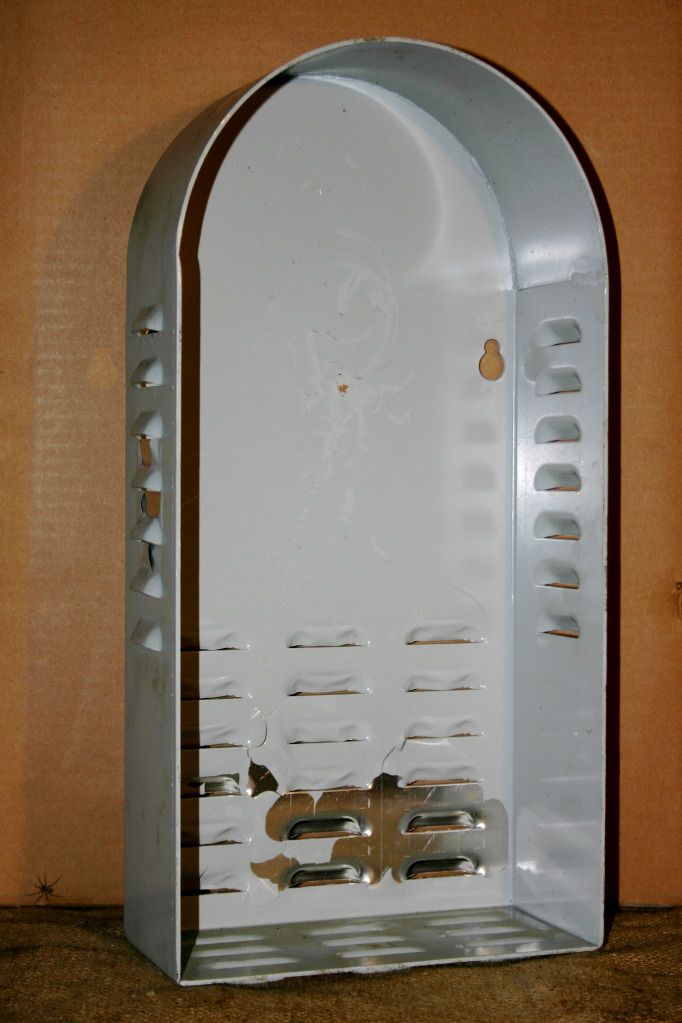 The off the shelf blower had an aluminum Belt Guard with a rubber lip that is not shown. The guard resonated and the RoastMaster wore Ear Protectors. Obviously the level of balance is greatly affected by the speed of the 6" Rotor. If that manufacturer recognizes his cover they will realize that they have a problem and then see the solution. Well, they have more problems than that which is why they do well to focus on ambient temperatures. The paint has flaked which reflects badly on the quality of the work.
The output of our design was better than expected therefore we were able to reduce the speed. To improve upon the case design, first, we increased the mass by making the Belt Guard from steel sheet. It was better, or as they say, "Good, but not so good".
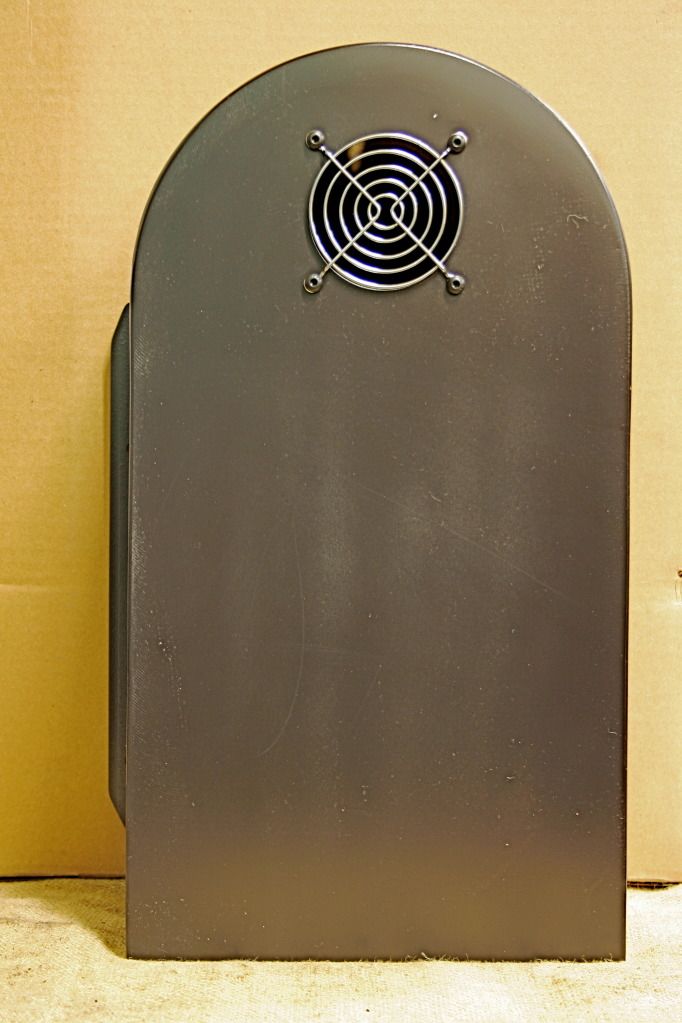
Heavier bar stock was screwed to the front and sides to increase the mass and reduce the amplitude of the resonance. The roaster was delivered with that modification but the client still found the noise to be disturbing to the working environment.
In his youth the client was a hot rodder and had some experience with taming unwanted frequencies though I suspect that most of his energy went into making the engine louder.
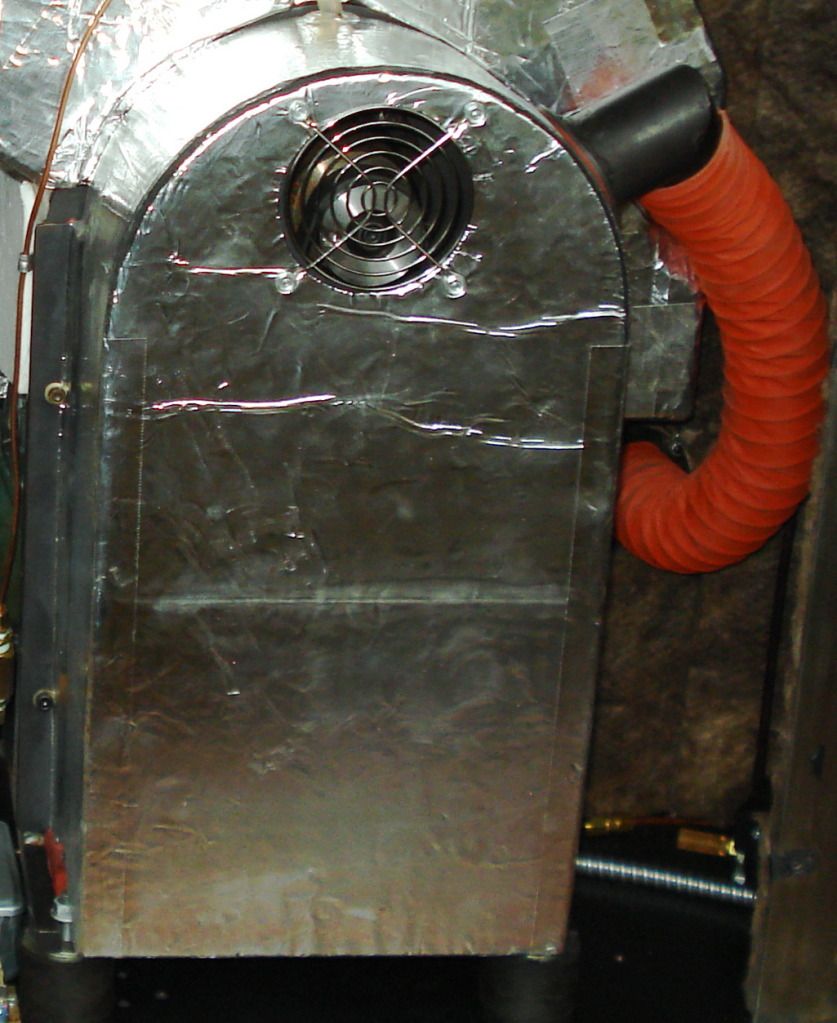
He covered the Roastaire Belt Guard with an aluminized Butyl Rubber sheet product. It worked so well that the covering panels got the same treatment. The "sound treatment" was so effective that CBC Radio did part of "On the Island" Roastery Interview in front of the working Roastaire.
At the Eptech show Ampco's Rick Gagne discussed such a product that they carry. It is not necessary to cover much more than 25% of the surface to stop the ringing but esthetics would take a beating with less than full coverage. The alternative was to place strips on the interior walls but if the bond fails after a while then that will certainly lead to belt failure. Perhaps we can revisit and find a conclusion after a year - with the help of a freshly roasted coffee.
Virtually every manufacturer claimed that their composite bearings would work at the 250°C air temperature. They must not have realized that 18,000 rpm was on the faster side which greatly reduced the life of their product. Regular bearing races are too soft for this temperature and speed combination. It takes very little Brinelling which creates a looseness that, at 18K rpm, allows the shaft to vibrate and the bearings self destruct. Note: the faster the speed the smaller the movement of the vibration, all other things being equal. Bearings were repacked with high temperature grease that was measured out in milligrams. Oil bathed bearings were tried. Many iterations of new seals had to be turned because the stock items were intended for ambient temperatures. Most modifications succeeded in improving the longevity; 25 hrs, 55 hrs, 125 hrs, 225 hrs, 320 hrs, and after a couple years it was over 1300 hrs. Not that great, but the client could live with it while we were working on a new blower that is featured in the other blog pages. A specialized bearing manufacturer made a bearing for us that goes like the proverbial bunny. All we have to do is pay them a lot of money. The switch over to our blower design started two years ago. We do not know the MTBF because of the lack of failures (no! no! that is good).
The aim of this blog is to discuss the blower noise that was generated by that first blower compared to what we have today.
The output of our design was better than expected therefore we were able to reduce the speed. To improve upon the case design, first, we increased the mass by making the Belt Guard from steel sheet. It was better, or as they say, "Good, but not so good".
Heavier bar stock was screwed to the front and sides to increase the mass and reduce the amplitude of the resonance. The roaster was delivered with that modification but the client still found the noise to be disturbing to the working environment.
In his youth the client was a hot rodder and had some experience with taming unwanted frequencies though I suspect that most of his energy went into making the engine louder.
He covered the Roastaire Belt Guard with an aluminized Butyl Rubber sheet product. It worked so well that the covering panels got the same treatment. The "sound treatment" was so effective that CBC Radio did part of "On the Island" Roastery Interview in front of the working Roastaire.
At the Eptech show Ampco's Rick Gagne discussed such a product that they carry. It is not necessary to cover much more than 25% of the surface to stop the ringing but esthetics would take a beating with less than full coverage. The alternative was to place strips on the interior walls but if the bond fails after a while then that will certainly lead to belt failure. Perhaps we can revisit and find a conclusion after a year - with the help of a freshly roasted coffee.
Monday, 21 May 2012
Vented Bags Revisited
The original blog of Do Coffee Bags "Lock in the Flavour" ? and Packaging Optimism gathered the most visits. Does this mean that those people believe or want to believe that there is a magical way to preserve roasted coffee. Well, apparently there is but it involves a -273°C or -459°F refrigerator. That is no ordinary ice box. Even then the degrading chemical reaction is only slowed down not stopped.
This little valve is, in my view, good engineering. The object can be mass produced cheaply and there is much more to the design than the average coffee drinker pays attention to. Notice the fiber filter which is backed by a plastic frame to give it strength. I assume that the purpose is to keep coffee particles away from the sealing lip but then it may also keep small life forms out of the bag.
This little valve is, in my view, good engineering. The object can be mass produced cheaply and there is much more to the design than the average coffee drinker pays attention to. Notice the fiber filter which is backed by a plastic frame to give it strength. I assume that the purpose is to keep coffee particles away from the sealing lip but then it may also keep small life forms out of the bag.
Interestingly, the valve is required to preserve the bag rather than the coffee. In the days after roasting the coffee beans will produce enough CO2 to burst the bag ( it depends on the bag material but I found that 250 to 350 grams was the limit for un-vented vacuum packed bags). I suspect that the "longevity improving" aspect was more an invention of the marketing department than an engineering criteria.
A marginal improvement in longevity might be possible with vacuum packed vented bags. If the bags are packed within the hour after roasting they will need the valve even if they are vacuum packed. The porosity of the bean is relatively low and it takes time for the CO2 to migrate from the bean. Without a vent even vacuum packed packages look like overstuffed pillows. Obviously that would not allow efficient boxing of the bags.
Rather than believe that the bag was not kept in a warehouse for months and or spending days in truck trailers I prefer to buy from a local roastery or from Fresh Cup because they expedite the order on the day it is roasted. Oh well, that offer is only for Canada which means that more than Alaska and Hawaii are hit by the shipping restriction.
Subscribe to:
Posts (Atom)