Pages

Showing posts with label Green Roasting. Show all posts

Friday, 21 September 2018

Extending Freshly Roasted Coffee Lifespan

The main enemies of Freshly Roasted Coffee are Time, Oxygen, and Moisture.

A solution has been presented to the public that is more beneficial to the manufacturers than to the end user.

Background info:

Immediately after roasting the coffee beans begin to emit carbon dioxide in sufficient volume and pressure to burst a hermetically sealed bag.  Some roasters opted to degas the beans for one to three days to alleviate this problem while manufacturers came up with a new product, the valve.
http://nxt-roasters.blogspot.com/2011/12/do-coffee-bag-valves-leak-1.html
http://nxt-roasters.blogspot.com/2012/05/revisited.html

Valve Limitation - as currently used:
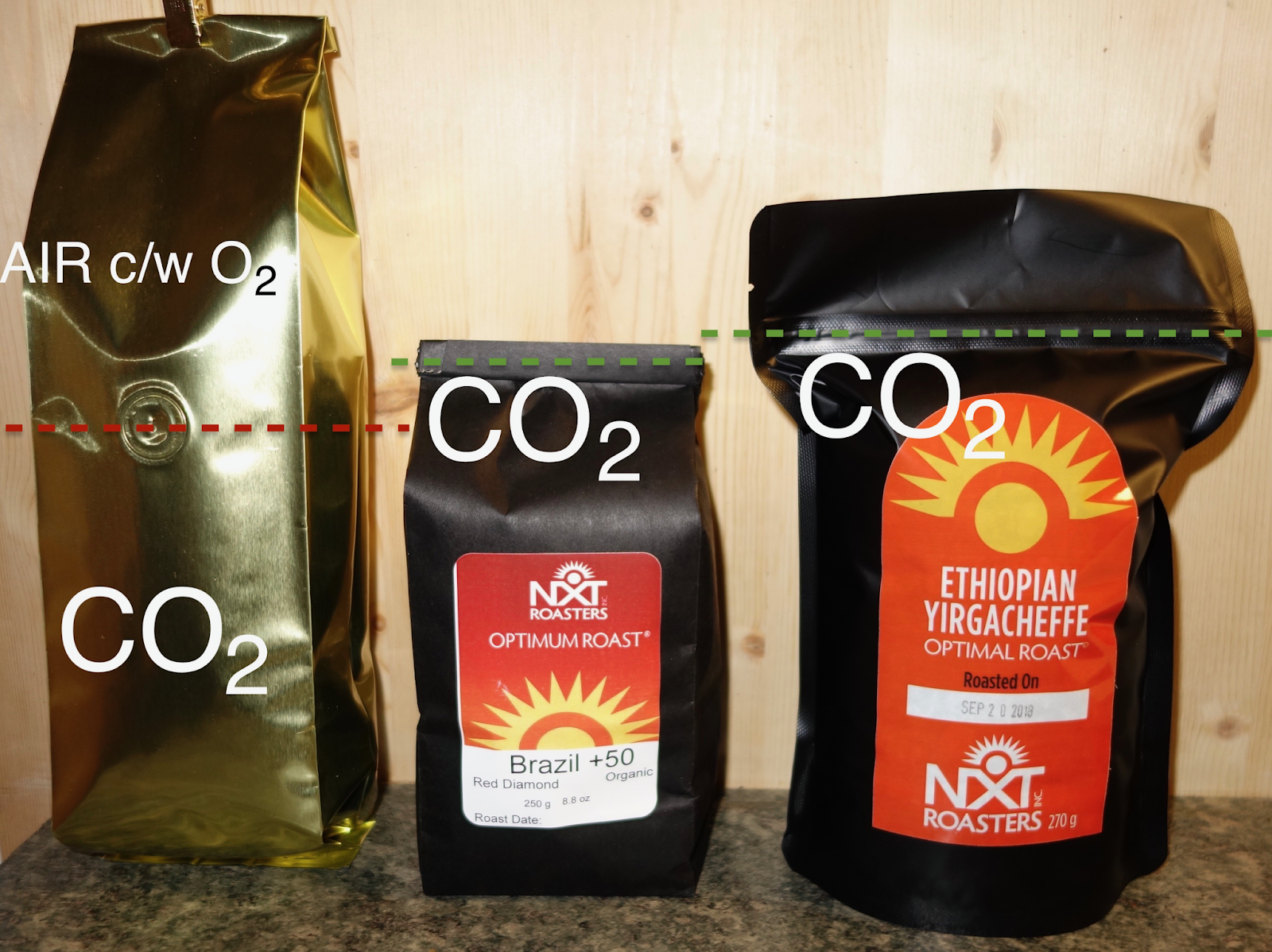
It is possible that the valve is a single solution to burst bags when with a little more thought it could have also help to extend the freshness of coffee beans.

The CO2 is roughly 50% denser than the air we breathe, which consists of about 21% Oxygen.  This means when packaged, on the first day, beans emit CO2 that gas drops to the lowest level in the container and pushes the existing air upwards.  Surrounded the Freshly Roasted Coffee Beans with CO2 retards the oxidation process, hence, slows down the staling process.  How well and for how long the freshness is preserved is much more difficult to assess and beyond the limits of a one page blog entry.  For arguments sake I say it gives an extra week.  This process exists for the beans that are continually bathed in CO2 which is not the case when there is a venting valve.  As shown in the photo the CO2 will rise up to the valve then exit rather than flush out the air above the valve.  That means that, as the photo illustrates, that only 2/3 of the beans are in CO2 providing the bag is not tilted.  If the bag was laid on it back so that the valve was at the high point of the bag then there would be a different outcome but bags are not stored, shipped, or displayed laying down.  That scenario would be improved by moving the valve upwards to minimize the amount of air in the bag.

Using a valve does allow the roaster to degas in the heat sealed bag which offers the consumers the security and assurance that the bag contents have not been tampered with.

Alternatives:

The NXT solution to this dilemma is to use a ziplock bag which presents more flexible packaging options.  First, all the oxygenated air is pushed out of the bag when the bag is kept upright.  We recommend that people scoop out the beans for immediate consumption rather than pour them out which would drain much of the CO2.  Leaving CO2 to protect the beans extends the freshness.  Our bags are in a supervised area and they are not opened after closing but for added security, where bags are placed in a public area and a heat seal is required a simple pin prick between the ziplock and the heat seal which will prevent bursting the bag and allow a flushing of the oxygenated air.

NXT advocates degassing in the bag to take advantage of the emitted CO2 to extend the freshness of the coffee beans.

We have a Carbon Dioxide high pressure tank and a regulator to test the effect of giving a shot of CO2 to a bag of beans that are more than a day old when outgassing has mostly ceased.

It might mean some beans will be destroyed with water to determine the volume of the interstitial spaces which will indicate how much CO2 has to be injected to bathe all the beans in a protective gas.

To Do:

Test to determine how CO2 will enhance the life of ground coffee.

Thursday, 13 December 2012

Coffee Roasting & Heat Transfer

One of the challenges in attempting a discussion that compares roasting environments is that too many "just know that they are right" without doing any tests or measurements.

An untested concept is, more often than not, nonsense.  Transformation processes require laboratory equipment and technical training to understand.  Some technologies have been around for a long time and have been saddled with claims that just do not stand up to scrutiny.  Drum roasting has many devotees that have been critical of other drum roaster users and other roasting methods. There have been several comments of disbelief about the R. Eggers quotation  from  "Espresso Coffee"  in which he claims that "the typical gas temperature of a drum roaster is 400° - 550°C".  The people contesting this did not measure the air temperature in a drum roaster but "felt" that it was way too high.   Now, I have not measured it either but then, I don't have a drum roaster nor do I advocate for their use.  Some drum roasters use heat exchangers which can be fed with variable volumes of air which consequently alters the air temperature sent to the roasting drum.  Perhaps someone will grace us with the range in temperatures achievable and the slope at which changes can be made.   What they don't have is an efficient way of transferring the energy in the air to the beans.   Without a high pressure blower forcing the hot air through the beans it is only possible to transfer significant heat to the outside layer.  In this situation more energy goes up the chimney than into the beans.

Efficient use of energy can only be attained through recirculation of the roasting air which has to be continually scrubbed of smoke to prevent redepositing on the beans.  Untreated air sent to the chimneys is responsible for many chimney fires.

Sunday, 1 July 2012

After Burners and Greener Roasting !

The car market illustrates a large selection of solutions to what at first appears to be a transportation problem.  Such a wide scope of solutions implies that much more is in play than moving passengers from A to B.  Some features are at the expense of others such as high performance usually eliminates the possibility of incredible fuel savings.   Maximizing nearly all characteristics usually implies a large financial outlay whether it is comfort, performance, or low fuel consumption.

Some people wish to believe that their "prized possession" is simply the best.  That is usually more than a subjective analysis or wishful dreaming where the shortcomings are deemed unimportant.  The Internet provides, sometimes humourous, pictures of people "stretching" the capability of their vehicle such as cars that are  given the role of heavy transporters which is a usage not foreseen by the designers.  Of course the danger, failure, and wear rate is abnormally high.

The same occurs in industrial machinery which is usually characterized by a design that has been optimized to solve a well defined problem.  Better equipment has many of these features; consistent, reliable, efficient, clean, predictable, safe, repairable, and of course they tend to be more expensive.  The expense of a heavy duty design sometimes requires the marketers of lesser units to "upgrade" the features and to declare that shortcomings are really features that were not understood.

Clean technology should mean more than "not visible to the naked eye". A 400,000 BTU Afterburner does virtually eliminate the coffee roasting odours and visible smoke but it can hardly be considered green technology.  The 400,000 BTU/hr  signifies 400,000 BTU/(114,000 BTU per US Gallon of gasoline) or 3.5 US gallons per hour of operation.  Consumed in a car traveling at 55 mph that represents 15.5 miles per gallon, not really in the Prius performance standard.

Some natural gas roasters have countered with the claim that they recycle 100% of their air.  That must be a statement originating in the marketing department because engineering has not figured out how to sustain a flame with air depleted of its oxygen.

Design involves more than covering up the problem, it is turning a problem into part of the solution.  Good design is using the energy within the problem process to eliminate it and if possible to use the excess energy of that destruction to reduce the roasting energy cost.

Wednesday, 16 May 2012

The Importance of Timely Bean Cooling

Coffee is roasted by way of an exothermic reaction.  Without cooling, the beans would invariably burn because they reach the combustion point.   Roasting consistency can only be achieved through the timely introduction of the cooling air, which halts the roasting, to all the beans.

Drum roasting requires well developed skills because there is an extended lag between the moment the RoastMaster views the beans in the Bean Sampler and the termination of the exothermic reaction.  Several factors affect the degree of roast in a drum roaster; the air temperature is considerably higher than what is required for roasting  ("Espresso Coffee" R. Eggers writes the typical gas temperature of a drum roaster is 400° - 550°C. ), using a Bean Sampler is a relatively slow procedure, and the Cooling fans are relatively inefficient at moving air through several layers of beans.  Sucking the air downwards through the beans is also bad design because it packs beans together which greatly hinders air flow.  Many drum roasters spray water on the beans to cool them more quickly.  This is not good nor is it a measured cooling method.

The high temperature cooking analogy for beans hit by the super hot air is cooking Scrambled Eggs while using the stoves highest heat setting.   Even if they are continually mixed the heat is much higher than the egg can transmit to the interior.  The higher heat of the drum roaster still yields a relatively slow roast which highlights the inefficient transfer of energy.         For more details see "" and "Heating Coffee Beans to Roasting Temperature"

It is said that every second counts when "calling the roast" yet it takes many seconds to determine the degree of roast using a Bean Sampler especially if multiple readings have to be taken to follow the progression.

Many roasters are  stressed  by "calling the roast" even after they have been roasting for nine months.  The beans continue to roast during the dumping process and at the beginning of the air cooling cycle.  It is a common drum roasting technique that water is sprayed unto the beans to soak up heat.  It is impossible to accurately meter water coming from a garden hose.  Moisture is the #1 enemy of roasted coffee.  That lingering roast period means the drum RoastMaster must anticipate the roast quite a bit in advance of the required roast level.  An appropriate analogy is shooting ducks; the expert hunter aims for the position where the duck will be when the buckshot arrives.  The hunter must compensate for altitude, shell powder load, temperature, duck speed, and probably many other things that only a good hunter would know. For various reasons a lot of people have a problem with duck hunting (no ducks were harmed for this analogy).  The drum RoastMaster does not deal with less variables.

 To this end the NXT aka Roastaire uses a fluidized bed in which 240°C (adjustable as required) air is pushed, under pressure, through the beans.  This significantly increases the heat transferred to the entire batch of beans.  The beans have a limited ability to absorb the heat therefore the temperature gradient is more uniform throughout the batch with the forced air stream.  The added benefit is that the air flow continually churns the beans and carries away the chaff.

 The beans are cooled within the Roasting Chamber therefore "calling the roast" is done in real time.  The blast of cooling air also churns the beans so that there is even and rapid cooling.  The Roast Monitor communicates to the RoastMaster the roasting progress so that the Cooling Cycle is started at the proper moment.  It only takes a few seconds to cool the beans ( below 180°C according to R.Eggers and below 200°C according to Clarke & Macrae) to stop the roasting process.  After this 30 second Cool Mode the beans are transported to the Packaging Hopper while the NXT aka Roastaire loads nother batch freeing the RoastMaster to appreciate a freshly roasted coffee.

Friday, 4 November 2011

FRESHLY Roasted Coffee!

FRESHNESS is a contentious topic.  Groups that can't provide fresh coffee because of their long supply chain attempt to ignore this essential factor when selling a perishable food.  Cafés that Roast OnSite say that coffee staling begins to be noticeable one week after roasting.  They aim to sell "take home coffee beans" within the week and to serve all coffee within 1 1/2 weeks.  The question they ask is "Would you buy 10 day old bread?".  We attempt to bolster this strategy by providing an efficient small batch 3 kg roaster which makes it easy for the café to roast only the coffee beans that are required for the next few days.  This roaster benefits from the advantages of using electric heating which allows the re-circulation of the heated air after it is scrubbed of the smoke particles.  The built-in SmokEater™breaks down the exhaust gasses which otherwise cause neighbours to complain about roasting odours.

Café owners that buy from a local roaster sometimes do have fresh coffee but, obviously, they can't proudly serve their own creation.  The passion of creation communicates very well at the counter.  Perhaps they do not really know when the coffee beans were roasted.  One RoastMaster explained it like this: we put it for sale as an estate arabica, after some time we make blends, and if we still have some left we wet a cloth with some flavouring and tumble it and the beans in a small drum.  Is that flavouring to enhance or mask?  To the Café owner "Does the cost of your coffee pay for your roaster or your supplier's?"

A lot of lobbying dollars were spent to convince governments that coffee beans last more than 18 months therefore did not require expiry dates, in other words they concluded that roasted beans were non perishable.  This decision was required by centralized roasters and grocery chains because they cannot transport the beans to client coffee pots within two weeks.  Consequently, they promote peripheral messages such as freshly ground, freshly brewed, consistency, convenience, low price, contests, etc.   They can accessorize the product as much as they want but if you start with stale beans you can't make a quality drink.  Coffee parallels the preparation of food in that increased processing equals diminished quality.  Some of the tricks are to add cheaper robusta beans, which are more bitter than arabica beans, to the blend so that the espresso will have more crema like freshly roasted coffee.  It is not a great espresso and most likely they will suggest that you give it some zing with a flavouring.  Freshly roasted coffee has plenty of zing plus it has complexity that a flavouring does not even try to achieve.

Out of curiosity two books were consulted; one by a large Italian central roaster and other by UK specialists.  The first only mentions "freshness" as it pertains to serving it quickly after it is brewed.  The second book does not mention freshness.  Freshness is not part of the centralized roasting business model.  As a consumer the choice is yours "Do you wish to pay for freshness or warehousing?".

Packaging is often ascribed miracle properties.  In the first day(s) following roasting the beans emit a lot of carbon dioxide which can burst bags.  Hence, the use of the valve.  If the valve is the highest point in the bag the CO2 will force out the lighter gases such as air which is beneficial but it is hardly locking the flavour in.  One web site says that packaged coffee lasts a few months until the bag is opened but a little further down they claimHow long does coffee last? Coffee packaged with a freshness valve = 12 months then add a little further Ground coffee once the bag is opened = 2 weeks.  Check for consistency of message and verify that information.  Your priority is taste or the coffee experience theirs is sales.  Studies have been done about slowing down the degradation through cold storage but that requires colder deep freezers than those in homes.  An additional problem is that, due to the pressure differential, the deep freeze is the area with the highest humidity in a house.  Moisture accelerates staleness.

If possible observe a roasting session, you will learn.  You may find that some of the urban based coffee roasters are not used because of pollution complaints and that some RoastMasters , that do not have Afterburners, roast during the night. 

To improve the roasted beans' relatively short lifespan they should be ground just before brewing.  Make a comparison with beans that have been ground for half an hour. I expect that after half an hour the finely ground beans will make a flat coffee.  An espresso will have greatly reduced crema.  You will then be in a position to judge the statement "Ground coffee once the bag is opened = 2 weeks"

My mantra is "Buy from the roaster".

Friday, 28 October 2011

Sustainable Design Follows Function

In the Generation 1 the Roastmaster had to lift the beans over his head to fill the Loading Hopper.  Not surprisingly it was not the popular choice but it was the simplest solution.  The Roasting Chamber was pivoted from the Loading/Roasting position to the Dump position where the roasted coffee was dropped into a Cooling Tray.   The SmokEater™ (an efficient form of the After-burner used gas heated roasters) was attached but not an integral part of the machine.   Maintaining seal integrity on the sliding Roast Chamber was difficult and was exacerbated by the strong smoke of the dark roasts.

Generation 2 went through several iterations.  It did away with the sliding Roasting Chamber and overhead Loading Hopper.  The counter top roaster, again with an outboard SmokEater™ had pneumatically controlled valves which were able to route the air so that green beans could be loaded from a counter height Loading Hopper. The re-circulated pressurized air is able to transfer more heat evenly to the beans than the high temperature (often twice the temperature)- low pressure circulated air used in drum roasters because in the fluidized bed all the air goes through the beans without having a portion of the flow simply going around the beans.  This model also introduced the second generation of the Roasting Monitor.
The function of the NXT Roaster is responsible for the form it was given.  In brief, recirculation requires the shape of an "O" which is formed by the two larger columns tied together by the base and top pipes.  The left most small rear column is the Cyclone which removes the chaff from the circulating air while the right most  rear column is the SmokEater™which does the final air cleaning or smoke neutralizing before exhausting the air during the Cool Mode.

Shown above is the third generation 3 kg Roastaire™ that roasted on the exhibition floor at both the Toronto and the Vancouver Canadian Coffee & Tea Shows.  No chimney was used for the 110 batches of green beans roasted.  It was the only roaster that Roasted On-Site and inside the hall.   This version was a "complete re-think" of the functions and the layout of the coffee roaster.  It required the development of a High Temperature Blower capable of fluidizing the green beans, a new computer based Roasting Monitor, PID Temperature Controllers, two Pneumatic Bean Conveyors, initial bean cooling within the Roasting Chamber, and a Packaging Silo to further cool the roasted coffee beans.  The SmokEater™ was incorporated into the Roaster body so that the entire unit could be moved on casters and occupy a relatively small footprint.

The goal was to make the industrial roaster compatible with an urban environment, without requiring optional add-ons, yet be as compact as possible.  To improve the efficiency well above that of a gas burning roaster the air was recirculated.  The post "Roaster Pollution Reduction" shows photographic results, after 5 years of cafe roasting, that the air was cleaned before it was re-circulated to the Roasting Chamber.   This compares very well with the caked exhausts, of other roasters, shown by KaladiCoffee on Youtube.com .  It was not an overnight success but it works well.  The High Temperature Blower required a great deal of development since off the shelf blowers do not survive such temperatures for very long even with high priced precision bearings.  The pressure and flow is required to fluidize the beans which is among the most efficient ways to evenly transfer the heat to the beans.  The wasteful solution has been to move cold air which is then passed through the Heating Element.  Air is continually heated from ambient to roasting temperature.  The wasted energy is augmented when the Pollution Controls are implemented. The NXT Roaster only exhausts air for 75 seconds of the 10 to 12 minute roasting cycle,  During this phase the air is further cleaned, as shown in another photo in the already mentioned post.

The Computer based Roasting Monitor makes it possible for the Roastmaster to monitor the pyrolytic process to consistently and repeatedly attain the required degree of roast.  There will be another post along with annotated pictures of the program's screen view in a further post or maybe posts.  The Roasting Monitor clearly shows the the pyrolytic reaction is stopped within seconds, minimizing the roasting overshoot which allows the Roastmaster to "call the roast" for its degree rather than for what it will be in 60 to 90 seconds. Which is the time some units take to dump the beans, fill the bottom of the Cooling Tray, then turn on the Cooling Fan.

The PID ( Proportional Integral Derivative ) Temperature Controllers do not click Off/On as the temperature passes through the set point but rather the algorithms analyze the rate of temperature change to anticipate, with accuracy, reaching the temperature set point.

The Loading Pneumatic Conveyor allows the Roastmaster to fill the counter height Loading Hopper with 3 kg of green beans rather than the too common overhead hopper.  The Green Bean loading takes place at the same time as the roasted coffee beans are conveyed to the Packaging Silo then cooled for several minutes.  Typically this silo is positioned in the packaging area above the counter, shown in a photo from the Canadian Coffee & Tea Show booth.


Fresh Cup Roastery Café booth   (well, half of the booth)

There is no visible exhaust to show how effectively the Pollution Control System is.  We have reached the level of requiring sniffers and gas analyzers.  The electric elements obviously do not create combustion gases which, in gas fired drum roasters, are circulated through the coffee before flowing to the chimney.  Afterburners, for gas fired drum roasters, with a comparable output to the Roastaire™ range from 400,000 btu to 1 million btu which significantly increases the energy costs of each pound roasted.  Such a waste.  Perhaps an operational cost comparison blog is in the offing. 


Saturday, 8 October 2011

Sustainable Roasting


During the last decade we have been quite busy "doing" rather than writing about our goals.  Vancouver was the second Coffee & Tea Show in which the Roastaire™ was the only coffee roaster that was making magic in the hall.  In time, we should blog some of the fundamentals that drive the project i.e. efficiency, pollution controls, sustainability, "greeness", freshness, design, roasting, etc.
For more detail click photo and choose original size

 Function determined style for the roaster and the business model.  FRESHNESS is our dominant theme.  It, along with SUSTAINABILITY  has determined the roaster design and the business model.

No one involved had the desire to operate a roasted coffee warehouse.  For those who may not have given it much thought the green beans have a relatively long life span, just as other living seeds.  Given proper storage conditions they last more than a year. 

Roasted coffee has a short life span.  This is incongruous with the designation of non perishable food.  It has been written that lobbying by food purveyors resulted in a legislation that roasted coffee has a lifespan of greater than 18 months hence it was deemed non perishable.  The coffee continues to stale along its own time line but the vendors do not have to indicate when it was roasted.   Many gimmicks are used to give the impression that freshness is maintained or is not important.  Valves do not "lock in freshness" they prevent the carbon dioxide, given off by the recently roasted beans, from bursting the bags.  Cold storage does reduce chemical reactions but studies promoting this used temperatures that were much colder than the inside of a household deep freeze.  Furthermore, bar the bath tub, the refrigerator is the most humid place in a house.  It is not a good bean storage environment.  Moving beans between the cold storage and the coffee preparation counter only exacerbates the problem.  Grinding the beans at the time of purchase is most likely the worst practice.  Store ground beans are probably better than going without but you deserve so much more. 

The aim of getting the coffee to the consumer within 3 - 5 days has determined the size of the roaster and the business model.  People have found that the optimum flavour is produced 24 to 48 hours after roasting.  With this in mind   www,FreshCup.ca   opened an Online Store which ships coffee on roasting day via Expedited Parcel.  There is no compromise possible on shipping - it has to be as fast as possible.  To make the Expedited Parcel costs acceptable they are free within Canada for two lbs. of coffee, or more.  To present the consumer with a top notch product all elements of the preparation have to attain the same high level.  Giving someone the choice of saving a dollar with a snail like delivery was thought to be counter-productive.

It is getting quite obvious why this opinion was not a tweet.

The Roastaire™ has a 3 kg green bean capacity which yields nearly 6 lbs of roasted coffee depending on the degree of roast.  The darker the roast the greater the weight losses.  This roaster is able to do about 5 batches per hour, again depending on the degree of roast.  This implies that a café only needs to roast what is required in the immediate future.  The concept is "store green beans" and "move roasted coffee".   Regarding the café owners; they will pay for a coffee roaster regardless, either it will be their own or that of a supplier.

Even though we have reason to believe that our roaster produces excellent coffee I think that you can be well served by a local roaster if your coffee is freshly roasted On-Site.